The AirSafe.com News

↑ Grab this Headline Animator

Showing posts with label europe. Show all posts

04 July 2014

Three BBC interviews about DHS security enhancements for selected flights from Europe to the US

On July 2, 2014, the Department of Homeland security directed the TSA to implement enhanced security measures at certain overseas airports with direct flights to the United States. These changes were in response to intelligence information that suggested that one or more groups were attempting to detonate explosive devices on one or more aircraft traveling from the US from Europe. These measures were being implemented in the UK, and in other countries, though TSA and Homeland Security did not go into further details.

The Standard newspaper in the UK reported that the threat may be from “stealth” bombs that can't be detected using the screening technologies commonly used by airports. Other media outlets speculate that the devices may be built into specific mobile phone models, or that the people carrying these devices may be passport holders from the US and other western countries. However, this is speculation that has not been either confirmed or denied by official sources in the US and elsewhere.

On July 2nd and 3rd, Todd Curtis of AirSafe.com was interviewed several times by the BBC about several issues that were raised by this latest security situation.


Interview on Rudy Maxa's World
Todd Curtis was also interviewed on this issue on July 5, 2014 on Rudy Maxa's World.


Interview on July 7, 2014 with the Wall Srteet Journal


You can also find additional airline security information at http://security.airsafe.com, or at the following links:


09 August 2013

Passengers are not required to see or understand preflight safety briefings

While passengers, especially those who fly frequently, often ignore the preflight safety briefing, they do serve a vital purpose, and over the last few decades these briefings have no doubt allowed passengers and crews to avoid serious injuries and deaths during emergencies. However, the experience of one passenger, who is also a career aviation safety professional, highlights the fact that airlines may not be required to ensure that passengers can hear or understand these safety briefings.

On 20 July 2013 I flew on a SAS MD82 from FCO (Rome) to CPH (Copenhagen), and I was in seat 33A. A panel was just in front of my seat and I could not see the safety demonstration carried out by the flight attendant standing many rows ahead (see photo below). In the same time, listening by the loudspeaker (in English and probably Danish) was difficult and irregular. No other safety information was given before takeoff.


The view from seat 33A on an SAS MD82

I don’t need to receive a safety demonstration as I have been working in the Italian Civil Aviation Authority for more than 30 years, but the handler and the airline did not know this when they assigned that seat to me. The aircraft was also full of Italians who probably weren’t able to fully understand the message without a visual demonstration. If the demonstration had been different from the usual I would not have been able to understand it at all.

Now I am pretty sure that everything has been done according to the rules, only I would like to know which rules. Is that seat certificated for all kind of passengers? For example many airlines require that emergency exit seats are available only for English speaking people (for example Air Canada). As I think that many MD82s are still in service in the USA, what is your opinion about this topic? - Valter

Dr. Todd Curtis of AirSafe.com responds
You raise an interesting set of questions. I'm not aware of the rules around the world for passenger safety briefings, but in the US, airlines that fly aircraft that are of size of the MD82 have very clear guidance on the visibility of flight attendants during the safety briefing. FAA Advisory Circular AC121-24C describes what is required to be, or should be, covered in oral passenger briefings. In the section that discusses passenger briefing requirements for operations that include flight attendants, it states the following:

The pretakeoff oral briefing should be given so that each passenger can clearly hear it and easily see required demonstrations.

By that standard, it appears that your flight, if it had been a US airline, would not have been in compliance with the requirements of this FAA Advisory Circular.

This advisory circular also requires that an airline provide passenger briefing information in the languages used by the airline. However, there are no requirements that every passenger should be given an oral safety briefing in a language that is understood by that passenger, and there are also no requirements that accommodations be made for passengers who may have limited sight or hearing.

When it comes to exit row seating, in the Advisory Circular the FAA strongly encourages, but does not mandate, that air carriers require crewmembers to provide a preflight personal briefing to each passenger seated in an exit seat. The FAA did not mention whether an exit row passenger should also understand English.

In summary, it appears that the FAA gives US airlines wide latitude when it comes to passengers safety briefings, and from your description of your SAS experience, only the fact that you were not able to see the flight attendant give the briefing would have fallen short of FAA requirements. On your particular flight, the relevant requirements would have been the appropriate European regulations that would have been in effect for SAS.

One of those regulations appears to be European Regulation (Reg CE 8/2008), which unlike the FAA regulation does not specifically require that the safety demonstration be visible to every passenger. Like the FAA Advisory Circular, this European regulation does not specify that the briefing be given in language that a passenger can understand.

20 October 2012

A talk on the future of the European airline industry

Lufthansa executive Sadiq Gillani spoke to an overflow crowd at MIT last week, at a presentation sponsored by the MIT Center for Transportation and Logistics, where he presented an overview of the present state and likely future of airlines in Europe. Much of what he said had a familiar ring to it, especially to passengers who have experienced firsthand the changes in the US airline industry over the last decade.

Airline Profitability
One of Sadiq's not so surprising observations was that businesses that support airlines, for example maintenance and catering companies, are more consistently profitable than the airlines. There are many reasons for this, among them a cost structure, especially when it comes to the cost of capital and labor, that can't adjust quickly to changing market conditions.

One example of this that is an ongoing area of interest to US passengers is the how much pilots are paid. Sadiq mentioned that some senior Lufthansa pilots are compensated about 300,000 euro per year, or about $400,000 per year. By comparison, pilots at many major US airlines have had to take severe pay and benefits cuts, and new pilots at smaller carriers may get paid considerably less than $20,000 per year, about as much as the lowest level enlisted person in the US military.

While many US airlines have addressed cost issues by layoffs or restructuring debt or labor contracts through bankruptcy, Lufthansa and other European airlines have addressed cost issues by other means, including creating low-cost carriers to handle less profitable routes, expanding into more profitable airline support businesses, and growing revenue through joint ventures with other airlines.

Service Changes in Europe
A considerable portion of passenger traffic through many of the smaller cities in Lufthansa's network is for transit passengers who are changing planes, and a minority of the routes generate significant profits for the airline. As has been the case in the US with its extensive network of hub-and-spoke airports, Lufthansa and other airlines with significant hub-and-spoke operations will over time reduce services to and from some smaller markets, or replace some current flights with lower cost airline subsidiaries.

Competition
The most significant competition mentioned by Sadiq was from airlines outside of Europe, particularly Emirates and other airlines from the Gulf region. In part because these airlines have lower cost structures due to lower labor costs, lower taxes and fees in their home countries, and lower financing costs. The latter are lower because some of these airlines, unlike Lufthansa, are able to borrow at rates closer to that seen by governments, as opposed to the higher rates that are charged even for profitable and financially stable airlines like Lufthansa.

Ancillary Revenues
This is a somewhat fancy term for the extra fees and charges that have become the norm in the US. From checked bag fees, to early check-in fees, to fees for meals in coach, the average US traveler has come to expect to pay for what used to be offered for free with every ticket. Sadiq sees this as an area of opportunity and increased profits for Lufthansa and other major airlines in Europe.

Effect on passengers
The picture painted by Sadiq makes the near future for passengers in Europe look very similar to the current situation for passengers in the US. The availability of flights will likely decrease for smaller cities within Europe as routes are dropped or flight frequencies are reduced. Larger airlines like Lufthansa may use some of their lower cost subsidiary airlines to take an increasing share of this traffic. At the same time, passenger fees will increase for services and amenities that are currently free, and will form a more significant portion of future profits for Lufthansa and for other airlines in Europe.

09 March 2010

Pilot flying without proper licenses caught after two years on the job

Recently, a Corendon Airlines pilot who was about to fly 101 passengers from Amsterdam, Netherlands to Ankara, Turkey was arrested, allegedly because he did not have an appropriate license. According to various media reports, the pilot was a 41-year-old Swede and was in the cockpit when the Dutch police arrested him after a tip from the Swedish authorities.


The arrested pilot claims that he has been flying for 13 years and has over 10,000 hours of flying experience. He had worked for airlines in Belgium, Great Britain and Italy, and according to a lawyer for Corendon Airlines had been at that company for about two years.

The pilot did have a license, but it was not valid for the aircraft he was operating. In both the US and in most of Europe, civilian airline pilots for large jet transports like the 737 must have at least 1,500 hours of total flight time before obtaining the appropriate license, and in addition must meet additional requirements for the specific type of airliner.

While the pilot apparently did not have the correct credentials and was not certified to fly a 737 with passengers on board, it is not clear if he was unqualified to fly the aircraft. What is clear is that it was not the first time this pilot was accused of flying without the proper licenses. CNN reported that the pilot had been accused of similar infractions in his native Sweden.

Corendon Airlines is based in Turkey and was founded in 2004. According to the airline's web site, it operates a fleet of seven 737s, mostly to destinations throughout Europe. The airline has not had a fatal or serious accident.

Pilots with improper licenses are not limited to Turkey. A July 2008 article in the Sunday Times of Sri Lanka described the case of a German national used fake documentation to fly as a captain with SriLankan Airlines, operating a number of flights in the A340. According to the article, he was qualified to be a flight officer, but not a captain on an A340.

04 December 2009

Guidelines on the Use of Child Restraint Systems

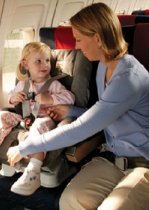
The use of child seats on aircraft has long been a concern of AirSafe.com. One area of concern are the variation in rules around the world. While seat belt use by adults is fairly standard, the use of child restraint systems (CRS) is not. In the US, the rule on child travel has been that children up to the age of two could ride either in a passenger's lap (without restraints), and children two and older must have their own seat. Child restraint systems are not required, and the FAA generally approves for flight any seat that is approved for use in automobiles.

An approved restraint device should have a tag, sticker, or other documentation that shows that it is approved for flight. Some devices, such as child restraint harnesses or booster seats, may be restricted from use during taxi, takeoff, and landing. Check the CRS documentation to be sure.

Child Restraint Systems in Europe
The EU requires that children under the age of two must be secured by an approved “child restraint device” on EU airlines. The most common method is the “loop belt” which is attached to the seat belt of adult holding the child on his or her lap (such belts are not used in the US or Canada). A number of airlines provide the option of using car child seats which are secured to an individual passenger seat.

The German Airline Association has published a list of child seats currently accepted by its member airlines (it helps if you can read German). The European Aviation Safety Agency has also certified a dedicated aircraft child seat for specific aircraft types.

Convenience Factors
In the US, child seats don't count against your carry on item or checked baggage limitations, and you can often get early boarding if you have small children. On the other hand, many of the approved child restraint systems were designed for car seats rather than airplane seats, and often the process of strapping and unstrapping the CRS in an airline seat can be inconvenient and somewhat difficult, especially on those flights where every seat is filled and everyone is trying to rush off the aircraft to make a connection.

Before You Fly with a Child
Wherever you fly, you may want to follow these suggestions when traveling with small children:
  • Check with the airline to find their busiest days and times. By avoiding these times you are more likely to be on a flight with an empty seat next to a parent. In many cases airlines will allow you to seat your child under two years of age in a child restraint in the empty seat at no extra charge. Ask your airline for its policy regarding an empty seat.

  • Ask the airline if they offer a discounted fare for a child traveling in a CRS. When you buy a ticket (discounted or full fare) for your child, you are guaranteed that they will have a seat and that you will be able to use the CRS.

  • If you purchase a ticket for your child, reserve adjoining seats. A CRS should be placed in a window seat so it will not block the escape path in an emergency. A CRS may not be placed an exit row.

  • Check the width of your CRS. While child seats vary in width, a CRS no wider than 16 inches (40.6 cm) should fit in most coach seats. A CRS wider than 16 inches (40.6 cm) is unlikely to fit. Even if the armrests are moved out of the way, a wide CRS will not fit properly into the frame of the aircraft seat.

  • If you need to change planes to make a connecting flight, request that the airline arrange for assistance in your connecting city.

Other Resources
Top 10 Safety Tips for Traveling with Children
FAA Brochure on Child Restraints