The use of
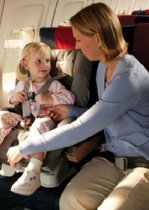
child seats on aircraft has long been a concern of AirSafe.com. One area of concern are the variation in rules around the world. While seat belt use by adults is fairly standard, the use of child restraint systems (CRS) is not. In the US, the rule on child travel has been that children up to the age of two could ride either in a passenger's lap (without restraints), and children two and older must have their own seat. Child restraint systems are not required, and the FAA generally approves for flight any seat that is approved for use in automobiles.
An approved restraint device should have a tag, sticker, or other documentation that shows that it is approved for flight. Some devices, such as child restraint harnesses or booster seats, may be restricted from use during taxi, takeoff, and landing. Check the CRS documentation to be sure.
Child Restraint Systems in EuropeThe EU requires that children under the age of two must be secured by an approved “child restraint device” on EU airlines. The most common method is the “loop belt” which is attached to the seat belt of adult holding the child on his or her lap (such belts are not used in the US or Canada). A number of airlines provide the option of using car child seats which are secured to an individual passenger seat.
The German Airline Association has published a
list of child seats currently accepted by its member airlines (it helps if you can read German). The European Aviation Safety Agency has also certified a dedicated aircraft child seat for specific aircraft types.
Convenience FactorsIn the US, child seats don't count against your carry on item or checked baggage limitations, and you can often get early boarding if you have small children. On the other hand, many of the approved child restraint systems were designed for car seats rather than airplane seats, and often the process of strapping and unstrapping the CRS in an airline seat can be inconvenient and somewhat difficult, especially on those flights where every seat is filled and everyone is trying to rush off the aircraft to make a connection.
Before You Fly with a ChildWherever you fly, you may want to follow these suggestions when traveling with small children:
- Check with the airline to find their busiest days and times. By avoiding these times you are more likely to be on a flight with an empty seat next to a parent. In many cases airlines will allow you to seat your child under two years of age in a child restraint in the empty seat at no extra charge. Ask your airline for its policy regarding an empty seat.
- Ask the airline if they offer a discounted fare for a child traveling in a CRS. When you buy a ticket (discounted or full fare) for your child, you are guaranteed that they will have a seat and that you will be able to use the CRS.
- If you purchase a ticket for your child, reserve adjoining seats. A CRS should be placed in a window seat so it will not block the escape path in an emergency. A CRS may not be placed an exit row.
- Check the width of your CRS. While child seats vary in width, a CRS no wider than 16 inches (40.6 cm) should fit in most coach seats. A CRS wider than 16 inches (40.6 cm) is unlikely to fit. Even if the armrests are moved out of the way, a wide CRS will not fit properly into the frame of the aircraft seat.
- If you need to change planes to make a connecting flight, request that the airline arrange for assistance in your connecting city.
Other ResourcesTop 10 Safety Tips for Traveling with ChildrenFAA Brochure on Child Restraints