The AirSafe.com News

↑ Grab this Headline Animator

Showing posts with label seat. Show all posts

09 August 2013

Passengers are not required to see or understand preflight safety briefings

While passengers, especially those who fly frequently, often ignore the preflight safety briefing, they do serve a vital purpose, and over the last few decades these briefings have no doubt allowed passengers and crews to avoid serious injuries and deaths during emergencies. However, the experience of one passenger, who is also a career aviation safety professional, highlights the fact that airlines may not be required to ensure that passengers can hear or understand these safety briefings.

On 20 July 2013 I flew on a SAS MD82 from FCO (Rome) to CPH (Copenhagen), and I was in seat 33A. A panel was just in front of my seat and I could not see the safety demonstration carried out by the flight attendant standing many rows ahead (see photo below). In the same time, listening by the loudspeaker (in English and probably Danish) was difficult and irregular. No other safety information was given before takeoff.


The view from seat 33A on an SAS MD82

I don’t need to receive a safety demonstration as I have been working in the Italian Civil Aviation Authority for more than 30 years, but the handler and the airline did not know this when they assigned that seat to me. The aircraft was also full of Italians who probably weren’t able to fully understand the message without a visual demonstration. If the demonstration had been different from the usual I would not have been able to understand it at all.

Now I am pretty sure that everything has been done according to the rules, only I would like to know which rules. Is that seat certificated for all kind of passengers? For example many airlines require that emergency exit seats are available only for English speaking people (for example Air Canada). As I think that many MD82s are still in service in the USA, what is your opinion about this topic? - Valter

Dr. Todd Curtis of AirSafe.com responds
You raise an interesting set of questions. I'm not aware of the rules around the world for passenger safety briefings, but in the US, airlines that fly aircraft that are of size of the MD82 have very clear guidance on the visibility of flight attendants during the safety briefing. FAA Advisory Circular AC121-24C describes what is required to be, or should be, covered in oral passenger briefings. In the section that discusses passenger briefing requirements for operations that include flight attendants, it states the following:

The pretakeoff oral briefing should be given so that each passenger can clearly hear it and easily see required demonstrations.

By that standard, it appears that your flight, if it had been a US airline, would not have been in compliance with the requirements of this FAA Advisory Circular.

This advisory circular also requires that an airline provide passenger briefing information in the languages used by the airline. However, there are no requirements that every passenger should be given an oral safety briefing in a language that is understood by that passenger, and there are also no requirements that accommodations be made for passengers who may have limited sight or hearing.

When it comes to exit row seating, in the Advisory Circular the FAA strongly encourages, but does not mandate, that air carriers require crewmembers to provide a preflight personal briefing to each passenger seated in an exit seat. The FAA did not mention whether an exit row passenger should also understand English.

In summary, it appears that the FAA gives US airlines wide latitude when it comes to passengers safety briefings, and from your description of your SAS experience, only the fact that you were not able to see the flight attendant give the briefing would have fallen short of FAA requirements. On your particular flight, the relevant requirements would have been the appropriate European regulations that would have been in effect for SAS.

One of those regulations appears to be European Regulation (Reg CE 8/2008), which unlike the FAA regulation does not specifically require that the safety demonstration be visible to every passenger. Like the FAA Advisory Circular, this European regulation does not specify that the briefing be given in language that a passenger can understand.

15 January 2010

The Miracle on the Hudson, Ejection Database, and A319 Landing Incident

Anniversary of the Miracle on the Hudson
One year after the ditching of US Airways flight 1549 in the Hudson River, the NTSB investigation is still ongoing. While the investigation may not be completed for several months, there is a large amount of information from the investigation that is available for the public to review. The NTSB information page on last June's public meeting about the accident has links to past NTSB press releases, and links to transcripts and videos from the three day public hearing. Additional information on the accident is available at the NTSB's public docket for this investigation.

Ejection Seat Database
If you ever had a question about military plane crashes featuring the use of an ejection seat, then Project Get Out and Walk is worth a visit. The site is an illustrated history of assisted aircrew escape system and has a database of all known ejections and bailouts, with ejections listed by year, country, and aircraft.

United Airlines Emergency Landing at Newark
On January 10th, a United Airlines Airbus A319 (N816UA, flight 634)was damaged when it landed at Newark's Liberty International Airport with its right hand main landing gear retracted. The aircraft was on a scheduled flight from Chicago's O'Hare airport, to Newark, and the flight was normal until approach, when the crew experienced problems with lowering the landing gear.

The crew carried out a missed approach, and later landed with the right main gear retracted and came to rest on the runway, damaging the right engine and the underside of the aircraft. All 48 passengers and five crew members evacuated using the emergency slides and there were no major injuries.

This being the Twitter era, it isn't surprising that there were a few Tweets (Twitter posts) on this event. A passenger on another aircraft with Twitter name @expodebbie said: On runway. Newark just closed. Another aircraft with bad landing- mechanical issues. Emergency vehicles. Zero idea just how bad. 6:28 AM Jan 10th

Below are several photos of the damaged aircraft, plus a video of the actual landing taken from the cockpit of another aircraft.


04 December 2009

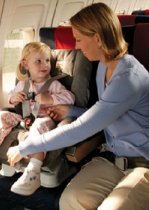
Guidelines on the Use of Child Restraint Systems

The use of child seats on aircraft has long been a concern of AirSafe.com. One area of concern are the variation in rules around the world. While seat belt use by adults is fairly standard, the use of child restraint systems (CRS) is not. In the US, the rule on child travel has been that children up to the age of two could ride either in a passenger's lap (without restraints), and children two and older must have their own seat. Child restraint systems are not required, and the FAA generally approves for flight any seat that is approved for use in automobiles.

An approved restraint device should have a tag, sticker, or other documentation that shows that it is approved for flight. Some devices, such as child restraint harnesses or booster seats, may be restricted from use during taxi, takeoff, and landing. Check the CRS documentation to be sure.

Child Restraint Systems in Europe
The EU requires that children under the age of two must be secured by an approved “child restraint device” on EU airlines. The most common method is the “loop belt” which is attached to the seat belt of adult holding the child on his or her lap (such belts are not used in the US or Canada). A number of airlines provide the option of using car child seats which are secured to an individual passenger seat.

The German Airline Association has published a list of child seats currently accepted by its member airlines (it helps if you can read German). The European Aviation Safety Agency has also certified a dedicated aircraft child seat for specific aircraft types.

Convenience Factors
In the US, child seats don't count against your carry on item or checked baggage limitations, and you can often get early boarding if you have small children. On the other hand, many of the approved child restraint systems were designed for car seats rather than airplane seats, and often the process of strapping and unstrapping the CRS in an airline seat can be inconvenient and somewhat difficult, especially on those flights where every seat is filled and everyone is trying to rush off the aircraft to make a connection.

Before You Fly with a Child
Wherever you fly, you may want to follow these suggestions when traveling with small children:
  • Check with the airline to find their busiest days and times. By avoiding these times you are more likely to be on a flight with an empty seat next to a parent. In many cases airlines will allow you to seat your child under two years of age in a child restraint in the empty seat at no extra charge. Ask your airline for its policy regarding an empty seat.

  • Ask the airline if they offer a discounted fare for a child traveling in a CRS. When you buy a ticket (discounted or full fare) for your child, you are guaranteed that they will have a seat and that you will be able to use the CRS.

  • If you purchase a ticket for your child, reserve adjoining seats. A CRS should be placed in a window seat so it will not block the escape path in an emergency. A CRS may not be placed an exit row.

  • Check the width of your CRS. While child seats vary in width, a CRS no wider than 16 inches (40.6 cm) should fit in most coach seats. A CRS wider than 16 inches (40.6 cm) is unlikely to fit. Even if the armrests are moved out of the way, a wide CRS will not fit properly into the frame of the aircraft seat.

  • If you need to change planes to make a connecting flight, request that the airline arrange for assistance in your connecting city.

Other Resources
Top 10 Safety Tips for Traveling with Children
FAA Brochure on Child Restraints

26 October 2009

Where Is the Safest Place to Sit on an Airplane? - AirSafe.com Takes a Stand

A common question for this site, one that is answered briefly on AirSafe.com's Top Ten Airline Safety Questions page, is about the safest place to sit on a plane. Last July, Business Traveller Asia-Pacific asked Dr. Todd Curtis of AirSafe.com about these issues, and what follows are their questions and AirSafe.com's response.

Business Traveller Magazine
In the wake of the Air France and Yemenia crashes, we feel it is appropriate to bring up once again the question about how one can survive a plane crash. Having done some preliminary research into the subject, I have uncovered some tips but would still like some expert opinions on the matter.

Questions

1. Some sources say that sitting at the back of the plane is better while others say sitting along the aisle and close to an exit is a smarter choice. Does where you sit in a plane really make a difference to your chances of survival in a crash?

2. If your answer to question 1 is yes, which then is the best place to sit?

3. What are the other factors in play that contribute to one’s chance of survival?

4. What can plane passengers do to increase their chances of survival should a crash occur?

Dr. Curtis Responds
As you can imagine, I've fielded quite a few questions about safety over the past month. In my opinion, the circumstances around airliner crashes in the first half of 2009 have resulted in far more media coverage than I normally see. The Yemenia crash had several things going for it. There were many recent media reports about the Air France 447 crash leading up to the end of June because of the missing black boxes and the fact that their locator beacons were scheduled to run out of power at the same time. Add to that the fact that it was an Airbus and that there was a sole survivor meant that there was much more attention paid to this event than to the average crash involving a developing country's airline.

As for your questions, where to sit on the plane to heighten survival chances depends very much on the circumstances of the crash. In my opinion, it does not really matter where you sit in most fatal crashes because the level of fatalities often are either very low, with less than 10% casualties, or very high with over 90% fatalities. In the first case, the aircraft is usually relatively intact and the aircraft is either relatively undamaged or the damage does not keep passengers from exiting the aircraft. In the latter case, the aircraft is usually severely damaged or destroyed, with no survivors or a few survivors.

What makes an analysis of where to sit particularly difficult is that in most cases where there are a substantial number of fatalities and survivors, there is either no major investigation of the crash, or the investigating authorities do not make an effort to map out where people were sitting at the time of the crash. In some of the few cases where I have seen a seat map, the report often mentions that the map represents where passengers were scheduled to sit, not where they were actually sitting at the time of the crash.

To answer your last question, it isn't a question of where you sit, but rather a question of how you behave when you are a passenger. For example, a passenger who is aware of where the nearest exits are, who has reviewed the emergency information for the model aircraft they are on (typically provided on a card in the seat pocket), and who listens to the crew safety briefing has given himself or herself the opportunity to respond quickly and effectively if there is an emergency. Also, it helps to keep alcohol consumption to a minimum, since it may affect your ability to respond to an emergency situation.

Airline emergencies are extremely rare. If one occurs while you are a passenger, your best defense is ability to act quickly and appropriately in order to escape danger and survive.

One More Thought - New Rules Will Make All Seats Safer

Several years ago, the FAA changed the rules for airline seats to make them more sturdy in the event of an accident. Starting in 2009, seats must be able to withstand crash forces that are up to 16 times the force gravity (roughly the forces experienced in a 30 mph automobile collision). This is much higher than the previous standard of nine times the force of gravity. These 16g seats are much more likely to withstand the dynamic loads that the aircraft would experience in a crash with survivable impact forces, allowing passengers a better chance to escape the aircraft after such an accident.

Airplanes that were certified after 1988, for example the 777 and A380, were already required to have these seats. While most new airliners are based on models that were certified after 1988, some new airliners based on older designs, such as the 747-400, still had 9g seats installed. Starting October 27, 2009, all airliners will have to meet this standard.

Airplane Airbags
To comply with the new 16g requirement, some airlines will use airbags for some seat locations. These airbags may be incorporated in the seat belt or it could be attached to another part of the aircraft.

Basic Crash Positions
The FAA provides guidance on the kinds of crash positions that you should take for various situations. The video below has suggested positions for regular coach seats, rear facing seats, and for other situations. If you can't play the video, you can also download the audio podcast or the video podcast below:
Six Basic Crash Positions Podcast: MP3, MP4, WMV


Six Basic Crash Positions


Send Us Your Thoughts
We welcome your comments and questions. Feel free to add your comments to any of the articles on this site. You can also contact us at by phone at 408.905.6259, or in writing at the feedback form at feedback.airsafe.org.