The AirSafe.com News

↑ Grab this Headline Animator

25 November 2009

Airlines Fined for Stranding Passengers Plus The Best Passenger Safety Briefing Ever

Three Airlines Fined for Stranding Passengers Overnight
Earlier this year on August 8th, Continental Express Flight 2816, which was en route from Houston to Minneapolis and carrying 47 passengers, was diverted to Rochester, Minnesota because of thunderstorms where it landed about 12:30 am. The passengers and crew ended up stranded on the aircraft for over seven hours because the terminal had already closed for the night, and the employees who could have opened the terminal refused to do so.

This event attracted national attention at the time, and the US Department of Transportation (DOT) announced yesterday that it would impose $175,000 in fines on the three airlines involved. Continental Airlines and its regional airline partner ExpressJet, which operated the flight for Continental, were each fined $50,000. Mesaba Airlines, which was responsible for operating the terminal at Rochester, Minnesota, was fined $75,000.

This was the first time that the DOT has fined airlines for stranding passengers on the tarmac, but by no means was this the first time that passengers have been stuck on the tarmac for long periods of time. Earlier this month, AirSafeNews.com had an article about the delay statistics made available by the DOT's Bureau of Transportation Statistics.

The Best Passenger Safety Briefing Ever
When it comes to preflight passenger safety briefings, most passengers have sat through many of them, and most of them are not the least bit entertaining or memorable. The FAA does not dictate what information airlines should provide passengers during the preflight safety briefing. However, the FAA provides general guidance in Advisory Circular 121-24C, where one of the suggestions is that "The pretakeoff oral briefing should be given so that each passenger can clearly hear it and easily see required demonstrations. Flight attendants giving these briefings should speak slowly and distinctly."

Flight attendant David Holmes of Southwest Airlines created a preflight passenger briefing that ignored the advice about speaking slowly, and was both entertaining and memorable.


National Geographic Traveler published an extensive interview with David Holmes where he talked about his in-flight rapping. The following question and answer is the highlight of that interview.

National Geographic Traveler - The Federal Aviation Administration has some pretty strict requirements about in-flight safety announcements. How did you ensure that you met those, while still maintaining your artistic integrity?

David Holmes - Everything we have to say is carefully scripted for us -- all the safety information. As you know, one challenge is getting people to listen -- the other is making sure they have all the info. Why shouldn't it be fun?

Why not indeed.

24 November 2009

Anniversary of the Plane Crash that Killed Singer Melanie Thornton

Eight years ago today, singer Melanie Thornton was killed in the crash of a Crossair Avro RJ100 near Zurich, Switzerland. The aircraft was on a flight from Berlin, Germany to Zurich, Switzerland when it crashed into a wooded area about two miles (3.2 km) from the runway during a night approach to Zurich's airport. Thornton was one of the 24 passengers and crew killed during the crash. Also killed were two members of the pop trio Passion Fruit, Maria Serrano-Serrano and Nathaly van het Ende. The third member of the group, Debby St. Marteen, survived.

Prior to her solo career, Thorton led the dance act La Bouche to a series of hit CDs including "Sweet Dreams," and "S.O.S." Ms. Thornton left the group in early 2000 for an independent career. At the time of her death, she was on tour to promote her solo album "Ready to Fly". The CD, which included the single "Heartbeat," had been scheduled for release two days after the crash. Another single, "Wonderful Dream," had also been chosen for a Coca-Cola TV commercial.

Accident Investigation Findings
The Swiss accident investigation report implied that the aircraft flew into the ground in a controlled manner as a consequence of the crew allowing the aircraft to descend below the minimum descent altitude without having the required visual contact with either the approach lights or the runway

Resources
Melanie Thornton Wikipedia Page
Swiss Aircraft Accident Investigation Bureau Accident Report
Fatal BAe/RJ100 Plane Crashes
Fatal Events Involving Celebrities

23 November 2009

Holiday Air Travel Advice That Will Keep You and Your Family Out of Trouble

In the US, this week marks the beginning of holiday travel season with Wednesday, shaping up to be the busiest travel day of the year. For many, this may be the only time this year that they will travel by air, and for some, it will be their very first time in the sky.

For novice and veteran fliers, there are many things that can ruin your trip, from missed connections and lost baggage to having some of your carry on items confiscated by airport security. Please review the following pieces of advice, you may find something that will help you avoid problems, or help you deal with them should they happen to you.

Get to the Airport Early
Assume that getting to the airport, parking, going through check in, and going through security lines will take longer than usual. Arrive early, and do what you can to avoid delays. If you are only taking carry-on bags, print out your boarding pass before getting to the airport and go straight to the security gate.

Keep Track of Any Flight Changes
A day or two before your trip, check with your airline to see if your flight's schedule has changed. If you can, sign up for phone, email, or text messaging alerts from your airline to find out about any last minute changes to your schedule. Keep your cell phone with you and have the airline's customer service or reservations number handy just in case you run into problems and have to call the airline directly.

Identification
In the US, the Transportation Security Administration (TSA) requires travelers over the age of 18 to have some sort of photo identification issued by a state, local, or national government agency. This would include driver's licenses, passports, and military ID cards but would not include student ID cards or employee ID badges.

If you do not have these kinds of IDs, you may be able to present alternative documentation to the TSA. Non-US/Canadian citizens are not required to carry their passports if they have documents issued by the U.S. government such as Permanent Resident Cards. Those who do not should be carrying their passports for domestic US travel.


Checkpoints
Depending on the level of security in place when you are at the airport, the security agents may insist on searching every bag, package, and suitcase. Be prepared by arriving at the airport at least a half hour earlier than usual.


Flying with Holiday Food
During the Thanksgiving and Christmas holidays, traveling with food is fairly common. You should be aware that some food items are banned from carry on baggage because they contain liquids or gels. While you can carry cakes, pastries, and pies with you in the cabin, the following should either be in checked baggage or left at home:

* Cranberry sauce
* Creamy dips and spreads (cheeses, peanut butter, etc.)
* Gravy
* Jams, jellies, and syrup
* Oils and vinegars
* Salad dressing
* Salsa
* Sauces
* Soups
* Wine, liquor and beer
* Gift baskets with one or more of the above items

There are exceptions for small amounts of gels, liquids, and aerosols, and more generous exceptions for medically related items, but for most items, if you can pour it, pump it, squeeze it, spread it, smear it, spray it, or or spill it, you probably can't take it with you. Visit AirSafe.com to find out what you are not allowed to take on an airplane.

Duty Free Items
If you are traveling to or from the US, you should make sure that you don't run into problems with duty free liquids like alcohol, perfume, and cosmetics. AirSafe.com provides detailed advice on how to deal with these kinds of duty free items.

Gifts
If you carry gifts, either in checked or carry-on baggage, make sure they are unwrapped. TSA has to be able to inspect any package and would have to unwrap a gift to do so. You can ship wrapped gifts ahead of time or wait until you arrive at your destination to wrap them.
Baggage Issues
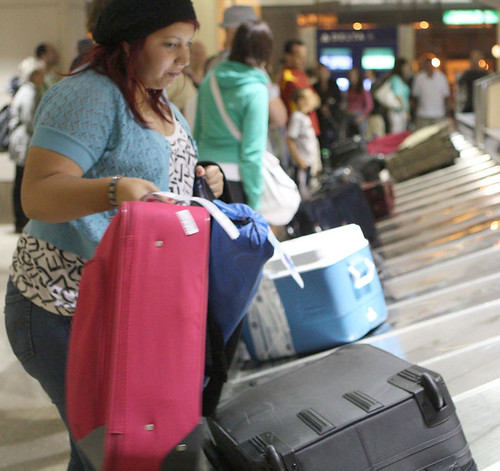
There are three baggage issues that become important during the holidays. The first is that most US airlines are charging you for every checked bag, so using carry-ons only will save you some money. Second, if you do check one or more bags, be prepared to deal with a lost, stolen, or damaged bag. That means if it is valuable to you and you can't deal with having it lost or stolen, keep it with you on your person or in your carry-on bag. That includes things like money, jewelry, medicine, passports, eyeglasses, and laptop computers.

The third potential problem is that if there is no space in the overhead bins, you may be forced to have your carry-on bag checked. If this happens, be prepared to take out any valuables from your carry on before a cabin crew member or a gate agent takes it away.

Unaccompanied Children
If you have a child who will be traveling alone, you should be aware of your airline's specific rules on this kind of travel. AirSafe.com has detailed advice on travel by unaccompanied children, including having the child carry a copy of all contact information and if the child is old enough, a working cell phone. Brent, a flight attendant with a major US airline, wrote to AirSafe.com and offered the following additional advice:

I liked that you suggest having the unaccompanied minor carry a copy of all contact information. One issue I run into is illegible handwriting on the form we use that stays with the child. This form is filled out by hand by the guardian of the child when they present the unaccompanied minor for the flight.

Although the agent who accepts the child and inputs the information in to the computer should check for legibility, this is often not done. Flight attendants don't have access to any information on the company's computer system while on board the aircraft, so we must try to make out poor hand writing in the event we must contact the adult listed. It seems like a minor issue. But when you are on board an aircraft we must be able to effectively utilize the few resources we have.

Also, as you mentioned, cell phones for unaccompanied minors are a very good idea. I don't have any problem contacting an adult for an unaccompanied minor from my cell phone in the event of a delay. However, this might be more than some flight attendants are willing to do. It also opens the flight attendant up to sharing personal phone contact information with a stranger that some flight attendants might not be comfortable with that.

A child with a properly charged cell phone and contact information can be very helpful. This often helps to calm the nerves of the child's parent or guardian and the child because of the separation. A quick chat on the phone with a responsible adult representative of the airline who is on board the child's flight can make all the difference when it comes to peace of mind. I have heard the relief in many parents and grandparents voices.


Resources
General Baggage Issues
Carry-on Bag Issues
Travel by Unaccompanied Children
Top 10 Tips for Children Traveling Alone
What You Are Not Allowed to Take on an Airplane.

Photos: Eileen Mansoorian, TSA

20 November 2009

Update to the Investigation into the 17 January 2008 Crash of a British Airways 777 in London

At SAE's recent 2009 AeroTech Congress and Exhibition, which was held in Seattle earlier this month, a Boeing fuels systems expert provided an update on the investigation of the January 2008 crash of a British Airways 777-200 (Flight 38, G-YMMM).

In the January 2008 crash, the flight from Beijing to London was routine until the the aircraft was on final approach, when both engines had an uncommanded power reduction, or engine rollback, which caused the plane to land short of the runway. Although the aircraft was seriously damaged, only one of the 136 passengers was seriously injured, and there were no serious injuries among the 16 crew members.

The Air Accidents Investigation Branch (AAIB) of the UK is heading the investigation, and has released several interim reports, most recently in March 2009. In that report, a buildup of ice in the fuel system was identified as a likely cause of the uncommanded power reduction.

The most revealing insights provided by Boeing was that this kind of fuel icing problem was identified in the 1960s with the B-52, and the lessons learned from that experience led to changes in fuel system design that largely eliminated the problem. The January 2008 British Airways event, and a subsequent November 2008 rollback event involving a single engine on a Delta 777, led to a very thorough review of both the 777 fuel system and to the dynamics of fuel icing.

Among the more surprising findings from fuel system tests (which included system components from the accident airplane) was that in some situations, 777s flying with Rolls Royce engines can have ice form in the fuel system, and that ice could in turn block fuel flow at the fuel oil heat exchanger.

It was a difficult problem to study because ice formation was somewhat unpredictable in that tests similar environmental and fuel flow conditions may have produced significant amounts of ice in one test, and very little or no ice in another test.

In spite of the difficulty Boeing had in recreating the conditions that could cause icing, solving the problem was relatively easy. Changes in the fuel oil heat exchanger, plus changes in flight crew procedures, will be enough to prevent these kids of icing events in the future.

AAIB is still investigating this accident, and when the final report is released, AirSafe.com will review the report and summarize the findings in the AirSafe.com News.

For more details on this investigation, including videos summarizing previous Interim reports from the AAIB, visit 777.airsafe.org.


Report on March 2009 AAIB and NTSB Updates
Watch or listen to the report below, or read the transcript
Audio: MP3 | VideoiPod/MP4 | WMV |  Google Video | YouTube


For more videos, visit the AirSafe.com YouTube channel.

19 November 2009

Free Airborne WiFi Makes it More Likely That You Will See Inappropriate Inflight Entertainment

Recently, Google announced that it would provide free wireless access at 47 airports throughout the US, and on domestic US flights on Virgin America. While this is a temporary promotion, it represents a progression that will probably lead to universal, and likely free, Internet access in airport terminals and in aircraft.

While online access is something that most passengers will welcome, there are a few issues that have not been resolved, and likely will not be resolved by laws or regulation, and that is the issue of what is acceptable online behavior in an airport or on an airplane.


While laptop computers, cell phones, and other personal electronics have been around for more than a generation, only in the last few years have these technologies have made it easy to play videos, and the costs dropped so much that almost anyone can afford to have some kind of electronic device that can play audio files or video files, or stream audio and video online.

The problems come when one person's freedom to read, hear, or watch almost anything imaginable runs into another person's freedom from objectionable material. In the years before there were iPods and laptops, about the worst thing that a passenger could bring on board was a magazine featuring nudity (magazines still widely available in airport newsstands).

While there are no federal guidelines for what kind of content is allowed on PEDs, most flight attendants would likely use a common sense approach similar to the one described in a November 12, 2009 Washington Post article written by Monica Hesse. She quotes a flight attendant who said that he flights attendants don't do anything about what people are watching unless it is disturbing other passengers.


AirSafe.com has provided general guidelines for how a passenger should behave with their personal electronic devices. When it comes to wireless activity in the terminal, and especially in an aircraft AirSafe.com suggests the following guidelines:

  • Don't Make Noise When playing music or other audio content, use headphones or earphones. If you are using a laptop, video game, or other device where you need the visuals but don't need the audio, turn the audio off. If that isn't possible, don't the device.

  • Don't Display Inappropriate Images - Inappropriate images generally include sexually oriented material, material depicting extreme acts of violence, or other images that could be upsetting to other passengers. You can display these kinds of images only if no one else can see your display, but few seats in an aircraft or in a terminal would likely have this amount of privacy. This rule holds true

  • Avoid Phone Calls While in Flight - It may be tempting to use in flight online access to make calls on Skype or some other VOIP service, but don't. It unlikely that your seatmate will take kindly to an unwanted conversation, and though it may be possible to make a call in privacy from the lavatory, but would you want to admit that in public later on?

  • Read Whatever You Want - If someone is close enough to read what you are reading, then that person is violating your privacy.


Please Take the Time To Respond to Our Survey

The survey is now closed. The results of the survey are available here.

Photos: hfabulous, Wikipedia

18 November 2009

Updates on Two Recent Qantas Accidents Involving an A330 and a 747

Second Interim Report on Qantas Accident of 7 October 2008
The Australian Transport Safety Bureau (ATSB) released its second interim report about a 7 October 2008 event when a Qantas A330-300 (VH-QPA, Flight 72) experienced an unexpected and rapid change in altitude while the aircraft was in cruise at 37,000 feet. The accident resulted in injuries to 110 passengers and nine crew members.

The first interim report identified two significant safety factors. First, one of the air data computers provided incorrect data that was not detected by the aircraft systems. Second, the aircraft's flight control computers did not process some of the aircraft's attitude data in a specific situation.

The second interim report did not identify the cause of the October 2008 event, but detailed the safety actions that have been taken that would prevent a recurrence of the event, including modifications to the A330's primary flight control computer and changes in flight crew operational procedures.


The ATSB addressed the possible relationship between the October 2008 Qantas A330 event and the June 2009 crash of an Air France A330-200 (F-GZCP, Flight 447). Although both investigations are ongoing, the ATSB pointed out several key differences between the two events:

• The air data computers on the two aircraft were different models, and constructed by different manufacturers.

• The cockpit messages and maintenance fault messages from both flights showed a significantly different sequence and pattern of events, with the maintenance messages that were transmitted by the Air France aircraft prior to the accident showing inconsistencies between the measured airspeeds and the associated consequences on other aircraft systems. No such messages were recorded by by the Qantas aircraft.

• The airspeed sensors (pitot probes), which were a issue of great concern in the Air France Accident, were not an issue in the Qantas accident because they were different airspeed sensor models made by different manufacturers.

Update on Qantas 747 Decompression Event
On 25 July 2008, a Qantas 747-400 (VH-OJK, Flight 30) experienced a rapid decompression while cruising at 29,000 feet after an oxygen cylinder that was part of the emergency oxygen system exploded and blew a hole in the fuselage. In their second interim report on the decompression event, the ATSB reported that there is no evidence of a safety problem with the oxygen bottles of the type involved in the accident.

ATSB reported that among the actions taken by Qantas were a fleet-wide safety inspections of oxygen system installations and a revision of flight crew emergency procedures, including the introduction of a new depressurisation checklist. Also, various tests have not been able to replicate the cylinder failure that initiated the accident.

Additional Information
You can find more details about these three accident investigations, including links to the interim reports from the investigating authorities, at the following pages:
Qantas 747 Depressurization Accident 25 July 2008
Qantas A330 In Flight Upset Accident 7 October 2008
Air France A330 Crash 1 June 2009

17 November 2009

How to Share and Reuse AirSafe.com Content for Your Web Site, Blog, or Newsletter

All of the content on AirSafe.com and on AirSafe.com-related online resources exist there for the benefit of the traveling public. In order to promote greater public awareness of airline safety and airline travel issues, AirSafe.com allows anyone to use most AirSafe.com material without limitation. Typical ways that you can reuse the material include web sites, blogs, newsletters, audio or video productions, books, or research reports.

AirSafe.com Resources
There are a number of online and offline resources where the copyright is owned or controlled by AirSafe.com creator Dr. Todd Curtis, or by AirSafe.com, LLC. These properties include AirSafe.com, AirSafeNews.com, AirSafe-Media.com, FlightsGoneBad.com, Plane-Crash-Videos.net, BirdSrikeNews.com, the Conversation at AirSafe.com podcast (including the videos at AirSafe.com's YouTube Channel, and the Todd Curtis books Understanding Aviation Safety Data and Parenting and the Internet.

Material That Can Be Used Without Limitation
Facts such as dates, locations of accidents, and other raw data can be freely used without limitation. Also, there are also no limitations on basic ideas that are described in the various online resources, for example the mathematical formulas used to determine fatal event rates.

Crediting the Use of AirSafe.com-related Content
Any written or multimedia content on an AirSafe.com-related resource can be reprinted or reused for non-commercial use in a web site, newsletter, blog, or other publication so long as no substantial changes are made in the text and if credit for the source of the material is included. That credit should state credit and URL is included: Dr. Todd Curtis AirSafe.com http://www.airsafe.com. If you use complete video or audio programs, they already have AirSafe.com copyright information included, so no further notification is needed. However, please identify the source if you only reuse a portion of an AirSafe.com-related video or audio program. You can find links to all AirSafe.com audio and video files at podcast.airsafe.org.

Permission for Commercial Use
If you want to use AirSafe.com related material for some commercial or for-profit use, please contact AirSafe.com for permission.

Limitations on Some Content
The copyrights to some the photographic and video content within an AirSafe.com-related resource are not controlled by AirSafe.com. If you are unsure of who owns the copyright, either don't use the material or contact AirSafe.com for guidance. Please review the disclaimer statement on the AirSafe.com web site for other key limitations. This disclaimer statement applies to all AirSafe.com-related material.