The AirSafe.com News

↑ Grab this Headline Animator

Showing posts with label investigation. Show all posts

06 May 2015

French authorities release preliminary report on the Germanwings crash investigation

On 6 May 2015, the BEA (Bureau d'Enquêtes et d'Analyses pour la Sécurité de l'Aviation Civile) released a preliminary report on the crash of Germanwings flight 4U9525 which highlighted the following findings:

  • At about three minutes after the aircraft reached its cruising altitude of 38,000 feet, the captain left the cockpit.

  • Within 30 seconds of the captain leaving the cockpit, the first officer commanded the aircraft to descend to 100 feet, which is well below ground level.

  • Within five minutes of the commanded altitude change, the airspeed was changed at least ten times, reaching a maximum of 350 knots (402 mph, 648 kph).

  • The descent rate reached a maximum of 5,000 feet per minute, and averaged about 3,500 feet per minute.

  • The descent was continuous, and controlled by the autopilot.

  • Air traffic controllers and the French military attempted to contact the aircraft several times, but received no response.

  • Before the collision with the terrain, there were multiple aural warnings heard on the CVR.

  • The aircraft impacted the ground about 10 minutes and 13 seconds after the aircraft started its descent.

  • Autopilot and autothrust remained engaged until impact.

  • On the previous flight, while the captain was out of the cockpit, the first officer twice commanded the aircraft to descend to 100 feet for short periods of time.

The role of the first officer in the crash
The preliminary report did not state a definitive cause of the crash, but it did state that during the cruise phase, the first officer was alone in the cockpit and intentionally modified the autopilot instructions to order the aircraft to descend until it collided with the ground. The report also stated that the first officer did not open the cockpit door during the descent, despite requests for access made via the keypad, with cabin interphone, and by knocking on the door.

Aircraft trajectory

(click to enlarge)

First officer training history
The preliminary report provided an outline of the first officer's training history, including the fact that he started his flight training at the Lufthansa Flight Training Pilot School in Germany on 1 September 2008, but that his training was suspended for medical reasons for over eight months, from 5 November 2008 to 26 August 2009. It was during this period, specifically from April to July 2009, that the first officer did not have a valid medical certificate due to depression and his medical treatment for his condition.

From October 2010 to March 2011, he continued his flight training in the US, but was under contract as a flight attendant with Lufthansa for over two years before beginning his training to become an A320 first officer. He was appointed as an A320 copilot in June 2014.

Related information
Germanwings crash details from AirSafe.com
Lufthansa plane crashes
Other A320 crashes
Germanwings Wikipedia page
Flight 9525 Wikipedia entry

04 November 2014

NTSB provides timeline of SpaceShipTwo mishap

The following is an overview of the preliminary findings presented by the NTSB on the third day of their investigation.

During the fourth media briefing on the third day of the on site portion of the NTSB investigation of the crash of SpaceShipTwo, the most significant information provided by acting NTSB chair Christopher A. Hart was a general timeline of the events between the release of SpaceShipTwo from its mothership WhiteKnightTwo, and the loss of telemetry from SpaceShipTwo. In that roughly fifteen second span, a number of events occurred inside SpaceShipTwo:

  • SpaceShipTwo released from mothership WhiteKnightTwo at 10:07:19 PDT (17:07:19 UTC)
  • The rocket engine was ignited about two seconds later.
  • About eight seconds later, and 10 seconds after release, SpaceShipTwo was traveling at about Mach 0.94
  • Sometime during the next two seconds, the feather lock handle was moved from the locked to the unlock position by the person sitting in the right seat.
  • At about 12 seconds after release, the vehicle was traveling at Mach 1.02
  • The feathers began to deploy at about 13 seconds after release.
  • Telemetry and video data was lost about two seconds later, roughly 15 seconds after release.

In addition to the timeline, the NTSB stated that lightweight debris was recovered about 30-35 miles northeast of the main wreckage area, and it was not clear what role wind may have played in the distribution of that wreckage. Also, while there was clear evidence that the pilot in the right seat moved the feather lock handle, during the media briefing, Hart was not clear if it was the pilot or the copilot who did so.

Shortly after the media briefing, NTSB clarified its position on Twitter, stating that the copilot, who did not survive the mishap, was the person in the right seat who moved the lock/unlock handle into the unlocked position.

Additional resources
Initial NTSB SpaceShipTwo accident investigation
Review of first two NTSB briefings on 1 November 2014
Review of third NTSB briefing on 2 November 2014
Review of fourth NTSB briefing on 3 November 2014

03 November 2014

NTSB hints that SpaceShipTwo breakup was not related to an engine failure

The following is an overview of the factual data presented by the NTSB on the second day of their investigation.

During the media briefing on the second day of the NTSB investigation of the crash of SpaceShipTwo, acting NTSB chair Christopher A. Hart, reported on some of their early findings that implied that there was no fire, explosion, or other kind of breach or failure involving the engine, fuel tank, or oxidizer tank. Early evidence instead points to an un uncommanded deployment of the feathering system just prior to the loss of telemetry from SpaceShipTwo.

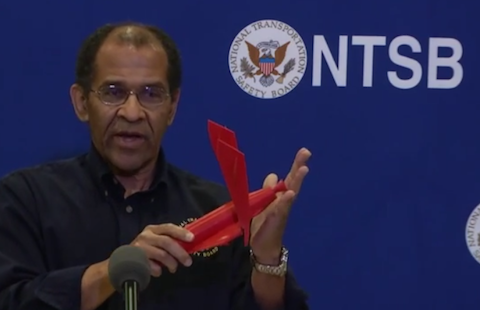
The feathering system on SpaceShipTwo allows the twin booms on the vehicle, referred to as the feathers, to rotate upward in order to provide more aerodynamic drag on reentry. They are intended to be deployed after the engine has shut down and prior to reentry. According the information provided at the briefing, deploying the feathers takes two actions from the flight crew. The feathering system has to first be unlocked before they can be deployed by moving the feather handle into the feathered position.

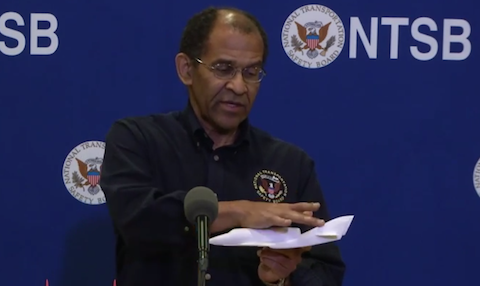
There is a feathering handle that moves the feathers into the feathered position. Based on video evidence from inside SpaceShipTwo, the copilot unlocked the system, but the system deployed without any crew input.


Model of SpaceShipTwo in unfeathered position

Model of SpaceShipTwo in feathered position


The sequence of events was roughly as follows:

  • After being released from its carrier aircraft, the crew of SpaceShipTwo ignited the rocket engine.
  • About nine seconds after engine ignition, telemetry data showed that the feather parameters changed from locked to unlocked.
  • Video from the cockpit showed that the copilot had unlocked the feathering system, and is consistent with the telemetry data.
  • About two seconds later, the feathers moved toward the deployed position even though the feather handle had not been moved into the feather position.
  • The feather deployment occurred at a speed just above Mach 1.
  • Shortly after feathering occurred, video data and telemetry data terminated.
  • The engine burn was normal prior to the deployment of the feathers.
  • Normal procedures would have had the crew unlocking the feathering system at a speed of about Mach 1.4.
  • Unlocking the feathering system alone should not have allowed the feathers to deploy.
  • The inflight breakup of the vehicle began sometime after telemetry ceased.
  • The NTSB has not determined if the inflight breakup was caused by aerodynamic forces or from some other cause.
  • The rocket engine, fuel tank, or oxidizer tank showed no evidence of a breach or burn through consistent with some sort of fire, explosion or structural failure affecting those components.

The NTSB emphasized that their statements were statements of fact rather than a determination of a cause of the mishap. Below is a video of the third media briefing.

Additional resources
Initial NTSB SpaceShipTwo accident investigation
Review of first two NTSB briefings on 1 November 2014
Review of third NTSB briefing on 2 November 2014

Note: An earlier version of this story inadvertently stated that there was evidence of a breach or burn on some components.

01 November 2014

Virgin Galactic SpaceShipTwo NTSB accident investigation

The NTSB is leading the investigation into yesterday's crash of Scaled Composites SpaceShipTwo north of Mojave, CA. Saturday November 1st was the first day of the investigation, and the NTSB has already had one one media briefing with a second planned for late in the evening.

The following is an overview of the crash and comments on the early media briefings.

31 October 2014; Scaled Composites; Model 339 (SpaceShipTwo); N339SS; near Cantil, CA: The vehicle, which is designed to fly into the lower reaches of space (above 100 km above Earth) was on its first powered test flight with a new engine fuel and oxidizer combination (nylon and nitrous oxide). SpaceShipTwo was dropped from its carrier vehicle at about 45,000 feet, and ignited its engine.

Roughly two minutes after release from the carrier aircraft White Knight Two, the SpaceShipTwo vehicle experienced an inflight breakup. One of the two crew members was killed, and the other was able to bail out of the vehicle and was injured.

Prior to the accident flight, there had been the 54 test flights of SpaceShipTwo, of which 34 involved a release from the carrier aircraft, including three powered flights.

Scaled Composites, which conducted the flight test, is a partner of Virgin Galactic, which had planned on using SpaceShipTwo to take passengers on suborbital trips into space in the near future.


Summary of first two NTSB briefings on 1 November 2014
Both NTSB briefing were given by acting NTSB chair Christopher A. Hart, was short, and provided the following preliminary information about the accident:

  • While the NTSB has previously participated in the investigations of the Challenger and Columbia Space Shuttle accidents, this will be the first time it has taken the lead role in the investigation of a crewed space launch vehicle accident.
  • The NTSB team consists of about 13-15 investigators and specialists in the areas of structures, including systems, engines, vehicle, performance, and operations.
  • The parties to the investigation are the FAA, Scaled Composites, and Virgin Galactic
  • The vehicle was flying in a southwesterly direction, and the wreckage field is about five miles (8 km) long, and is oriented from the northeast to the southwest.
  • The wreckage pattern indicates that an inflight breakup occurred, but the NTSB has not yet determined why this happened.
  • The left and right tail booms were near the beginning of the wreckage trail, followed by the fuselage, fuel and oxidizer tanks, cockpit, and the rocket engine.
  • There were a total of three tanks in the vehicle, a fuel tank, an oxidizer tank, and a methane tank.
  • The NTSB was unaware of the altitude of the mishap.
  • There was extensive video data available from the flight, including six cameras on SpaceShipTwo, another three on White Knight Two, one in a chase aircraft, and one on the Edwards AFB test range.
  • The NTSB does not know if the six cameras on board SpaceShipTwo have been recovered.
  • There were six data sources on SpaceShipTwo and about 1000 parameters of telemetry available from the flight. There was also a radar on the chase aircraft.
  • Interviews have been conducted, but NTSB will not reveal what has been discovered until later in the investigation.
  • The surviving pilot has not yet been interviewed because his doctors recommended against doing so at this time.
  • The NTSB does not know how the surviving pilot exited the vehicle.
  • The on scene portion of the investigation will continue for another four to seven days, and the full investigation will take about a year.
  • Scaled Composites can continue operations during the investigation.
  • News and updates to the investigation will be available at the NTSB's web site (www.ntsb.gov) Twitter feed (@NTSB).

Initial SpaceShipTwo NTSB briefings


Initial NTSB SpaceShipTwo briefings 1 November 2014

25 June 2014

NTSB report on July 2013 crash of an Asiana Airlines 777 in San Francisco

On 24 June 2014, NTSB Board members met to determine the probable cause of the July 2013 crash of Asiana Airlines flight 214 in San Francisco, CA, which resulted in the deaths of there passengers. The Board concluded that there were a number of probable and contributory causes for the accident, with many of them revolving around the crew's understanding of the aircraft's automated systems.

Synopsis
On July 6, 2013, about 11:28 am local time, a Asiana Airlines flight 214, a Boeing 777-200ER (HL7742), struck a seawall while attempting to land on runway 28L at San Francisco International Airport (SFO). Three of the 291 passengers were killed, and 40 passengers were serious injured. All 16 crew members survived, but nine were seriously injured.


Aprroach sequence
Although air traffic control (ATC) allowed the aircraft to attempt a landing under visual flight rules, the flight crew used both the autopilot and autothrottle system during the landing. The sequence of events shortly before the crash featured a number of changes in the flight control system, and according to the NTSB the flight crew's understanding of how the aircraft performed in various autopilot and autothrottle modes led to the crash.

The following is a synopsis of the portion of the NTSB report on the crash of flight 214 that focused on the landing approach:

  • The flight was vectored for a visual approach to runway 28L, and intercepted the final approach course about 14 nautical miles from the threshold at an altitude that put the aircraft slightly above the desired three degree glide path.

  • The flight crew accepted an ATC instruction to maintain 180 knots until five nautical miles from the runway, but mismanaged the airplane’s descent, which resulted in the airplane still being above the desired three degree glide path when it reached the five nautical mile point.

  • In an attempt to increase the airplane’s descent rate and capture the desired glide path, the pilot flying (PF) selected an autopilot mode that resulted in the autoflight system initiating a climb. The chosen autopilot mode, 'flight level change,' attempted to bring the aircraft to the selected altitude, which was above the aircraft's altitude at that point of the approach.

  • The PF disconnected the autopilot, moved the thrust levers to idle, and then pitched the aircraft down, which increased the decent rate.

  • When the PF disconnected the autopilot, that action caused the autothrottle to change to the 'hold' mode, which is a mode where the autothrottle does not control airspeed. Neither the PF or the other two pilots in the cockpit noted this change in the autothrottle mode.

  • Asiana’s procedures dictated that the approach must be stabilized by the time the aircraft descends to 500 feet above the airport elevation. The approach was not stabilized, and the crew should have initiated a go-around, but instead continued the approach.

  • As the approach continued, it became increasingly unstabilized as the airplane descended below the desired glidepath.

  • Airspeed continued to decrease, and at about 200 feet, the flight crew became aware of both a low airspeed and low glide path condition, but still did not initiate a go-around.

  • The crew finally initiated a go-around when the airplane was at less then 100 feet of altitude. However, at that point the airplane did not have the performance capability to accomplish a go-around.


NTSB animation of the final approach


Crash sequence
The following information was in the NTSB report synopsis released on 24 June 2014, and from two NTSB media briefings given shortly after the accident.

  • The main landing gear hit the sea wall first, followed by the tail section.

  • The main landing gear sheared away from the aircraft as designed, and the wing fuel tanks were not punctured by the gear separation or during the rest of the crash sequence.

  • The tail section broke off after the aircraft contacted the sea wall. Cabin flooring and galley components were found on the chevrons in the runway overrun area between the sea wall and the runway threshold.

  • Two passengers and four flight attendants were ejected from the aircraft. All four flight attendants were seriously injured, and both passengers were killed.

  • Neither of the ejected passengers were wearing seat belts at the time of the crash, and one of these passengers was later run over by two of the responding firefighting vehicles. The NTSB noted that had the passengers been wearing their seat belts, they would have likely remained in the aircraft and survived.

  • One of the flight attendants initiated an evacuation after became aware of a post-crash fire. All but five of the passengers were able to evacuate on their own. Firefighters rescued five passengers, one of whom later died.

NTSB probable and contributing causes
The NTSB determined that the probable causes of this accident was due to a combination of flight crew actions:

  • Mismanagment of the airplane’s descent during the visual approach,

  • Unintended deactivation of the automatic airspeed control system,

  • Inadequate monitoring of airspeed, and

  • Delayed execution of a go-around after they became aware that the airplane was below acceptable glide path and airspeed tolerances.

The NTSB found that there were also several contributing causes:

  • Complex autothrottle and autopilot flight director systems that were inadequately described in Boeing’s documentation and Asiana’s pilot training,

  • The flight crew’s nonstandard communication and coordination regarding the use of the autothrottle and autopilot systems,

  • Inadequate training on the planning and executing of visual approaches;

  • Inadequate supervision of the pilot flying by the instructor pilot; and

  • Flight crew fatigue.


Key NTSB Asiana investigation resources
Abstract of NTSB accident report
Asiana flight 214 investigation main page
Asiana flight 214 accident docket
Asiana flight 214 investigative hearing transcript (11 December 2013 hearing archived by AirSafeNews.com)

Related AirSafeNews.com articles

13 December 2013

Review of NTSB Asiana flight 214 investigative hearing

On 11 December 2013, the NTSB conducted a day-long investigative hearing into the 6 July 2013 crash of Asiana flight 214 in San Francisco, featuring public testimony from representatives of Boeing, Asiana Airlines, and other organizations directly involved in the accident and the subsequent investigation. While the NTSB had previously released to the public substantial amounts of information about the accident, there was quite a bit more new material presented at the hearing.


For a summary of the hearing, listen to the Al Jazeera America interview featuring their transportation contributor Dr. Todd Curtis.


The amount of information presented at the hearing was noteworthy, as was the way that it was released. Like it has since the day of the accident, the NTSB has been very innovative in the way that it has used the Internet to get information very quickly to the public. This article describes some of the information presented in the hearing, and also points out some of the areas where the information released could be incomplete or misleading.

The purpose of the investigative hearing
The NTSB holds public hearings during major accident investigations for many reasons, among the most important is making the public aware of the progress of the investigation, and to focus attention on the key areas of the investigation. While the key parties involved in the investigation, most notably Boeing and Asiana airlines, provided testimony and answered detailed questions from NTSB Board members, they have all been closely involved with the investigation from the beginning, and have likely already provided the same information to the investigators.

The public testimony is more of an opportunity for the media and the general public, including accident victims and their families, to learn additional details of the investigation and to get an idea of where the investigation is heading.

What the NTSB discussed
The NTSB investigative hearing focused on five areas:

  1. Boeing 777 flight deck design concepts and characteristics
  2. Asiana pilot training on Boeing 777 automated systems and visual approach procedures
  3. Effects and influence of automation on human performance in the accident sequence
  4. Emergency response
  5. Airplane cabin crashworthiness and occupant protection.

The investigation is far from complete
The investigative hearing is only part of the accident investigation process, focusing on the factual aspects of what happened in the accident and the initial emergency response to the crash, as well as factors that may have played a role in circumstances that led up to the accident or that affected the emergency response.

Hearing testimony provided insights into the "what happened" kind of questions being asked by the NTSB, such as what was the sequence of events that occurred immediately before and after the accident, as well as insights into "why it happened" questions such as the kind of training provided to the flight crew on the accident aircraft. The latter parts of the investigation focuses on answering "why it happened."

Other "why it happened" type of questions may address issues or explain circumstances that happened days, months, or even years before the accident, and that may have led to the situations that allowed the accident to occur and that may have made deaths and injuries either more or less likely once the accident occurred. The hearing didn't fully answer all of the "what happened" and "why it happened" questions. Complete answers to these questions, and well as recommendations for changes and improvements, will likely not happen until the final report is published.

These recommendations, which are answers to "what should be done" questions, typically, but not always, get answered at the time the final report is published because much of the analysis of the accident happens after the NTSB and their investigative partners have had an opportunity to sort through information from a variety of sources. NTSB final reports have a similar organization, and typically have three sections; Findings, Probable Cause, and Recommendations, that are associated with the three kinds of questions mentioned earlier. The "Findings" section would answer the "what happened" questions, the "Probable Cause" section would answer the "why it happened" questions, and the "Recommendations" section would address the "what should be done" questions.

Key implied "what happened" questions
While the investigation is not complete, and other factual information may come to light later, the testimony provided in the hearing implied that the following scenario led to the crash:

  • Although the glideslope portion of the landing runway's instrument landing system was not operational, and the crew was vectored for a visual approach to the landing runway, the Asiana crew decided to used both the autothrottle and autopilot during their landing.
  • The autothrottle was being used to control airspeed, and the autopilot was being used to control the flight path.
  • During the latter part of the landing attempt, the crew disconnected the autopilot and manually adjusted the throttles, and this put the autothrottle in a mode where it was no longer controlling airspeed.
  • The crew continued the landing attempt, and the airspeed was decreasing, but did not take actions to increase the airspeed soon enough to avoid crashing short of the runway.

Key unanswered "why it happened" questions
Critical "why it happened" questions that were hinted at in the hearing, but not yet answered, include the following:

  • Why didn't the crew take corrective action sooner in the landing sequence?
  • Why did the crew use the autopilot and other cockpit automation in ways not recommended by Boeing?
  • Why did the Boeing training organization make certain assumptions about how much airline pilots know about how to use cockpit automation?

How this investigation was different
The Asiana crash was a high profile event, not only in the US, but also in South Korea, where Asiana is based, and China, which had a significant number of its citizens on the flight. The NTSB went to great lengths to accommodate the media interest in this investigation; as well as the public interest in the US, South Korea, and China; by doing the following:

  • Providing a streaming online video stream of the entire hearing,
  • Providing a real-time translation of the hearing in Mandarin Chinese and Korean,
  • Providing a simultaneous transcript in English of the proceedings,
  • Using social media, primarily Twitter, Flickr, and YouTube, to provide related photos,videos, and links to additional material.

While the NTSB has historically provided information freely to the public, until the advent of the Internet, it was very difficult for individuals to get access to the final reports or the supporting data behind their investigations. In recent years, and especially during the Asiana investigation, the NTSB has aggressively used social media like Twitter, Flickr, and YouTube to provide more information than ever before, with even fewer delays. While this level of openness has caused some friction in the past between NTSB and other aviation organizations, the amount and types of information provided by the NTSB during this hearing was consistent with their recent communications policies.

Issues with the NTSB's hearing information
While providing a live webcast, a real-time transcript, and simultaneous translations into other languages were very positive actions with respect to providing information, it is important to recognize that there are potential issues with this information that may limit its usefulness or lead to misinterpretations by the media or the public:

  • The transcript of the Asiana hearing was not completely accurate, so if someone requires an accurate transcription, that portion of that transcript should be compared to the appropriate portion of the video.
  • The webcast video of the hearing will be archived, but it is not clear if the original, somewhat flawed, transcript will also be archived, if there will be a revised transcript archived, or if the NTSB will not archive any transcript.
  • The participants in the hearing were provided with simultaneous translations of all the statements made during the hearing, and it is not clear if those translations were completely accurate. Some of the technical information provided in the hearing was both complex and subtle, and may not be completely understood even if the speaker and listener shared the same language. Some of the spoken testimony has accompanying presentation slides that would help understanding, and may be necessary to view those to make sense of the spoken testimony or the information in the transcript.

Dr. Todd Curtis interviewed by Al Jazeera America
Dr. Todd Curtis, transportation contributor for Al Jazeera America, was interviewed by John Seigenthaler about some of the issues discussed during the NTSB hearing.
Listen to the interview

Key NTSB Asiana investigation resources
Asiana flight 214 investigation main page
Asiana flight 214 accident docket
Asiana flight 214 investigative hearing transcript (archived by AirSafeNews.com)

Key NTSB social media resources
NTSB webcast archives
NTSB YouTube channel
NTSB Flickr photos
NTSB Twitter stream
NTSB RSS feeds
NTSB email subscriptions

Related AirSafeNews.com articles


Find out how to help Todd Curtis run the Boston Marathon at marathon.airsafe.com

11 December 2013

NTSB has live webcast of Asiana 214 investigative hearing today

The NTSB's hearing on Asiana flight 214 began this morning and will end this evening. It is notable for its use of technology to get information quickly to the public. There is no only a live webcast, but also also a live written transcript in English combined with options for translations in Korean and Mandarin Chinese.

This hearing was originally scheduled to take place over two days, but the first day was cancelled due to weather in the Washington, DC area. The agenda was revised so that it could be completed today, and the hearing will run until about 8:00 p.m. This hearing will also be archived for several months, making it very easy for the media and especially the general public to come to their own conclusions about the information provided by witnesses.

Finding live comments on Twitter
If you are searching for recent comments on Twitter, helpful hashtags include #NTSB, #Asiana, and #777.

Resources
Asiana flight 214 NTSB investigative hearing information

07 August 2013

Second NTSB update on Southwest 737 accident at LaGuardia

Earlier this week, the NTSB released a second update on the 22 July 2013 Southwest Airlines flight 345 landing accident at New York's LaGuardia Airport. The accident, which is being handled by the NTSB's Major Investigations Team, resulted in substantial damage to the aircraft.


Initial press release
The initial NTSB press release on 23 July 2013 stated that the jet's nose landing gear collapsed rearward and upward into the fuselage, damaging the electronics bay. The aircraft was also damaged from sliding over 2,000 feet (610 meters) before coming to rest off to the right side of the runway.

First investigative update
Key findings from the first NTSB investigative update released on 25 July 2013 included the following:

  • Evidence from video and other sources was consistent with the nose landing gear making contact with the runway before the main landing gear (this is the reverse of what happens in a normal landing).
  • Flaps were set from 30 to 40 degrees about 56 seconds prior to touchdown.
  • Altitude was about 32 feet, airspeed was about 134 knots, and pitch attitude was about 2 degrees nose-up approximately 4 seconds prior touchdown.
  • At touchdown, the airspeed was approximately 133 knots and the aircraft was pitched down approximately 3 degrees.
  • After touchdown, the aircraft came to a stop within approximately 19 seconds.

Second investigative update
Key findings from the second NTSB investigative update released on 6 August 2013 revealed additional information about the accident flight:

  • This was the first trip the flight crew had flown together and it was the second leg of the trip.
  • The first officer had previous operational experience at LGA, including six flights in 2013.
  • The captain had one previous flight into LaGuardia.
  • On approach into LaGuardia, the first officer was the pilot flying and the captain was the pilot monitoring.
  • The wind changed direction prior to landing, from an 11-knot tailwind when the aircraft was at 1,000 feet, to an 11-knot headwind at landing.
  • The aircraft had been cleared for an ILS approach on runway 4 (see diagram below).
  • The crew reported the airplane was on speed, course and glideslope down to about 200-400 feet.
  • At some point above 400 feet, there was an exchange of control of the airplane and the captain became the flying pilot and made the landing.
  • The NTSB has so far found no mechanical anomalies or aircraft malfunctions, and that a preliminary examination of the nose landing gear indicated that it failed due to stress overload.
  • The NTSB has collected five videos showing various aspects of the crash landing. The team will be analyzing these recordings as part of the investigation.


Photos: NTSB, Wikipedia

24 July 2013

NTSB launches investigation of Southwest Airlines LaGuardia accident

22 July 2013;Southwest Airlines 737-700; flight 345; LaGuardia Airport, New York, NY: The airliner, with 145 passengers and five crew members on board, was on a scheduled flight from Nashville, TN to New York, had a problem after landing which led to a collapsed nose landing gear and a runway excursion.


After the aircraft came to a stop in a grassy area adjacent to the runway, the occupants evacuated the aircraft using the emergency slides. Nine of the occupants were treated for minor injuries, and no one was serious injured or killed.

The NTSB has launched a formal investigation of this accident, and has already begun processing the information from the cockpit voice recorder and flight data recorder. While this is not a major investigation on the scale of what is happening with Asiana flight 214, this will be a more extensive investigation than what would normally happen after a typical landing gear accident. This is likely because of the level of damage caused by this event.

As can be seen in the photo below, the nose landing gear not only collapsed, it was also pushed up into the electronics bay beneath the cockpit.

Why so much media attention to this accident? While the response of the NTSB is typical for this kind of accident, the media response is not. While it did not garner the kind of nonstop coverage that happened on major cable news shows after the Asiana crash, it has two qualities that are often associated with high levels of media coverage of airline events:

  • It involved a major US airline, and
  • It occurred in New York, the most influential media market in the US, and arguably in the the entire English-speaking world.

The last point is possibly the most important since not only do many US news and broadcast media organizations have headquarters in New York, many of the people who work at those organizations use the airport where the accident occurred. Had the same event occurred at a US airport that was not in a major media market, it is unlikely that this event would have led to much media coverage.

Additional resources
Previous Southwest events

Photo: NTSB; Video: Bobby Abtahi

13 July 2013

Summary of final two NTSB briefings on Asiana 777 plane crash in San Francisco

On Wednesday, 10 July 2013 and Thursday, 11 July 2013, NTSB conducted their final two press conferences in San Francisco, and covered a variety of issues around the accident, including the operation of the autopilot and autothrottle, damage to the airplane, injuries to the flight attendants, the evacuation of the aircraft, and other initial factual findings from the investigation.

The NTSB emphasized in both of these press conferences that the information was factual in nature, and in many cases had not yet been confirmed or corroborated. For example, statements received from the flight crew still have to be matched up with information from sources such as the cockpit voice recorder (CVR) and the flight data recorder (FDR).

Cockpit automation and its role in the crash
As mentioned in a previous AirSafeNews.com article, use of the autothrottle by the crew to maintain speed was an issue because although the crew was heard on the CVR stating that the target speed was 137 knots, the aircraft was significantly slower than that speed before the crash. In Wednesday's press conference, the NTSB stated that there were five distinct autothrottle modes used in flight, and in the last 2.5 minutes of flight, there were several autothrottle and autopilot modes used.

As explained by the NTSB, the autopilot helps pilots manage pitch, roll, attitude, and heading; while the autothrottle helps to control speed or thrust. The two systems can work together, and the NTSB has to determine, with the help of Boeing, the following:

  • Whether autopilot and autothrottle modes were commanded by the pilots or activated inadvertently,
  • How the various autopilot and autothrottle modes are designed to work, and
  • What are the ways the systems are expected to respond in the various modes.

Comparison to automobile cruise control
NTSB chair Deborah Hersman used an analogy to a much simpler automated system to illustrate the role that an autothrottle plays. Like in an airliner, a car's cruise control can be set to a specific speed, but it is up to the driver to monitor the speed. Also, cruise control may not engage if the car is in a particular mode, for example below a certain speed. While in cruise control, the driver may be allowed to increase or decrease speed within certain limits. Disengaging cruise control can be done by disarming the system or by hitting the car's brake.

Status of the pilots on flight 214
There were a total of four pilots on board, and they consisted of two crews. The first crew consisted of a training captain going through his initial operating experience (IOE) on the 777 and an instructor pilot (IP) who was a training captain. The relief crew consisted of a captain and a first officer (FO) This first crew performed the takeoff from Seoul and flew for several hours before the relief crew took over, and then the first crew flew approximately the last 1.5 hours of the flight.

Shortly before landing, when the aircraft was at around 10,000 feet, the relief FO entered the cockpit and was in the jumpseat for the rest of the flight. The NTSB provided details on the experience of the three pilots in the cockpit:

  • The training captain was in the left seat at was the pilot flying (PF),
  • The training captain had about 9,700 total hours, including about 5,000 as pilot in command (PIC),
  • The PF was hired by Asiana in 1994, and trained in Florida,
  • The PF was rated to fly the 737, A320, 747, and 777, and from 2005-2013 flew the A320, serving as an A320 captain before moving to the 777,
  • The PF was also a ground school and simulator instructor for the A320 and A321
  • The IP was also a 777 captain who served in the South Korean air force for about 10 years before joining Asiana,
  • The PF's IOE was to consist of 60 flight hours and 20 flight legs, and had gone through 10 flight legs and about 35 flight hours at the time of the crash,
  • The IP had about 13,000 flight hours, including about 3,000 in the 777, and 10,000 as a PIC,
  • The IP served as the PIC on flight 214, and was sitting in the right seat,
  • This flight was the first time that the PF and the PIC had flown together, and it was the PIC's first trip as an instructor pilot
  • The relief FO was a former F-5 and F-16 pilot in the South Korean air force, and had about 4,600 total hours, including 900-1,000 hours in the 777,
  • The relief FO had flown to San Francisco five or six times as an observer.

Landing aids in use at the airport
Air traffic control was allowing pilots to operate under visual flight rules (VFR) when flight 214 was approaching the San Francisco airport (SFO), which means that pilots were not required to use the instrument landing systems at the landing runway (28L) or any automated systems on their aircraft. One of the electronic aids that provide aircraft guidance on their glide slope was inoperable, but this had been published for some time and all flight crews using the airport should have been able to see this information. The NTSB has not stated if this crew were aware of this.

A glide slope aid that was in operation at runway 28L were the precision approach path indicator (PAPI) lights, a set of four lights arranged in a horizontal line that provide pilots with a visual indicator of whether the aircraft on the glide slope, above the glide slope, or below the glide slope.

A pilot who is on the glide slope would see two sets of red lights on the left and two sets of white lights on the right. In the example shown here (not from SFO), the three left indicators are red and the right one is white, indicating that the aircraft is slightly below the glide slope. Four red lights would indicate that the aircraft is well beloe the glides slope, and four white lights is an indicator of being well above the glide slope.

Final approach sequence
Over the last two press conferences, the NTSB discussed the following key parts of the final approach:

  • The approach path took the aircraft directly over SFO, followed by a wide teardrop left turn to line up with the runway (see below),

    (click to enlarge)
  • Air traffic control (ATC) called for a maximum airspeed of 180 knots until the aircraft was five miles out,
  • The IP recalled that the aircraft was above the intended glide path at 4,000 feet, and that vertical speed mode was set at 1,500 feet per minute,
  • ATC gave a landing clearance about 1.5 miles from the runway, about 90 seconds prior to the crash,
  • There was a sink rate callout prior to the aircraft reaching 500 feet,
  • At about 500 feet, the FP noted a blinding flash of light directly in front of the aircraft but not on the runway,
  • The FP stated that he looked away into the cockpit, and was able see the cockpit instruments, including the speed tape,
  • There was no mention of the light on the CVR,
  • The FP believes it may have been a sun reflection, and the NTSB is determining if this could have been the case,
  • There was an automated 500 foot callout about 35 seconds before the crash,
  • Shortly after this callout, the landing checklist was completed,
  • At about 34 seconds prior to impact, the IP noted that the aircraft was below the glide path at 500 feet, and speed was at about 134 knots, with three red PAPI lights showing, and told the PF to pull back
  • Autothrottle was armed and set at 137 knots
  • between 500-200 feet, the IP noted that there was a lateral deviation and that the aircraft was low,
  • At 200 feet, the IP noted four red PAPI lights, that the speed tape was hatched (a visual indicator of an impending stall), and that the autothrottle had not maintained speed,
  • There was an automated 200 foot callout 18 seconds before impact,
  • There was an automated 100 foot callout nine seconds before impact,
  • Almost immediately after this 100 foot callout, a crew member mentioned airspeed (the NTSB noted that there were no mentions of speed heard on the CVR between 500-100 feet),
  • About three seconds before impact, there was a call for a go around,
  • The IP established a go around attitude, and went to push the throttles forward manually, but saw that the FP had already done so,
  • A second call made for a go around was made by a different crew member about 1.5 seconds before impact.

Crash sequence

  • The main landing gear hit the sea wall first, followed by the tail section,
  • The main landing gear sheared away from the aircraft as designed, and the wing fuel tanks were not punctured by the gear separation or during the the rest of the crash sequence,
  • Cabin flooring and galley components were found on the chevrons in the runway overrun area between the sea wall and the runway threshold,
  • The initial impact displaced rocks from the sea wall and some of them were distributed several hundred feet along the debris trail (see photo below),

    (click to enlarge)
  • All passenger seats stayed inside the cabin, but three flight attendant seats were ejected onto the runway,
  • Door 4L detached from the aircraft at some point in the crash sequence
  • Six of the 12 flight attendants were interviewed, and they stated that two of the eight escape slides inflated inside the cabin after a secondary impact (from a witness video, it appears that the aircraft rotated almost 360 degrees counter clockwise, with the rear of the cabin rising up at an angle before hitting the ground at the end of the crash sequence),
  • The right engine had detached from the wing, had rotated about 90 degrees counter clockwise, and was laying alongside the fuselage (see photo below).

(click to enlarge)

Post-crash actions and fire

  • After the aircraft came to a stop, the lead flight attendant (who was near door 1L) went to the cockpit for advice, and was advised not to initiate evacuation (see door layout in photo below),

    (click to enlarge)
  • Fire extinguisher switches were pulled for both engines and the auxiliary power unit,
  • The flight crew was able to communicate with the control tower, and the cabin crew was able to use the public address system to communicate to passengers,
  • A flight attendant who was trained as a lead flight attendant was at door 2L, saw fire outside door 2R near row 10 of the aircraft, and sent the other flight attendant at door 2L to the front of the cabin to inform the rest of the crew about the fire and the need to evacuate (in earlier briefings, the NTSB stated that the source of the fire was a ruptured oil tank that leaked fuel onto hot engine parts from the right engine),
  • Passenger evacuation began about 90 seconds after the aircraft came to a stop, escape slides were first deployed from door 2L and then from door 1L, and passengers also escaped from door 3R,
  • The control tower called for emergency vehicles after the aircraft hit the runway, the first vehicle arrived about two minutes after the crash, and extinguishing agent was first applied about three minutes after the crash,
  • Cabin emergency exit lighting came on during the evacuation,
  • There were six flight attendants who were injured and hospitalized: three seated in the rear of the plane who were ejected out onto the runway, another flight attendant in the rear who was injured, and two who were injured by the slides that deployed inside the cabin including one at door 1R and a second at door 2R,
  • The remaining six flight attendants had evacuated most of the passengers by the time the fire had spread to the cabin,
  • Aiport fire crews entered the cabin with a fire hose to help fight the fire,
  • Flight attendants helped to fight the fire with fire extinguishers, and also used the extinguishers to help extract the two flight attendants who were trapped by the two escape slides that deployed inside the cabin.

Cabin damage
Prior to the cabin fire, a firefighter entered door 2L and turned right to walk toward the rear of the cabin, and along the way observed that seats in that section were almost pristine, with minimal damage detectable, and that one could just fluff the pillows to get that section ready for the next flight. As he walked toward the rear, he observed more cabin damage, with a sharp contrast between the front and back of the passenger cabin. The photo below shows the pristine area of the cabin that was later damaged by fire.


(click to enlarge)

The NTSB structures team noted that from the cockpit to rear spar of the center wing box, the cabin floor was structurally sound. Aft from the rear spar to doors 3R and 3L, in the passenger seating compartment, support structure were compromised on the right side (flayed out from the aircraft), but still sound on the left side. Between doors 3 and 4, the floor was canted down at an angle, with damage progressively worse towards the back, and there was no cabin floor behind door 4.

Dr. Curtis and Capt. Tom Bunn discuss the crash
The day after the crash, Dr. Curtis of AirSafe.com and Capt. Tom Bunn of the SOAR fear of flying program, who both spent several hours on the day of the crash on cable news programs providing expert commentary, discussed the media's response to the accident and shared their thoughts on the early reports of the crash.

Additional information
AirSafeNews.com 10 July 2013 article on the role of the autothrottle
AirSafeNews.com 8 July 2013 article on early findings of the crash investigation
Other Asiana plane crashes
Other 777 plane crashes
Accident details from Aviation Safety Network
Wikipedia page on this accident

Photos: Wikipedia, NTSB

10 July 2013

Asiana 777 accident investigation and the role of the autothrottle

During the Tuesday, 9 July 2013 NTSB press conference, numerous facts about the accident were revealed, including details about the training and experience of the pilots in the cockpit, and the fact that the initial impact not only tore the tail section off the aircraft, but also caused two flight attendants seated in the rear of the aircraft to be ejected out of the cabin. Both survived, but were injured.

Perhaps the most revealing information from the conference was evidence gathered from statements from the pilots, that seemed to indicate that the while the pilots had planned to use the autothrottle to control the aircraft's airspeed during landing, the autothrottle was not engaged at the time the crew was attempting to execute a go around in order to attempt another landing.

The NTSB emphasized that this was preliminary factual information that has yet to be corroborated with other data from sources such as the flight data recorder. However, it implies that one of two possible scenarios may have occurred during the latter stages of the flight:

  1. The crew intended to use the autothrottle, but did not take all the steps needed to engage the autothrottle, or
  2. The flight crew took steps to engage the autothrottle, but the autothrottle either did not engage or it disengaged at some point.

Basic autothrottle operation
In order to understand the possible significance of these preliminary NTSB findings, it helps to have a bit of background knowledge on how autothrottles are used.

In the 777, as in many modern airliners, the autothrottle allows a pilot to control the power setting of an aircraft's engines automatically rather than manually. Flight crews use the autothrottle to maintain, or try to attain a particular value for either speed or thrust without having to manually adjust throttle settings. For example, a pilot may want to maintain a specific airspeed, and would use the autothrottle to maintain that airspeed while the pilot may be manually controlling other aspects of the flight.

The autothrottle can also enhance safety by keeping the aircraft within safe operating limits. For example, if the pilot commands the autothrottle to attain a speed that is at or below a minimum safe speed or above a maximum safe speed, the autothrottl will not allow the aircraft to fly at those unsafe speeds.

Arming and engaging the autothrottle
In the 777, using the autothrottle to control airspeed is a two-step process. First, the autothrottle has to be armed using two switches (one for each engine) on the mode control panel (MCP). Being armed means the autothrottle is available to be used. The second step is to engage the autothrottle, which means it is now being used to control airspeed. The autothrottle is engaged by using an appropriate switch on the mode control panel.

Mode control panel
The cockpit of many modern airliners, including the 777, have a mode control panel (MCP), which contains the controls that the flight crew would need to automatically manage the aircraft's flight, and in the 777, the MCP controls a number of functions, including the autopilot and autothrottle.

Below are two photos depicting the 777. The first is a representation of the MCP from a NASA computer simulator, and the second is from the cockpit of a 777 and shows both the MCP and several cockpit display screens. Note the neither one may represent the exact configuration of the MCP in the Asiana accident aircraft.


(click to enlarge)

(click to enlarge)

The following video describes how a simulated version of the 777 MCP behaves. The first couple of minutes describes how the autothrottle has to be armed before it can be engaged and used to control speed.


Is the autothrottle the key to the cause of the accident?
The NTSB emphasized in their press conference that all of the information that they have released so far is factual in nature, and that they have no intention of speculating or deciding upon a cause or causes of the accident at this stage of the investigation. Also, the information gathering stage of the investigation is ongoing, and there may be other facts that the NTSB either has not yet discovered or has not yet released to the public.

Another perspective on this accident
For an excellent perspective on this accident and the revelations from the early part of the investigation, I highly recommend the Slate article of Patrick Smith, a professional airline pilot and recent guest of the AirSafe.com podcast.

Dr. Curtis and Capt. Tom Bunn discuss the crash
The day after the crash, Dr. Curtis of AirSafe.com and Capt. Tom Bunn of the SOAR fear of flying program, who both spent several hours on the day of the crash on cable news programs providing expert commentary, discussed the media's response to the accident and shared their thoughts on the early reports of the crash.

Additional information
AirSafeNews.com 13 July 2013 article
AirSafeNews.com 10 July 2013 article on the role of the autothrottle
AirSafeNews.com 8 July 2013 article on early findings of the crash investigation
Other Asiana plane crashes
Other 777 plane crashes
Accident details from Aviation Safety Network
Wikipedia page on this accident

Photos: 777boeing.com, NASA

16 February 2013

Video of webinar on 787 battery fire investigation now available

Dr. Todd Curtis of AirSafe.com hosted a 14 February 2013 webinar discussed the January 2013 grounding of the entire 787 fleet after two serious fires on a JAL and ANA 787 involving lithium ion batteries. Dr. Curtis summarized the status of the investigations by the NTSB and JTSB, and explains the process that Boeing and the airlines will go through in order to return the aircraft to service.

Previous AirSafeNews.com Articles
Should passengers fear the 787? - 18 January 2013
FAA orders comprehensive review - 11 January 2013
What's wrong with the 787? - 9 January 2013

For additional information on the 787 investigation, including links to the ongoing investigation of the NTSB, visit 787.airsafe.com.

17 April 2010

Early Findings in the Investigation of the Polish President's Plane Crash

While the investigation into the crash is in its early stages, some facts about the circumstances around the crash are coming into focus.

Number of Victims
Early media reports gave the number of people on board the aircraft as either 96 or 97. It looks like the confusion was due to the passenger list from Polish authorities that listed 89 passengers. Apparently one passenger did not make the flight.

Crash details
The aircraft, a Polish Air Force Tupolev TU-154M, had been on a nonstop flight from Warsaw, Poland to Smolensk North Airport (a military installation) near Smolensk, Russia. At the time of the crash, there was dense fog in the area. Reportedly, Russia's Prime Minister Putin was briefed by local officials and told that the required horizontal visibility for the approach to the airbase would have been 1000 meters, with actual visibility of only 400 meters at the time of the crash.

Unlike many large international airports, this airport did not have an instrument landing system designed for poor visibility conditions, but rather a less sophisticated system using a non-directional beacon.

Russia's Interstate Aviation Committee (IAC) is the organization responsible for investigating this accident. According to a 1998 memorandum of understanding between the US and Russian governments, this would be the same organization that would be responsible for investigating any accidents involving US registered aircraft in Russian territory. AirSafe.com is unaware if the Polish government has a similar memorandum of understanding.

According to the IAC, preliminary analysis of the flight data and cockpit voice recorders indicated that the airplane impacted trees 1050 meters short of the runway threshold and about 40 to 45 meters to the left of the extended runway centerline. The airplane continued for another 200 meters before the left wing impacted another tree and the airplane broke up. The airplane came to rest about 350-500 meters short of the runway threshold and about 150 meters left of the extended runway centerline. The debris field was about about 210 meters long.

Some early media reports stated that the aircraft had made several landing attempts prior to the crash, however Polish officials confirmed that the airplane was on its first approach to the airbase, when it impacted the trees. Three flights were to land at the airbase in that period of time: the first was a Yakovlev YAK-40 carrying journalists accompanying Poland's president, which made a safe landing. The second was a Russian Ilyushin IL-76, which diverted after two unsuccessful approaches. The third was the presidential Tupolev TU-154M.

Comparisons to the Ron Brown Crash of 1996
There are some similarities between the 2010 crash of the Polish President's aircraft, and the 1996 crash that killed US Commerce Secretary Ron Brown. In both cases, the crash involved a military flight crew using an approach with a non-directional beacon. In an article on the site of The New Republic, Jonathan Kay describes his experience analyzing the Ron Brown accident report, and concluding that the accident had more to do with the mindset of the flight crew than about technology or flight procedures. It will be interesting to see if the IAC report implies that something similar happened with the Polish President's crash.

General view of crash site area


Closeup view of crash site with debris


Photo Credits: AvHerald.com, European Pressphoto Agency, Google Earth


Free Downloads from AirSafe.com
AirSafe.com offers a variety of of free information about airline safety and other topics. Feel free to make copies of these downloads and distribute them. You can also place links to these downloads on your web site or blog.

List of AirSafe.com web sites, blogs, podcasts, and other resources
http://www.airsafe.com/airsafe-resources.pdf

AirSafe.com Baggage and Security Guide
Includes extensive information on what is allowed or prohibited on board aircraft, as well as advice on how to reduce your risk of theft or damage to items in checked baggage.
http://www.airsafe.com/issues/baggage/airsafe-baggage-and-security-guide.pdf

Parenting and the Internet
Written by AirSafe.com founder Dr. Todd Curtis, this book is a practical how-to manual for providing children's guidance for using the Internet. PDF download available at http://www.airsafe.com/downloads/pati.pdf, and other ebook options at http://www.smashwords.com/books/view/12280.

27 January 2010

Update to the Investigation into the 25 January 2010 Crash of an Ethiopian Airlines 737


The investigation into the 25 January 2010 crash of the Ethiopian Airlines is still in the early stages, with searchers still looking for wreckage and victims. While there has been no formal announcement of the death toll by the investigating authorities, no survivors have been found in the two days since the crash. Most of the aircraft wreckage, including the cockpit voice recorder and flight data recorder (black boxes) is on the seabed just off the coast has not been recovered. On the 27th, several media outlets, including Ethnomedia.com, reported that at least one of the black boxes was located in about 500 feet of water, and that recovery would be attempted. The American naval vessel USS Rampage was assisting in this effort.

The aircraft crashed into the sea about 6 km past the end of runway 21, about 3.5 km from the village of Naameh. According to the departure procedures for that runway, the airplane was supposed to have turned right due to high terrain east and south of the airport.

Several media outlets also reported that the aircraft failed to follow air traffic control instructions after takeoff or that witnesses reported seeing the aircraft in flames before it struck the surface of the water. None of these reports have been confirmed by part of the Lebanese government that is tasked with investigating this event.

Below is an AP report on the early results of the investigation, including wreckage recovery.


NTV in Kenya filed the following report:


BBC Report on Crash Aftermath
BBC reporter Uduak Amimo interview on the Focus on Africa program about what the mood was like in Addis Ababa, Ethiopia's capital the day of the crash.


Resources
More information on the Ethiopian Airlines Crash
American Airlines 737-800 crash in December 2009
Ethiopian Airlines fatal plane crashes
Fatal 737 plane crashes
Boeing 737 Technical Site
Example 737-800 cockpit with notes
Ethiopian Airlines announces order for 10 737-800 aircraft
Fatal airliner crash rates by model

08 January 2010

American Airlines Flight 331 Accident Investigation Update Released by Jamaican Authorities


As the investigation into the 22 December 2009 crash of American Airlines flight 331 enters its third week, the Jamaican authorities leading the investigation have provided extensive details about the circumstances of the accident.

Weather Conditions and Alternate Airports
The aircraft landed in Kingston, Jamaica in heavy rain about two hours after taking off from Miami, Florida. The crew chose to land with a tailwind, even after air traffic controllers advised them that the runway was wet and offered the crew an option that would have allowed the aircraft to land with a headwind.

The aircraft had sufficient fuel on board to reach its alternate airport at Grand Cayman Island.

Landing Speeds
The aircraft landed slightly below its permitted landing weight and with an airspeed of 148 knots (170 mph). However, because of the 14 knot tailwind, groundspeed was 162 knots (186 mph). The landing gear made contact with the runway about 4,000 feet down the 8,900 foot runway. The flight data recorder also showed that the aircraft bounced once before settling down on the runway, which further reduced the amount of remaining runway.

Aircraft Braking and Runway Overrun
Autobrakes deployed, and the crew was able to engage reverse thrust and spoilers, and also used maximum braking, but in spite of this, the aircraft veered to the left of the runway centerline and departed the end of the runway at a ground speed of about 63 knots (72 mph). The aircraft went through a fence and crossed a road before coming to rest on a beach about 175 feet (53 meters) beyond the end of the runway, and about 40 feet (12 meters) from the sea.


Aircraft and Airport Systems Normal Before Landing
The flight data recorder did not indicate any malfunctions or other anomalies with the brakes, spoilers, or thrust reversers, and that braking was normal given the wet runway and the autobrake setting. The fuselage was broken into three major pieces, and the right engine, right main landing gear, and parts of the right wing separated from the aircraft. Other than the crash related damage, no mechanical problems have been found with any part of the aircraft, and ground based navigation and landing aids were operating normally.

Other Accident Information
While the Jamaican authorities are running the investigation, the NTSB and other US organizations and companies are providing assistance. The aircraft wreckage will be shipped to the US and may be examined again later in the investigation.

The interim report did not provide any probable causes for the accident, and the runway has not yet been tested to see how slick it may be in rainy conditions. The interim report made no mention of crew issues, including whether the crew followed all relevant procedures, and whether the captain or first officer had any medical situation or physical condition that could have affected their performance.

AirSafeNews.com will continue to follow the progress of the investigation, and will publish additional information as it becomes available.

Additional Information
Previous AirSafeNews.com Article
Detailed information about this accident
Initial accident investigation press release

18 December 2009

Second Interim Report on Air France Flight 447 Investigation Released - No Causes Found Yet

Report Summary
The organization responsible for investigating the 1 June 2009 crash of Air France Flight 447, the French Bureau d’Enquêtes et d’Analyses pour la sécurité de l’aviation civile (BEA), released their second interim report on the accident investigation. Although the BEA did not identify one or more causes of the crash, it did conclude that inconsistencies in airspeed measurement led to the disconnection of various flight control systems, the autopilot, and the autothrottle.

Similar airspeed inconsistencies had occurred on other A330 and A340 flights, and the BEA performed a detailed analysis of 13 significant events involving five airlines operating these aircraft models. These events had several similarities with the accident flight. They occurred when the aircraft was in an area of unstable air masses with deep convective phenomena, the autopilot disconnected, and invalid airspeeds were reported to the flight control system. However, unlike Flight 447, these five aircraft had altitude deviations less than 1000 feet, and all remained within their normal flight envelope.

The BEA concluded that inconsistency in the measurement of airspeeds was one of the elements in the chain of events that led to the accident, though these inconsistencies did not fully explain why the airplane crashed. The BEA has so far not been able to recover the flight data recorder or the cockpit voice recorder. The information from these black boxes, as well as an examination of additional wreckage, may help the BEA figure out the cause of the accident.

The second interim report went into quite a bit of detail about what has so far been uncovered in the investigation, and the highlights of that interim report are below.

Accident Overview
The aircraft aircraft, an Air France A330-200 (F-GZCP), operating and flight 447, was on a scheduled international flight from Rio de Janeiro, Brazil to Paris, France. The aircraft departed late on 31 May 2009 from Rio, and crashed in the Atlantic Ocean in the early hours of 1 June 2009. The crash occurred about three hours and 45 minutes after takeoff, in an area of the Atlantic Ocean about 435 nautical miles north-northeast of Fernando de Noronha island.

There were no emergency or distress messages sent by the crew, though there were numerous automatically generate maintenance messages that were sent by the aircraft back to Air France. The last contact between the airplane and Brazilian air traffic control happened around 35 minutes before the crash.

Debris from the aircraft was found near the estimated position of its last radio communication. There were 216 passengers and 12 crew members on board, representing 32 nationalities. A total of 5o bodies were recovered from the ocean, and the remaining passengers and crew are missing and presumed dead.
Automated Maintenance Messages
The automated maintenance messages sent by the aircraft back to Air France provided information on the state of the airplane's systems and on the position of the aircraft. Almost all of these messages were linked to faults in the system used to measure the speed of the aircraft. These airspeed measurement issues were discussed in more detail in an earlier AirSafeNews.com article and on AirSafe.com's Flight 447 page.

Condition of the Airplane When it Struck the Ocean
Based on an examination of the recovered debris the BEA reported that the airplane struck the surface of the sea violently, with a slight pitch-up attitude and with a slight bank. The airplane was largely intact at the moment of the impact since the debris found came from all over the airframe. The airplane was pressurized, the oxygen masks had not been released, all of the life jackets that were found were still in their containers, and the airplane’s flaps were retracted at the time of the impact with the water. All of the wreckage that has been located or collected, and bodies that have been recovered had been floating on the surface of the ocean.

The investigators also said that 43 of the 50 bodies, which based on their assigned seats were from all parts of the cabin, showed multiple fractures to their spinal columns, pelvises and chests. These injuries were consistent with an upward shock to passengers seated in an aircraft that struck the water belly first.

Planned Undersea Search Operations
The BEA, with the help of Airbus, Air France, and a host of organizations from the US, Europe, and Brazil, will conduct an undersea search operation scheduled to start in February 2010 and with a planned duration of 60 days.

Initial AirSafe.com Reports on This Event (4:10)
Audio: MP3 | VideoiPod/MP4 | WMV | YouTube


Additional Resources
AirSafe.com Flight 447 page
Synopsis of second BEA interim report (English)
Complete second BEA interim report (English)
Complete second BEA interim report (French)
First BEA Interim Report (English)
First BEA interim report (French)
Other Air France Plane Crashes
Other Airbus A330 Plane Crashes
BEA Flight 447 page
Wikipedia Flight 447 page

Previous AirSafeNews.com Articles
Initial AirSafeNews.com article 3 June 2009
Air France Flight 447 Update 9 June 2009
Air France Flight 447 Update 10 June 2009
Air France Flight 447 Update 15 June 2009
Air France Flight 447 Update 19 June 2009
Air France Flight 447 Update 26 June 2009
Todd Curtis BBC Interview about Air France Flight 447
FAA orders A330 pitot tube replacements

A330 Photo: Garret Lockhart