The AirSafe.com News

↑ Grab this Headline Animator

Showing posts with label christmas. Show all posts

18 December 2012

Holiday Travel Tips from the TSA

Every year, the TSA provides a number of holiday tips for travelers, and this year there are a number of recent changes that will be of particular interest to families traveling with either young children or older relatives.

Shoe removal for younger and older passengers
Children who are 12 or younger, and adults who are 75 or older are no longer required to routinely remove their shoes. However, shoe removal may be required if a passenger is selected for additional screening.

Revised screening procedures for younger and older passengers
The TSA has made unspecified modifications to screening procedures for children who are 12 or younger, and adults who are 75 or older. These changes will reduce, but not eliminate, the pat-downs that happen after a passenger causes an alarm with the metal detectors or full-body scanners used by the TSA.

Some snow globes are now allowed
For quite some time, all snow globes were banned from the passenger cabin and from carry-on baggage. The TSA has relaxed those rules, allowing snow globes containing less than 3.4 ounces (100 ml) of liquid in your carry-on bags. Snow globes typically don't come with volume indicators, and the TSA suggests that globes up to about the size of a tennis ball will be acceptable.

TSA number for passengers with special needs
Travelers with questions about screening policies can call TSA Cares at 1-855-787-2227 to have their questions answered about what to expect at the security checkpoint. If you or someone who is traveling with you has a disability or medical condition that may cause a problem during screening, a TSA Cares a representative will answer your questions and can also provide assistance that is relevant to the passenger’s specific disability or medical condition.

How to fly with gifts
Some TSA regulations have not changed. The TSA has to be able to inspect any gift or package, whether in checked or carry-on bags, so if you have any gifts in your luggage, you should either wrap them after your arrival, or wrap them in such a way that they can be easily opened and inspected.

Additional Resources
AirSafe.com provides extensive travel advice resources, with information that is useful at any time of the year. Some of those resources are on the following pages:
Baggage.AirSafe.com - Checked and carry-on baggage advice
Security.AirSafe.com - Airport security basics
TSA holiday travel checklist

AirSafe.com Travel Books
AirSafe.com has published a number of guides filled with air travel advice, including a guide on baggage and security, and another on how to make complaints. If you subscribe to the AirSafe.com mailing list at subscribe.airsafe.com, you can download free PDF versions of these books, as well as buy ebook versions of the guides. If you sign up today, you will be notified when the newest guide for traveling with families comes out later this month.

29 January 2010

KPAM Radio Interview about Security Procedures and the Role of Air Marshals

Dr. Curtis was interviewed by KPAM radio in Portland, Oregon where he discussed three recent security events, including two situations where the behavior of unruly passengers led to the military escorting the airliners with fighter jets. Dr. Curtis also discusses several issues around the attempted bombing of Northwest Airlines Flight 253 on Christmas day 2009, including the role of air marshals. The following interview was first aired on 23 January 2010.

Listen to the interview
(6:00)

Related AirSafeNews.com Articles
AirSafeNews.com article on the attempted bombing
Description of four key US terrorist and TSA security databases
BBC interview with AirSafeNews.com's Dr. Todd Curtis

11 January 2010

Why the TSA Can't Eliminate the Threat from Bombs

In the wake of last month's attempted bombing of a Northwest Airlines A330, the US government has taken several steps which were intended to reduce the risk of someone else getting on an airplane with a bomb. While steps like these will reduce the risk, it will not eliminate the risk.

How Safe is Safe Enough?
When it comes to bombs on an airplane, the average passenger would consider the situation safe enough if the probability of a bomb on board an airplane were zero, but the reality of the situation is that as long as people have a desire to blow up airplanes full of passengers, steps can be taken to make flying safer by reducing that probability, but as long as there are airliners flying, the probability can't be eliminated.

Risk Management and Airline Security
Risk can be defined as the probability of some undesirable event like a bomb exploding on an airplane. Risk management is the process of reducing risk by either reducing the probability of an event or reducing the severity of the event. The steps taken by the US government are risk management steps that may reduce the likelihood that a bomb will be exploded on an airplane, but none of these steps are 100% effective.

How Airline Security Works
The short story is that there are multiple things that can be done to stop bombings, hijackings, sabotage, and other mayhem out of the skies. Passenger screening at the airport is one of the things that everyone can see, and there is much more that is not so visible, from bomb-sniffing dogs to terrorists watch lists. There are many procedures and systems in place because no one system or procedure can prevent every attempt to bring down an airplane. For an example, you can look at one part of the US government's response to the Christmas day bombing event, placing advanced screening systems in US airports.

Advanced Imaging Units Deployed to US Airports
Last week, the Department of Homeland Security announced that it would was adding at least 300 advanced imaging units throughout the United States by the end of 2010. This technology produces a full body scan that would show a graphic image of a person's body underneath his or her clothes. Had one of these devices been used to screen the alleged bomber, it would have presumably detected the the explosive device hidden under his clothes.

Sample Image from a Full Body Scan Device

How the Technology Was Used in 2009
While these detection systems may be useful, the way that they have been deployed in the past and the way that they will be deployed in the near future guarantee that not all passengers will be screened using these systems. The Transportation Security Administration provided a detailed overview of how 40 of these units were used in they were deployed in 2009 at 19 US airports. They were used as a primary screening method at only six airports, and as a secondary screening method at the 13 other airports. TSA plans to install hundreds more this year, but not all US airports will have this option available.

Why this Method Can't Be 100% Effective
In addition and plans to deploy at least 300 additional units in 2010. Even if the TSA meets its goal and adds 300 units to the 40 currently in use, not every airport will have them, since the TSA provides screening at about 450 airports. This means that for some airports passengers will have to be screened with systems or methods that don't have the advantages or capabilities of these advanced detection units.

Even if an airport has these devices in available, they may not be used. The TSA emphasized that these technologies were optional, and any passenger that did not want to use them could be screened with another method.

Why a Less than Perfect System Is Acceptable
While some passengers may wonder why TSA would place these advanced devices only in some airports, and would not require that all passengers be screened in this way, keep in mind that this kind of technology is only one kind of protective system, designed to protect airliners against individuals who try to sneak weapons, bombs, and other banned items into the secure area of an airport. Even a partial implementation of these security measures may find some banned items, and may deter some potential terrorists from attempting to bring bombs and guns on board aircraft.

Why Extra Security Is not Enough
The threat from those who want to disrupt the air transportation system is one that constantly evolves. For every system or procedure that is put into place, those who intend to bring harm to the system will take steps to either avoid those measures or find a way to defeat them. While extra measures will not make air travel perfectly safe, they will likely make travel less risky.

Resources
TSA imaging technology background information
Bomb related deaths on US and Canadian airliners since 1949

Poll Question of the Day
The USA Today newspaper and the Gallup polling organization recently released a poll that says 78% of air travelers who have taken at least one trip in the last 12 months approve of US airports' using full body scan imaging on airline passengers. AirSafe.com would like to know how you feel about this technology:

The survey is now closed. The survey asked the following questions:
  • Do you approve of full body scans at US airports?

  • Should children be scanned in this way?

  • Have you flown on airliner at least once in the past 12 months?

  • What do you think about the increased security?
The results of the survey are available here.

30 December 2009

CHQR Radio Interview About Attempted Bombing of Northwest Flight 253

Dr. Curtis and host of the Calgary Today show Whitney Dean of CHQR radio in Calgary, Canada discuss a number of issues related to the Christmas day bombing attempt on Northwest flight 253, including Nigerian airline security, a review of US terrorists databases, and the technologies and procedures that are currently used to prevent airliner bombing attempts. The following interview took place on 29 December 2009.

Listen to the interview
(16:10)

29 December 2009

WGN Radio Interview About Attempted Bombing of Northwest Flight 253

As information about the unsuccessful bombing of Northwest Airlines flight 253 continues to be uncovered, some are questioning the usefulness of some of the security measures being implemented, and whether profiling may be needed to deter attacks. The following interview was with WGN radio in Chicago on 29 December 2009

Listen to the interview
(14:39)

23 November 2009

Holiday Air Travel Advice That Will Keep You and Your Family Out of Trouble

In the US, this week marks the beginning of holiday travel season with Wednesday, shaping up to be the busiest travel day of the year. For many, this may be the only time this year that they will travel by air, and for some, it will be their very first time in the sky.

For novice and veteran fliers, there are many things that can ruin your trip, from missed connections and lost baggage to having some of your carry on items confiscated by airport security. Please review the following pieces of advice, you may find something that will help you avoid problems, or help you deal with them should they happen to you.

Get to the Airport Early
Assume that getting to the airport, parking, going through check in, and going through security lines will take longer than usual. Arrive early, and do what you can to avoid delays. If you are only taking carry-on bags, print out your boarding pass before getting to the airport and go straight to the security gate.

Keep Track of Any Flight Changes
A day or two before your trip, check with your airline to see if your flight's schedule has changed. If you can, sign up for phone, email, or text messaging alerts from your airline to find out about any last minute changes to your schedule. Keep your cell phone with you and have the airline's customer service or reservations number handy just in case you run into problems and have to call the airline directly.

Identification
In the US, the Transportation Security Administration (TSA) requires travelers over the age of 18 to have some sort of photo identification issued by a state, local, or national government agency. This would include driver's licenses, passports, and military ID cards but would not include student ID cards or employee ID badges.

If you do not have these kinds of IDs, you may be able to present alternative documentation to the TSA. Non-US/Canadian citizens are not required to carry their passports if they have documents issued by the U.S. government such as Permanent Resident Cards. Those who do not should be carrying their passports for domestic US travel.


Checkpoints
Depending on the level of security in place when you are at the airport, the security agents may insist on searching every bag, package, and suitcase. Be prepared by arriving at the airport at least a half hour earlier than usual.


Flying with Holiday Food
During the Thanksgiving and Christmas holidays, traveling with food is fairly common. You should be aware that some food items are banned from carry on baggage because they contain liquids or gels. While you can carry cakes, pastries, and pies with you in the cabin, the following should either be in checked baggage or left at home:

* Cranberry sauce
* Creamy dips and spreads (cheeses, peanut butter, etc.)
* Gravy
* Jams, jellies, and syrup
* Oils and vinegars
* Salad dressing
* Salsa
* Sauces
* Soups
* Wine, liquor and beer
* Gift baskets with one or more of the above items

There are exceptions for small amounts of gels, liquids, and aerosols, and more generous exceptions for medically related items, but for most items, if you can pour it, pump it, squeeze it, spread it, smear it, spray it, or or spill it, you probably can't take it with you. Visit AirSafe.com to find out what you are not allowed to take on an airplane.

Duty Free Items
If you are traveling to or from the US, you should make sure that you don't run into problems with duty free liquids like alcohol, perfume, and cosmetics. AirSafe.com provides detailed advice on how to deal with these kinds of duty free items.

Gifts
If you carry gifts, either in checked or carry-on baggage, make sure they are unwrapped. TSA has to be able to inspect any package and would have to unwrap a gift to do so. You can ship wrapped gifts ahead of time or wait until you arrive at your destination to wrap them.
Baggage Issues
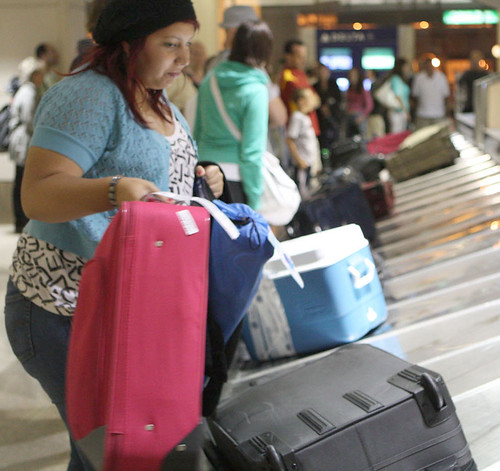
There are three baggage issues that become important during the holidays. The first is that most US airlines are charging you for every checked bag, so using carry-ons only will save you some money. Second, if you do check one or more bags, be prepared to deal with a lost, stolen, or damaged bag. That means if it is valuable to you and you can't deal with having it lost or stolen, keep it with you on your person or in your carry-on bag. That includes things like money, jewelry, medicine, passports, eyeglasses, and laptop computers.

The third potential problem is that if there is no space in the overhead bins, you may be forced to have your carry-on bag checked. If this happens, be prepared to take out any valuables from your carry on before a cabin crew member or a gate agent takes it away.

Unaccompanied Children
If you have a child who will be traveling alone, you should be aware of your airline's specific rules on this kind of travel. AirSafe.com has detailed advice on travel by unaccompanied children, including having the child carry a copy of all contact information and if the child is old enough, a working cell phone. Brent, a flight attendant with a major US airline, wrote to AirSafe.com and offered the following additional advice:

I liked that you suggest having the unaccompanied minor carry a copy of all contact information. One issue I run into is illegible handwriting on the form we use that stays with the child. This form is filled out by hand by the guardian of the child when they present the unaccompanied minor for the flight.

Although the agent who accepts the child and inputs the information in to the computer should check for legibility, this is often not done. Flight attendants don't have access to any information on the company's computer system while on board the aircraft, so we must try to make out poor hand writing in the event we must contact the adult listed. It seems like a minor issue. But when you are on board an aircraft we must be able to effectively utilize the few resources we have.

Also, as you mentioned, cell phones for unaccompanied minors are a very good idea. I don't have any problem contacting an adult for an unaccompanied minor from my cell phone in the event of a delay. However, this might be more than some flight attendants are willing to do. It also opens the flight attendant up to sharing personal phone contact information with a stranger that some flight attendants might not be comfortable with that.

A child with a properly charged cell phone and contact information can be very helpful. This often helps to calm the nerves of the child's parent or guardian and the child because of the separation. A quick chat on the phone with a responsible adult representative of the airline who is on board the child's flight can make all the difference when it comes to peace of mind. I have heard the relief in many parents and grandparents voices.


Resources
General Baggage Issues
Carry-on Bag Issues
Travel by Unaccompanied Children
Top 10 Tips for Children Traveling Alone
What You Are Not Allowed to Take on an Airplane.

Photos: Eileen Mansoorian, TSA