The AirSafe.com News

↑ Grab this Headline Animator

Showing posts with label turbulence. Show all posts

21 February 2014

Advice on how to prevent injuries from inflight turbulence

Turbulence happens on just about every flight, but most of the time the amount of turbulence is very small, and the level of risk is very low. Two turbulence events that happened earlier this week, one involving a Cathay Pacific 747 and the second a United Airlines 737 both led to injuries, and also received quite a bit of media attention.

These two events served as a reminder reminders of just how serious students can be, and the need for passengers to be aware of the potential danger.The following insights and advice should keep you from becoming one of those statistics.

Airline turbulence basics
You can experience turbulence for many reasons, typically due to weather conditions such as thunderstorms. Severe turbulence can happen in any phase of flight, but it's most likely to be hazardous during cruise when passengers and crew may be out of their seats and not belted in. In most cases a passenger experiencing turbulence will feel nothing more than a slight vibration. At the other extreme are those rare events that are severe enough to throw passengers around the cabin.

What causes turbulence?
Turbulence is air movement that normally cannot be seen. While it may sometimes be associated with weather conditions like thunderstorms, it can also happen in the following situations, which could happen even on a clear day.

  1. Thermals - Heat from the sun makes warm air masses rise and cold ones fall.
  2. Jet streams - Fast, high-altitude air currents shift, disturbing the air nearby.
  3. Mountains - Air passing over mountains can lead to turbulence as the air mixes above the air mass on the other downwind side.
  4. Wake turbulence - If an aircraft travels too close to another aircraft, the trailing aircraft may pass through an area of chaotic air currents caused by the lead aircraft.

How bad can it get?
Turbulence effects can range from the barely noticeable to the potentially dangerous. What you may feel can range from feeling a slight strain against your seat belts, to being forced violently against your seat belts, and having unsecured items (including yourself if you are unbuckled) being being tossed about the cabin.

Reducing your risks from turbulence
When the flight crew expects turbulence, they will work with the cabin crew to make sure that passengers are in their seats and belted in, and that serving carts and other loose items are properly secured. Even when turbulence is not expected, you should take a few basics steps before and during the flight to ensure your safety:

  • Follow the instructions of the crew - If the crew suggests that passengers return to their seats, do so as soon as you can.
  • Wear your seat belt at all times - Turbulence events can happen even during a smooth flight on a cloudless day. Turbulence is not always predictable and may arrive without warning.
  • Be aware of your overhead bin - If you are sitting under an overhead bin, make sure that the door is properly closed. Also, avoid sitting under a bin that is heavily packed or that contains one or more heavy items. If you can, move to a seat that is not directly under a bin.

Resources
Turbulence injuries on a United flight out of Denver - 18 Feburary 2014
AirSafe.com turbulence information
Passengers killed by turbulence
FAA turbulence information
How to measure turbulence while you fly
Using child restraints on aircraft
Airline pilot Patrick Smith weighs in on turbulence

Photo credit: Civil Aviation Safety Authority of Australia

18 February 2014

Turbulence injuries on a United flight out of Denver

17 February 2014, United Airlines 737-700, flight 1676, near Billings, MT: Yesterday, several passengers and crew members were injured in a turbulence event involving a United Airlines 737-700 that was en route from Denver, CO to Billings, MT, with at least one passenger hitting the ceiling hard enough to damage a panel. According to the FAA, the captain declared a medical emergency, and the aircraft landed without further incident. The event took place in the early afternoon, and the aircraft was reportedly in clear skies at the time of the incident.


United 737-700 in Billings, MT after turbulence event

The aircraft apparently encountered turbulence during descent that caused several flight attendants and unrestrained passengers to be tossed in the air. Most of the the injuries were minor, and only one victim, a flight attendant, required hospitalization.

Among those tossed in midair was an infant, who landed in a nearby seat and was not injured. According to United, there were 114 passengers and five crew members on board, and three flight attendants and two passengers were injured. Since the 737 has two flight crew members, this implies that all of the flight attendants who were on board were injured.

Turbulence events are not that rare, with the NTSB noting hundreds of such events in their online database. The FAA notes that in the 10-year period from 2002-2011, a total of 110 passengers and 219 crew members were injured by turbulence.

AirSafe.com has extensive background information on inflight turbulence at turbulence.airsafe.com, including advice on how to reduce turbulence risks and a link to a mobile phone app that will allow you to measure turbulence while you fly.

While significant turbulence events that lead to injuries occur several times a year, fatal events are much more infrequent. The last turbulence event that led to a passenger death was in 1997 on a United Airlines 747 that was on a flight from Japan to the US.


Fear of flying and turbulence
Capt. Tom Bunn of the SOAR fear of flying program offers insights into what causes turbulence, and shows passengers a method for controlling the anxiety that turbulence causes some passengers.

Get help NOW from the fear of flying experts at SOAR

Download AirSafe.com's fear of flying resource guide


Resources
AirSafe.com turbulence information
Passengers killed by turbulence
FAA turbulence information
How to measure turbulence while you fly
Using child restraints on aircraft
Airline pilot Patrick Smith weighs in on turbulence

Photo credit: Caleb VanGrinsven

07 December 2013

Measure turbulence while you fly

If you fly regularly, you will routinely experience turbulence. Although it is routine, it can be worrisome to some air travelers who are already anxious flyers. Most of the time the amount of turbulence is very small, and although the flight crew may reassure passengers either before or after encountering turbulence, they don't provide passengers with any kind of objective measures for turbulence, and passengers had no easy way of finding out on their own.

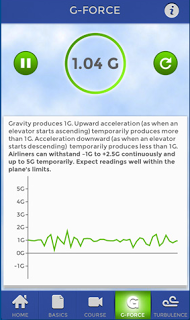
That has all changed with the release of the new SOAR Fear of Flying smartphone app. Available in versions for iPhone, iPad, and for Android devices, the app includes a G-force meter that you can use to chart the amount of turbulence that you are personally experiencing. An example of this screen is below:


Get the app today!
The app is free, and can be downloaded by clicking the image below or by clicking here:


21 July 2010

Turbulence on United Flight Sends at Least 20 to Hospitals

20 July 2010; United Airlines 777; flight 967; over Kansas: United Airlines Flight 967, a 777 en route from Washington's Dulles Airport (IAD) to Los Angeles (LAX), diverted to Denver, CO (DIA) after apparently experiencing significant turbulence while flying at 34,000 feet over Kansas.

According to United, the aircraft had 255 passengers and 10 crew members. FAA spokesman Ian Gregor in Los Angeles said 26 passengers and four crew members were injured, and that one person was critically hurt, though no additional details were provided about the most seriously injured person. Local media reported that 21 people were transported to Denver area hospitals.

Fox News reported that United had two other significant turbulence events earlier this year. The first was a February incident where about 20 people were injured when a United flight experienced turbulence on a trip from Washington, DC, to Tokyo. That flight was a Boeing 747 with 263 people on board.

The second incident was in May when 10 people suffered injuries, including broken bones, on a United 777 flight that hit severe turbulence over the Atlantic Ocean on its way from London to Los Angeles. That flight was diverted to Montreal.

Last month, a United Express crash in Ottawa, Canada injured three people, including both pilots and one passenger.

While this most recent event is suspected to be due to turbulence, the investigation into this incident is ongoing could reveal another cause or causes. For example, in October 2008, a Qantas A330 was involved in what was first thought to be a turbulence event, but the Australian authorities found that it was not the case.

Plane Crashes and Significant Events for United Airlines
Plane Crashes and Significant Events for the 777
Fatal Turbulence Events Since 1980
Turbulence Resources for Passengers

30 October 2009

AirSafe.com Survey Results Plus American Airlines 777 Turbulence Event near Tokyo

Survey Results for The Text to Speech Narrator
Since last week's debut of the Macbook's text to speech function as a podcast narrator, many of you responded to the survey about this narrator and have given AirSafe.com some valuable feedback. There were 78 responses, 63 of whome listened to the entire podcast. Of these 63, 10 said would not listen to this narrator again and 12 others were not sure if they would do so again. Most of those who would listen to this narrator again agreed that it would be appropriate for shorter podcasts.

Based on these results, this narrator will likely be used again, mostly for shorter episodes, or to supplement other audio content.

AirSafe.com Visitor Survey
In an earlier survey about what resources visitors use at AirSafe.com, most of the 35 who responded said that they visited multiple AirSafe.com related sites or services, with AirSafeNews.com, Plane-Crash-Videos.net, and the AirSafe.com podcast being the most popular choices.

Roughly half of the respondents have not listened to or viewed one of the podcasts. If you haven't done so yet, I invite you to check out one of the podcast videos that are hosted on YouTube. You can find all of audio and video podcasts are at podcast.airsafe.org

Only a few of the 35 admitted to using any social media resources. Also, when asked what they wanted changed AirSafe.com, the most popular response was adding more photos. A BirdStrikeNews.com article from last month addresses both points to some extent. In Ten Free Social Media Things You Can Do, AirSafe.com provided suggestions for free and easy to use social media tools you can use, as well as an example of tools that are actively used at AirSafe.com. Based on your feedback, some of them will be used on a more regular basis throughout AirSafe.com's network of sites.

By the way, some social media resources are in the right hand column. You can join the email notification list so you can get an email whenever this site is updated. You can also click on the Twitter logo and subscribe to AirSafe.com's Twitter account. If you don't have a Twitter account, you can easily sign up. Also, if you use Google Reader or another kind of RSS reader, you can click on the appropriate link or icon and subscribe that way as well. If you have no idea what RSS is all about, that will be covered in a future article.

American Airline Turbulence Event near Tokyo
Earlier this week, AirSafe.com came across several small article news articles about a turbulence event involving an American Airlines 777 (N777AN), Flight 61, near Tokyo on Monday (26 October 2009). Reportedly, nine passengers were injured and five, including three children, were treated at a local hospital after the aircraft landed. The plane encountered turbulence over the Pacific Ocean, about 70 kilometers (43 miles) southeast of Tokyo's Narita airport. The aircraft landed without further incident about 14 minutes later.

Passengers reported that the airplane had already experienced strong turbulence for about 20 minutes. Also, the 'fasten seatbelt' signs had been on for about 45 minutes before the event. There were 228 passengers and crew members aboard the Boeing 777.

Since this was an event that happened in Japan, and because it did not cause substantial aircraft damage or fatal injuries, it is unlikely that information from this incident will be in the accident and incident databases of the FAA or the NTSB. If you find any additional sources of news about this incident, please leave a comment and a link to that information.

Related Resources
Turbulence Risks
Selected Fatal Turbulence Events
Air Canada Turbulence Event from 2009
Child Restraint Advice from the FAA
TurbulenceForecast.com


Report About Air Canada Turbulence Event from January 2008


03 August 2009

At Least 14 Injured in Suspected Continental Turbulence Event


Continental Airlines Flight 128, a 767 en route from Rio de Janeiro to Houston, diverted to Miami after apparently experiencing a turbulence event. Unrestrained light attendants and passengers were thrown against the ceiling and into the overhead compartments. One woman reportedly hit a luggage bin so hard that her head stuck there. After landing, 14 people were taken to Miami-area hospitals and were treated for their injuries; four were in serious condition.

This is the fourth safety related event in the last 12 months for Continental. In December 2008, Continental Flight 1404 crashed in on takeoff in Denver and was destroyed by fire. None of the passengers or crew were seriously injured. In February 2009, Continental Connection Flight 3407 crashed near Buffalo during approach, killing all 49 passengers and crew members, as well as one person on the ground. In June of this year a Continental 777 captain died during a transatlantic flight en route from Brussels to Newark.

In its annual safety review released by the NTSB in March 2009 indicated that turbulence was associated with 22 percent of all U.S. airline accidents and 49 percent of serious injury accidents between 1996 and 2005.

While this is suspected to be a turbulence event, further investigation may reveal the ultimate cause of this event. For example, last year, a Qantas A330 was involved in what was first thought to be a turbulence event, but the Australian authorities found that it was not the case.

Plane Crashes and Significant Events for Continental
Plane Crashes and Significant Events for the 767
Fatal Turbulence Events Since 1980
Turbulence Resources for Passengers

29 June 2009

Infomercial Celebrity Billy Mays Dies After Flight


Television infomercial celebrity Billy Mays died in his sleep less than a day after he was involved in a landing incident where he was struck in the head by one or more falling objects. US Airways Flight 1241, a 737-400, departed from Philadelphia, PA just after noon on June 27, 2009 on a nonstop flight to Tampa, FL.

The aircraft experienced a hard landing, which ruptured the two nose wheel tires. The aircraft remained on the runway and the 138 passengers and five crew members, none of whom at the time appeared to be seriously injured, were taken to the terminal. Billy Mays was interviewed by a reporter from WTVT television in Tampa shortly after the incident and stated that he had been hit on the head by something falling from the ceiling.

Billy Mays had returned to Tampa on Saturday in order to undergo hip surgery the following Monday. According to his family, he had no other significant medical conditions at the time of his death. Tampa police reported that Mays wasn't feeling well the evening of the landing incident, and he went to bed at about 10 pm. He was found dead by his wife at about 7:45 the following morning.
Listen to the 911 Call from the Home of Billy Mays (2:25)
Source: Tampa Fire Rescue

So far, a direct connection between the head strike on Billy Mays during the hard landing and his subsequent death has been neither ruled in or ruled out by local authorities. Although Mays reported that he was struck in the head, neither he or the Tampa police could confirm that he was struck by luggage. Local authorities will conduct an autopsy to determine the cause of death, and the results may be available before the end of June.

If the authorities determine that Mays's death was not connected to the landing incident, then the incident will be considered minor and would likely not end up in the online incident and accident databases of the FAA or NTSB. If the death is determined to be associated with the hard landing, then this would be considered a fatal accident by the NTSB, but would not likely result in a major investigation.

The most recent significant safety event for US Airways was the ditching of an A320 in the Hudson River last January. The last fatal crash for US Airways involved a regional aircraft in Charlotte, NC in January 2003. That crash killed both pilots and all 19 passengers. The most recent fatal event involving a 737-400 was a Garuda Indonesia Airways crash in 2007.

Dangers from falling luggage have long been recognized by the airline industry. In 1998, the Flight Safety Foundation published the results of a study that estimated that worldwide, there were about 10,000 injuries every year involving falling baggage. The same study looked at 397 cases at a major US airline where a person was struck by falling luggage, and 30 percent of those strikes resulted in bruises or lacerations.

For more information on how to protect yourself from threats from falling luggage due to hard landings and in-flight turbulence, please visit turbulence.airsafe.org.

Resources
Listen to the Podcast About This Event (3:00)
Plane Crashes and Significant Events for US Airways
Plane Crashes and Significant Events for the 737

Update 29 June 2009
Hillsborough County Medical Examiner Vernard Adams stated that preliminary results from the autopsy of Billy Mays indicates that he had hypertensive heart disease. He also said that Mays was taking the prescription painkillers Tramadol and hydrocodone for hip pain, and that pill counts indicate that Mays had been taking the correct amount of the drugs. Initial tests showed no evidence of head trauma. Hillsborough County includes the city of Tampa.

13 January 2008

Turbulence Event on an Air Canada A319 Flight on 10 January 2008

The aircraft was on a scheduled domestic flight from Victoria, BC to Toronto, ON. The aircraft had a possible encounter with moderate to severe turbulence while in the vicinity of the Canadian Rockies. The crew diverted to Calgary, where injured passengers and crew members were treated for minor injuries. The aircraft was not seriously damaged, and there were no fatalities among the five crew members or 83 passengers.

For further details, please choose one of the podcast options below:

Audio: MP3 | Video: iPod/MP4 | WMV | Google Video | YouTube

To download a copy of the MP3 audio file or one of the MP4 or WMV video files, visit the AirSafe.com podcast home page at http://podcast.airsafe.org.

Related Resources: Turbulence Risks http://www.airsafe.com/cabin/turb.htm

To obtain a PDF file or PowerPoint presentation of the contents of this podcast, please contact AirSafe.com at http://feedback.airsafe.org/.