The AirSafe.com News

↑ Grab this Headline Animator

Showing posts with label crash. Show all posts

05 February 2016

This week in airline safety and security - 5 February 2016

First fatal airliner event of 2016
The February 2nd in-flight explosion on a Daallo Airlines A321 over Somalia led to the death of one passenger and was the first fatal airliner event of 2016. At present, the investigation into the explosion is ongoing, and the authorities in Somalia have not ruled out the possibility that the explosion was caused by a bomb.

Because of the nature of the event, and the ongoing challengers faced by the government of Somalia, there may not be a full and open investigation of the event. For a fuller description of the problems that the Somali government may have with the investigation, please read this recent article from AirSafe.com's Todd Curtis

A recent crash with many similarities to the Daallo event involved a MetroJet A321 last October.

This week's A321 event was the 13th time at least one airline passenger was killed on an A320 series aircraft.

Accident report from fatal AirAsia crash from December 2014 now available
The Indonesian government recently release their final report into the 28 December 2014 crash of an AirAsia A320 that killed all 155 passengers and seven crew members. The authorities concluded that a combination of system malfunctions and crew actions led to the crash.
Crash description and a link to the accident report

Laser encounter near Heathrow leads to arrest
Earlier this week, police near London's Heathrow airport arrested a man who allegedly pointed a laser at an aircraft. Laser encounters are a serious threat not only in the United Kingdom, but also in the United States, with over 20,000 laser encounters reported in the US between 2004 and 2014.

For a detailed look at the patterns of laser encounters in the US, as well as two Todd Curtis interviews with the BBC on laser threats to aircraft, please visit lasers.airsafe.com


Follow AirSafe.com
twitter.airsafe.com
facebook.airsafe.com
podcast.airsafe.com

Try out Uber and get up to $20 off your first ride

14 May 2015

Why the Amtrak train crash in Philadelphia is like a plane crash

The crash of Amtrak Northeast Regional Train 188 in Philadelphia, PA on May 12, 2015 involved an Amtrak passenger train, but in many ways this train crash was like a plane crash, specifically in the ways that the major US media outlets responded to the event. It is extremely rare for train crashes to generate intense media interest, but this kind of attention is routine for airline crashes. Upon closer review, the media response to the Amtrak crash is not so surprising.

Although it has only been a couple of days since the crash, the NTSB accident investigation team has revealed key details of the events that led to the crash. In short, it looks like the train was traveling just over 100 mph (161 kph), and derailed after entering a curve that had a 50 mph speed limit.

There were five crew members and about 240 passengers on board. Seven of those passengers were killed, and several dozen passengers and crew members were injured.


NTSB Board Member Robert Sumwalt at crash site

Amtrak accidents are common
While this accident has received the kind of attention usually given a major plane crash (for example, continuous coverage from major news networks that includes having news anchors at the crash site), Amtrak accidents are actually quite common. According to the Federal Railroad Administration, over the last decade, Amtrak has been involved with accidents and incidents that have resulted in over 1,000 deaths.


(Click to enlarge)

In the last three years, Amtrak has been involved in over 50 accidents per year, with 21 in the first two months of 2015.


(Click to enlarge)

Why this crash stands out
The circumstances around the Philadelphia crash that have led to an intense amount of media attention include where it happened, who was on the train, and perhaps more importantly, who is likely to travel by train on that route.

The crash took place on not only the most heavily traveled route in the Amtrak system, with over 12 million riders in 2011, it is also a route that connects New York City with Washington, DC, two metropolitan areas where many members of the US financial, political, and media elite live and work.

Many of the elite members of US society, even if they don't live or work in New York or Washington, have either traveled on that route on many occasions, or know friends, colleagues, or family members who do. A quick review of some of those killed in the crash can give you an insight into the kinds of people who regularly travel on this route. The dead include:

  • A tech company CEO
  • A software architect for a major news media organization
  • A US Naval Academy midshipman
  • A university dean
  • A senior vice president of a Fortune 100 company

Given the ongoing media coverage, it is very likely that the most influential business, political, and media decision makers throughout the US are not only keenly aware of the accident, but can also imagine circumstances where they could have been on that train that night. If it had been a jet airliner traveling between major cities in the northeast US, the airliner's passenger list would have likely reflected the profile of the people on that Amtrak train.

These are the reasons why the traveling public, especially the more influential members of the traveling public, may feel about this train crash the same way they would perceive a plane crash, as something that could happen to them.

Additional resources
Amtrak Northeast Corridor overview 2011

Graphics:
Federal Railroad Administration
National Transportation Safety Board

06 May 2015

French authorities release preliminary report on the Germanwings crash investigation

On 6 May 2015, the BEA (Bureau d'Enquêtes et d'Analyses pour la Sécurité de l'Aviation Civile) released a preliminary report on the crash of Germanwings flight 4U9525 which highlighted the following findings:

  • At about three minutes after the aircraft reached its cruising altitude of 38,000 feet, the captain left the cockpit.

  • Within 30 seconds of the captain leaving the cockpit, the first officer commanded the aircraft to descend to 100 feet, which is well below ground level.

  • Within five minutes of the commanded altitude change, the airspeed was changed at least ten times, reaching a maximum of 350 knots (402 mph, 648 kph).

  • The descent rate reached a maximum of 5,000 feet per minute, and averaged about 3,500 feet per minute.

  • The descent was continuous, and controlled by the autopilot.

  • Air traffic controllers and the French military attempted to contact the aircraft several times, but received no response.

  • Before the collision with the terrain, there were multiple aural warnings heard on the CVR.

  • The aircraft impacted the ground about 10 minutes and 13 seconds after the aircraft started its descent.

  • Autopilot and autothrust remained engaged until impact.

  • On the previous flight, while the captain was out of the cockpit, the first officer twice commanded the aircraft to descend to 100 feet for short periods of time.

The role of the first officer in the crash
The preliminary report did not state a definitive cause of the crash, but it did state that during the cruise phase, the first officer was alone in the cockpit and intentionally modified the autopilot instructions to order the aircraft to descend until it collided with the ground. The report also stated that the first officer did not open the cockpit door during the descent, despite requests for access made via the keypad, with cabin interphone, and by knocking on the door.

Aircraft trajectory

(click to enlarge)

First officer training history
The preliminary report provided an outline of the first officer's training history, including the fact that he started his flight training at the Lufthansa Flight Training Pilot School in Germany on 1 September 2008, but that his training was suspended for medical reasons for over eight months, from 5 November 2008 to 26 August 2009. It was during this period, specifically from April to July 2009, that the first officer did not have a valid medical certificate due to depression and his medical treatment for his condition.

From October 2010 to March 2011, he continued his flight training in the US, but was under contract as a flight attendant with Lufthansa for over two years before beginning his training to become an A320 first officer. He was appointed as an A320 copilot in June 2014.

Related information
Germanwings crash details from AirSafe.com
Lufthansa plane crashes
Other A320 crashes
Germanwings Wikipedia page
Flight 9525 Wikipedia entry

27 March 2015

At least seven deliberate crashes by airline pilots since 1980

24 March 2015; Germanwings A320-200; D-AIPX; flight 4U9525; near Barcelonnette, France: The aircraft was on a scheduled international flight from Barcelona, Spain to Düsseldorf, Germany. About a half hour after takeoff, while at a cruising altitude of 38,000 feet, the aircraft began losing altitude, and crashed about ten minutes later. The investigative authorities suspect that the first officer deliberately crashed the aircraft. All six crew members and 144 passengers were killed.

A review of the cockpit voice recorder made the authorities suspect that the first officer locked the cockpit door while the captain was outside of the cockpit. The online flight tracking service FlightRadar24 reported than an analysis of their data showed that the autopilot was set to the minimum altitude of 100 feet, which is well below the ground level where the crash took place.

These recent revelations of the suspected cause of the Germanwings crash highlight the reality that despite all of the changes that the airline industry has made since 9/11 to prevent passengers or other outsiders from threatening aircraft, there is still a risk that crew members have the opportunity and the ability to deliberately crash airliners.

At least seven events since 1980
Since 1980, there have been at least seven occasions where an airline pilot is suspected to have deliberately crashed an airliner. One one occasion in 1994, a FedEx DC10 crew had to fight off an off duty pilot who had intended to crash the aircraft, and were barely able to survive the attack. For more details on these eight events, please visit http://t.co/XbqXIThVjB

Related information
Lufthansa plane crashes
A320 plane crashes
Airliners deliberately crashed by a flight crew member

24 March 2015

Germanwings A320 crashes in France with the loss of all on board

24 March 2015; Germanwings A320-200; D-AIPX; flight 4U9525; near Barcelonnette, France: The aircraft was on a scheduled international flight from Barcelona, Spain to Düsseldorf, Germany. About a half hour after takeoff, while at a cruising altitude of 38,000 feet, the aircraft began losing altitude, and crashed about ten minutes later. All six crew members and 142 passengers were killed.

Germanwings is owned by Lufthansa, and this crash was the fourth Lufthansa or Lufthansa-related crash since 1970

Related information
A320 plane crashes
Flight 4U9525 Wikipedia entry

Below is the flight track of flight 4U9525 showing the flight track ending in southeastern France


Source: FlightAware.com

13 March 2015

Recent interviews about Harrison Ford's plane crash and the MH370 one year anniversary

Recent interviews featuring Todd Curtis of AirSafe.com included:

  • An interview with the BBC about claims that some airlines in the Middle East are receiving unfair subsidies,
  • Several interviews discussing Harrison Ford's latest plane crash,
  • Several discussions about the one year anniversary of Malaysia Airlines flight MH370, and
  • Dissecting the preliminary information from the latest landing incident at La Guarida.

You can find all of these AirSafe.com interviews, and past interviews, at:

Free fear of flying information from AirSafe.com
If you have fear or anxieties around flying, or know someone who does, you may want to check out one of these resources from AirSafe.com:

Have other anxiety issues?
If you have fear or anxieties around flying, or know someone who does, you may want to check out the resources available at Panic Away.

23 February 2015

Recent interviews on drones, drug use at Boeing, and more

Recent interviews featuring Todd Curtis of AirSafe.com included:

  • An interview on the Rudy Maxa show on proposed FAA drone regulations,
  • A CJOB radio interview about last month's fatal crash of a Greek F-16,
  • Several interviews about the crash of a TransAsia ATR-72 in Taiwan, and
  • A KING TV report on Boeing factory workers fired for selling and using drugs on the job.

You can find all of these AirSafe.com interviews, and past interviews, at:

Free fear of flying information from AirSafe.com
If you have fear or anxieties around flying, or know someone who does, you may want to check out one of these resources from AirSafe.com:

04 February 2015

TransAsia Airways has second fatal crash in less than a year

4 February 2015; TransAsia Airways ATR 72-600; B-22816; flight GE232; near Magong, Taiwan: The aircraft was on a scheduled domestic flight between Taipei and Kinmen Island, Taiwan. The airplane crashed into a river shortly after takeoff from Songshan Airport in Taipei. The aircraft hit a bridge, as well as a vehicle on that bridge, before plunging into the Keelung River. Shortly before hitting the bridge, the aircraft rolled sharply to the left.

There were 53 passengers and five crew members on board, and at least 18 occupants were killed. At least five people on the ground were also injured. There was heavy rain in the area at the time of the crash.
Other TransAsia Airways crashes
ATR 72 plane crashes
Flight GE235 Wikipedia entry

Airlines with more than one crash within one year
This TransAsia crash is the second time in less than a year that the airline has had a crash that resulted in passenger deaths. The previous crash was on 24 July 2014 and involved another ATR 72, this time on a domestic flight between Kaohsiung and Magong, Taiwan. All four crew members and 44 of the 54 passengers were killed.

Below is a partial list of airlines since 1970 that have had multiple fatal plane crashes separated by less than one year. Each item represents a sequence of at least two plane crashes or other events that led to the death of one or more passengers. For each sequence, there is a gap of less than one year between events. These sequences, which are listed in reverse chronological order, may include the airline or one of its subsidiaries.

  1. TransAsia Airways 2014-2015
  2. Malaysia Airlines 2014
  3. American Airliners 2001 (3)
  4. United Airliners 2001
  5. Cubana 1999
  6. TAM 1996-1997
  7. ADC (Nigeria 1996-1997
  8. Delta Air Lines 1995-1997 (3)
  9. American Airliners 1994-1995 (4)
  10. USAir 1994
  11. China Eastern 1993
  12. USAir 1991-1992 (3)
  13. Nordeste (Brazil) 1991-1992
  14. Aeroflot 1990-1991 (3)
  15. Avianca 1989-1990
  16. United Airliners 1989
  17. Korean Air Lines 1989
  18. Continental Airlines 1987-1988
  19. Philippine Air Lines 1987
  20. Northwest Airlines 1987
  21. TWA 1985-1986
  22. TAM 1983-1984
  23. CAAC 1982-1983 (3)
  24. Pan Am 1982
  25. VASP 1982
  26. Aeromexico 1981
  27. Saudia 1980
  28. THY 1979-1980
  29. Indian Airlines 1979-1980
  30. Air New Zealand 1979
  31. Air Rhodesia 1978-1979
  32. THY 1974-1975 (3)
  33. Eastern Air Lines 1974-1975
  34. TWA 1974
  35. Pan Am 1973-1974 (3)
  36. Japan Air Lines 1972
  37. Indian Airlines 1971-1973 (3)

The above list may not include every airline with two or more fatal crashes within a year. If you know of any others, please contact AirSafe.com.


Various videos and photos of the TransAsia Airways crash


Source: YouTube MrOutofcontrolvideos


Source: YouTube FSXninja


Source: LiveLeak

Final Moments of flight (Photo: APA):
Final Moments of flight (Photo: APA)

The wreckage almost submerged in the Keelung River:
The wreckage almost submerged in the Keelung River

Overview of wreckage in Keelung River (Photo: APA):
Overview of wreckage in Keelung River (Photo: APA)

Detail Map (Graphics: AVH/Google Earth):
Detail Map (Graphics: AVH/Google Earth)

Map (Graphics: AVH/Google Earth):
Map (Graphics: AVH/Google Earth)

Speed and altitudes (FlightRadar24):
Speed and altitudes (FlightRadar24)

04 November 2014

NTSB provides timeline of SpaceShipTwo mishap

The following is an overview of the preliminary findings presented by the NTSB on the third day of their investigation.

During the fourth media briefing on the third day of the on site portion of the NTSB investigation of the crash of SpaceShipTwo, the most significant information provided by acting NTSB chair Christopher A. Hart was a general timeline of the events between the release of SpaceShipTwo from its mothership WhiteKnightTwo, and the loss of telemetry from SpaceShipTwo. In that roughly fifteen second span, a number of events occurred inside SpaceShipTwo:

  • SpaceShipTwo released from mothership WhiteKnightTwo at 10:07:19 PDT (17:07:19 UTC)
  • The rocket engine was ignited about two seconds later.
  • About eight seconds later, and 10 seconds after release, SpaceShipTwo was traveling at about Mach 0.94
  • Sometime during the next two seconds, the feather lock handle was moved from the locked to the unlock position by the person sitting in the right seat.
  • At about 12 seconds after release, the vehicle was traveling at Mach 1.02
  • The feathers began to deploy at about 13 seconds after release.
  • Telemetry and video data was lost about two seconds later, roughly 15 seconds after release.

In addition to the timeline, the NTSB stated that lightweight debris was recovered about 30-35 miles northeast of the main wreckage area, and it was not clear what role wind may have played in the distribution of that wreckage. Also, while there was clear evidence that the pilot in the right seat moved the feather lock handle, during the media briefing, Hart was not clear if it was the pilot or the copilot who did so.

Shortly after the media briefing, NTSB clarified its position on Twitter, stating that the copilot, who did not survive the mishap, was the person in the right seat who moved the lock/unlock handle into the unlocked position.

Additional resources
Initial NTSB SpaceShipTwo accident investigation
Review of first two NTSB briefings on 1 November 2014
Review of third NTSB briefing on 2 November 2014
Review of fourth NTSB briefing on 3 November 2014

03 November 2014

NTSB hints that SpaceShipTwo breakup was not related to an engine failure

The following is an overview of the factual data presented by the NTSB on the second day of their investigation.

During the media briefing on the second day of the NTSB investigation of the crash of SpaceShipTwo, acting NTSB chair Christopher A. Hart, reported on some of their early findings that implied that there was no fire, explosion, or other kind of breach or failure involving the engine, fuel tank, or oxidizer tank. Early evidence instead points to an un uncommanded deployment of the feathering system just prior to the loss of telemetry from SpaceShipTwo.

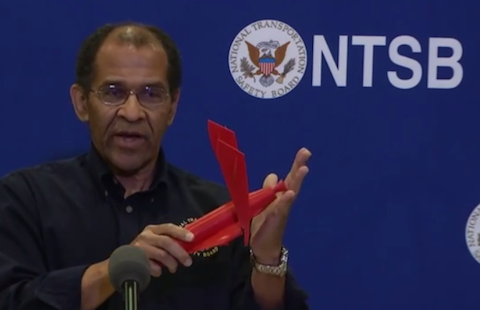
The feathering system on SpaceShipTwo allows the twin booms on the vehicle, referred to as the feathers, to rotate upward in order to provide more aerodynamic drag on reentry. They are intended to be deployed after the engine has shut down and prior to reentry. According the information provided at the briefing, deploying the feathers takes two actions from the flight crew. The feathering system has to first be unlocked before they can be deployed by moving the feather handle into the feathered position.

There is a feathering handle that moves the feathers into the feathered position. Based on video evidence from inside SpaceShipTwo, the copilot unlocked the system, but the system deployed without any crew input.


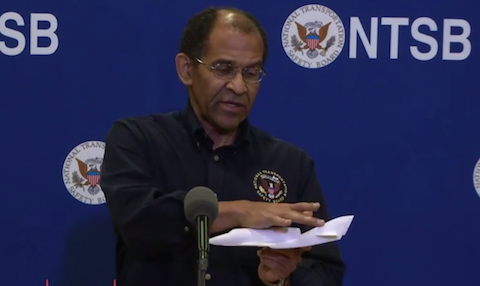
Model of SpaceShipTwo in unfeathered position

Model of SpaceShipTwo in feathered position


The sequence of events was roughly as follows:

  • After being released from its carrier aircraft, the crew of SpaceShipTwo ignited the rocket engine.
  • About nine seconds after engine ignition, telemetry data showed that the feather parameters changed from locked to unlocked.
  • Video from the cockpit showed that the copilot had unlocked the feathering system, and is consistent with the telemetry data.
  • About two seconds later, the feathers moved toward the deployed position even though the feather handle had not been moved into the feather position.
  • The feather deployment occurred at a speed just above Mach 1.
  • Shortly after feathering occurred, video data and telemetry data terminated.
  • The engine burn was normal prior to the deployment of the feathers.
  • Normal procedures would have had the crew unlocking the feathering system at a speed of about Mach 1.4.
  • Unlocking the feathering system alone should not have allowed the feathers to deploy.
  • The inflight breakup of the vehicle began sometime after telemetry ceased.
  • The NTSB has not determined if the inflight breakup was caused by aerodynamic forces or from some other cause.
  • The rocket engine, fuel tank, or oxidizer tank showed no evidence of a breach or burn through consistent with some sort of fire, explosion or structural failure affecting those components.

The NTSB emphasized that their statements were statements of fact rather than a determination of a cause of the mishap. Below is a video of the third media briefing.

Additional resources
Initial NTSB SpaceShipTwo accident investigation
Review of first two NTSB briefings on 1 November 2014
Review of third NTSB briefing on 2 November 2014

Note: An earlier version of this story inadvertently stated that there was evidence of a breach or burn on some components.

01 November 2014

Virgin Galactic SpaceShipTwo NTSB accident investigation

The NTSB is leading the investigation into yesterday's crash of Scaled Composites SpaceShipTwo north of Mojave, CA. Saturday November 1st was the first day of the investigation, and the NTSB has already had one one media briefing with a second planned for late in the evening.

The following is an overview of the crash and comments on the early media briefings.

31 October 2014; Scaled Composites; Model 339 (SpaceShipTwo); N339SS; near Cantil, CA: The vehicle, which is designed to fly into the lower reaches of space (above 100 km above Earth) was on its first powered test flight with a new engine fuel and oxidizer combination (nylon and nitrous oxide). SpaceShipTwo was dropped from its carrier vehicle at about 45,000 feet, and ignited its engine.

Roughly two minutes after release from the carrier aircraft White Knight Two, the SpaceShipTwo vehicle experienced an inflight breakup. One of the two crew members was killed, and the other was able to bail out of the vehicle and was injured.

Prior to the accident flight, there had been the 54 test flights of SpaceShipTwo, of which 34 involved a release from the carrier aircraft, including three powered flights.

Scaled Composites, which conducted the flight test, is a partner of Virgin Galactic, which had planned on using SpaceShipTwo to take passengers on suborbital trips into space in the near future.


Summary of first two NTSB briefings on 1 November 2014
Both NTSB briefing were given by acting NTSB chair Christopher A. Hart, was short, and provided the following preliminary information about the accident:

  • While the NTSB has previously participated in the investigations of the Challenger and Columbia Space Shuttle accidents, this will be the first time it has taken the lead role in the investigation of a crewed space launch vehicle accident.
  • The NTSB team consists of about 13-15 investigators and specialists in the areas of structures, including systems, engines, vehicle, performance, and operations.
  • The parties to the investigation are the FAA, Scaled Composites, and Virgin Galactic
  • The vehicle was flying in a southwesterly direction, and the wreckage field is about five miles (8 km) long, and is oriented from the northeast to the southwest.
  • The wreckage pattern indicates that an inflight breakup occurred, but the NTSB has not yet determined why this happened.
  • The left and right tail booms were near the beginning of the wreckage trail, followed by the fuselage, fuel and oxidizer tanks, cockpit, and the rocket engine.
  • There were a total of three tanks in the vehicle, a fuel tank, an oxidizer tank, and a methane tank.
  • The NTSB was unaware of the altitude of the mishap.
  • There was extensive video data available from the flight, including six cameras on SpaceShipTwo, another three on White Knight Two, one in a chase aircraft, and one on the Edwards AFB test range.
  • The NTSB does not know if the six cameras on board SpaceShipTwo have been recovered.
  • There were six data sources on SpaceShipTwo and about 1000 parameters of telemetry available from the flight. There was also a radar on the chase aircraft.
  • Interviews have been conducted, but NTSB will not reveal what has been discovered until later in the investigation.
  • The surviving pilot has not yet been interviewed because his doctors recommended against doing so at this time.
  • The NTSB does not know how the surviving pilot exited the vehicle.
  • The on scene portion of the investigation will continue for another four to seven days, and the full investigation will take about a year.
  • Scaled Composites can continue operations during the investigation.
  • News and updates to the investigation will be available at the NTSB's web site (www.ntsb.gov) Twitter feed (@NTSB).

Initial SpaceShipTwo NTSB briefings


Initial NTSB SpaceShipTwo briefings 1 November 2014

29 July 2014

Three airliner crashes in one week is not that rare

The recent loss of three airliners within a seven day span, starting with Malaysia Airliners flight MH17 on July 17th, has certainly drawn a large amount of attention from the world's media, the traveling public, and even from major aviation safety organizations.

In a 28 July 2014 article published by CNN, a representative of the Flight Safety Foundation, a nonprofit organization that since 1947 has provided safety guidance and resources for the aerospace industry, implied that with the exception of the 9/11 attacks, it was hard to know whether the loss of three airliners in seven days was unprecedented. A review of the AirSafe.com records revealed that this kind of loss has had a number of precedents within the last 20 years.

In a previous AirSafeNews.com article, a review of AirSafe.com records from 1996 to 2014 revealed that there were 25 occasions where there were three or more significant aviation events where the events were separated by 10 days or fewer.

Inspired by the statement from the Flight Safety Foundation, Todd Curtis reviewed AirSafe.com's records again, this time discover how many times the there had been three or more losses of airliners in no more than a seven day period, and where the following criteria were also met:

  • At least one passenger was killed in each aircraft,
  • The aircraft was either destroyed or seriously damaged and no longer flyable,
  • The aircraft had the capacity to carry at least 10 passengers, and
  • The airliner event could have been due to any cause, including hijacking, sabotage, or military action.

The review revealed that there were eight occasions during the 19 calendar years that AirSafe.com has been in operation (1996-2014), where three or more airliners have been lost within a seven day period. Below are the years and the dates of occurrence:

  1. 1997 - December 13, 15, 17, and 19
  2. 2001 - September 11, 12, and 18
  3. 2003 - January 8, 9, and 9
  4. 2008 - August 20, 24, and 24
  5. 2010 - May 12, 15, 17
  6. 2010 - August 24, 24, and 25
  7. 2011 - July 8, 11, and 13
  8. 2014 - July 17, 23, and 24

Noteworthy occurrences include the following:

  • In 1997, there were four separate events within seven days, and if an event on December 9th is included, five within 10 days.

  • In 2001, there were four airliners lost on 9/11, and one each in the two subsequent events

  • In 2010, if a fourth event on May 22 is included, there were four events in 10 days.

Given that the rate at which serious airline events occur has steadily decreased over the years, if this same analysis were done in the period prior to 1996, there would likely be a higher frequency of cases where three or more airliner were lost within a seven day span.


Fatal and serious events by year
1996, 1997, 1998, 1999, 2000
2001, 2002,2003, 2004, 2005
2006, 2007, 2008, 2009, 2010
2011, 2012, 2013, 2014

Related information
"Do plane crashes happen in threes" AirSafeNews.com article
Todd Curtis discusses his findings on the Rudy Maxa Show (6:44)
Related article from Patrick Smith of AskThePilot.com


AirSafe.com Bonuses
All subscribers to the AirSafe.com mailing list at subscribe.airsafe.com will be able to download free copies of all of the recent AirSafe.com books, including the latest, AirSafe.com Family Air Travel Guide.

Also available is the AirSafe.com Fear of Flying Resource Guide, with an overview of the symptoms of fear of flying, as well as recommended resources for managing or eliminating these fears.

24 July 2014

Do plane crashes happen in threes? - yes, and sometimes in fours and fives

Note:This an updated version of an article first published in February 2009

Since AirSafe.com was launched in 1996, the site has tracked fatal events and other significant events involving airline passengers. When these events occur, especially if two occur a just a few days apart, I sometimes get the "Do bad things like plane crashes always happen in threes?" question asked by visitors to the site, by members of the media, and by others.

I used to just dismiss the question out of hand because events like plane crashes, especially those involving passenger airliners, are very rare, and the circumstances are usually very different for each crash, often involving different airlines, different aircraft types, and even different countries.

Although it's easy to reject the original question, it is quite legitimate to ask a related question about how frequently groups of rare events occur over a relatively short period of time.

One day, just for fun, I turned the "things happening in threes" question into something that could be analyzed systematically using the information within AirSafe.com. I changed the general question into the following specific question: "How frequent are sequences of three or more fatal or significant aviation safety and security events where the time between events is ten days or less?"

For example, a sequence of three events could happen on the same day, or it could be over a period as long as 20 days, with a 10-day gap between the first and second event, and another 10-day gap between the second and third event.

The most recent sequence of three events took place over the course of seven days beginning with the crash of Malaysia Airlines flight MH17 on July 17th, followed by the crash of an TransAsia ATR airliner in Taiwan on July 23th, and ending with the crash of an Air Algerie MD83 in Mali on July 24th.

For the purposes of answering this question, I limited the data to those events that are regularly tracked by AirSafe.com. These would be plane crashes or other airline events that kill at least one passenger, or other events that AirSafe.com considers to be significant with respect to aviation safety or aviation security.

Multiple events due to the same cause (for example, the four crashes associated with 9/11) were treated as one event. Significant events that don't kill anyone sometimes attract more media attention than the average plane crash. The January 2008 ditching of a US Airways A320 in the Hudson River in New York was one example. It was very dramatic, it got a huge amount of media exposure, and no one was killed.

A review of the AirSafe.com records from 1996, the year AirSafe.com was launched, to July 2014 revealed some interesting facts:

  • With the exception of 2007, 2009, and 2013, every year since 1996 included at least one sequence of three fatal or significant events that were separated by no more than ten days. There was a sequence of five significant, but nonfatal, events in January 2008 (one of which involved Senator Barack Obama), and a sequence of eight events in 2010, seven of which involved fatalities.

  • There were 25 sequences of three or more events that were separated no more than ten days. One was a sequence of eight events, three were sequences of five events, five sequences had four events, and the other sixteen consisted of three events each.

  • Most of the fatal and significant events tracked from 1996 to the present were not part of any sequence of three or more events.

  • Well known fatal events that were a part of one of these sequences include the Swissair MD-11 crash in 1998, the Concorde crash in 2000, the August 2006 crash of a Comair jet, in Lexington, KY, the August 2008 crash of a Spanair MD83 in Madrid, and the July 2014 crash of Malaysia Airlines flight MH17.

  • Well known events that were not a part of one of these sequences include the ValuJet and TWA Flight 800 crashes in 1996, the Alaska Airlines crash in 2000, the four crashes associated with 9/11, and the March 2014 loss of Malaysia Airlines flight MH370.

  • For 16 of the past 19 calendar years (1996 to 2014), there has been at least one grouping of three or more fatal or significant events that occurred over a relatively short period.

  • No information has come about in the investigations of any of those events that indicates that there was any sort of connection among the crashes that were part of a sequence of three or more events, or that suggested that earlier events in a sequence made a later event more likely.

After reviewing the facts, I no longer say that plane crashes don't happen in threes. Since 1996, they have happened in sequences of three, four, five, and eight.

- Todd Curtis


Fatal and serious events by year
1996, 1997, 1998, 1999, 2000
2001, 2002,2003, 2004, 2005
2006, 2007, 2008, 2009, 2010
2011, 2012, 2013, 2014

Related information
26 July 2014 - Todd Curtis discusses his findings on the Rudy Maxa Show (6:44)
Related article from Patrick Smith of AskThePilot.com
Losing three airliners in one week is not that rare


AirSafe.com Bonuses
All subscribers to the AirSafe.com mailing list at subscribe.airsafe.com will be able to download free copies of all of the recent AirSafe.com books, including the latest, AirSafe.com Family Air Travel Guide.

Also available is the AirSafe.com Fear of Flying Resource Guide, with an overview of the symptoms of fear of flying, as well as recommended resources for managing or eliminating these fears.

29 June 2014

Six month safety review for 2014

This review of plane crashes and other significant events from the first six months of 2014 discusses three airline events, two of which involved at least one confirmed passengers fatality, and the third, which involved suspected passenger fatalities on Malaysia Airlines flight MH370.

Since AirSafe.com began tracking such events in 1996, there have been three or fewer fatal events in the first six months of a calendar year on five other occasions. There were also three fatal events in the first six months of 2001, 2005, and 2010. There was a single fatal event in the first six months of 2006 and 2013.

This review includes all fatal events, specifically events involving passenger fatalities in aircraft which have the capacity to seat at least 10 passengers where those models are used in regular airline service in North America, western Europe, Australia, or Japan. Also included are plane crashes and other significant events that did not qualify as a fatal event, but that either had high media interest or that had noteworthy aviation safety or security implications.

All of the events in the first half of 2014 were fatal events, and there were no significant events. From 1996 to 2014, there have been a total of 81 fatal events and 35 significant events in the first half of the year, for an average of 4.26 fatal events and 1.94 significant events each year.

The AirSafe.com definitions page has additional details on how an event is assigned to a category. The Malaysia Airlines flight MH370 event led to a change in the definitions, expanding the fatal event category to include situations where an airliner has been missing for at least 30 days, and where there is also substantial indirect evidence that one or more passengers were killed.


Events Killing Airline Passengers

  1. 16 February 2014; Nepal Airlines DHC-6 Twin Otter 300; 9N-ABB; flight 183; en route between Pokhara and Jumla, Nepal: The aircraft was on a scheduled domestic flight from Pokhara to Jumla, Nepal. Radio contact was lost about 30 minutes after takeoff. The crashed aircraft was found the next day, and all three crew members and 15 passengers had been killed.

  2. 8 March 2014; Malaysia Airlines 777-200; 9M-MRO; flight MH370; unknown location: The aircraft was on a scheduled international flight between Kuala Lumpur, Malaysia and Beijing, China and went missing while en route. The current location and status of the aircraft, along with that of the 227 passengers and 12 crew members who were on board, is unknown.

    This is a numbered event as defined by AirSafe.com because there is substantial indirect evidence that one or more passengers were killed.

    Visit the Malaysia Airlines flight MH370 page for additional information, including links to articles and interviews of Dr. Todd Curtis of AirSafe.com

  3. 24 June 2014; Pakistan International Airlines (PIA); A310-300; AP-BGN; flight PK756; Peshawar, Pakistan The aircraft was on a scheduled international flight from Riyadh, Saudi Arabia to Peshawar, Pakistan, when it was struck by several bullets shortly before landing. Two cabin crew members and one passenger were hit, and the passenger died of her injuries. There were no other injuries among the 10 other crew members or 177 other passengers.
    Fatal PIA Events


Other Significant Events

None


Other Years
1996, 1997, 1998, 1999, 2000,
2001, 2002, 2003, 2004, 2005
2006, 2007, 2008, 2009, 2010
2011, 2012, 2013


AirSafe.com Bonuses
All subscribers to the AirSafe.com mailing list at subscribe.airsafe.com will be able to download free copies of all of the recent AirSafe.com books, including the AirSafe.com Family Air Travel Guide.

Also available is the AirSafe.com Fear of Flying Resource Guide, with an overview of the symptoms of fear of flying, as well as recommended resources for managing or eliminating these fears.

25 June 2014

NTSB report on July 2013 crash of an Asiana Airlines 777 in San Francisco

On 24 June 2014, NTSB Board members met to determine the probable cause of the July 2013 crash of Asiana Airlines flight 214 in San Francisco, CA, which resulted in the deaths of there passengers. The Board concluded that there were a number of probable and contributory causes for the accident, with many of them revolving around the crew's understanding of the aircraft's automated systems.

Synopsis
On July 6, 2013, about 11:28 am local time, a Asiana Airlines flight 214, a Boeing 777-200ER (HL7742), struck a seawall while attempting to land on runway 28L at San Francisco International Airport (SFO). Three of the 291 passengers were killed, and 40 passengers were serious injured. All 16 crew members survived, but nine were seriously injured.


Aprroach sequence
Although air traffic control (ATC) allowed the aircraft to attempt a landing under visual flight rules, the flight crew used both the autopilot and autothrottle system during the landing. The sequence of events shortly before the crash featured a number of changes in the flight control system, and according to the NTSB the flight crew's understanding of how the aircraft performed in various autopilot and autothrottle modes led to the crash.

The following is a synopsis of the portion of the NTSB report on the crash of flight 214 that focused on the landing approach:

  • The flight was vectored for a visual approach to runway 28L, and intercepted the final approach course about 14 nautical miles from the threshold at an altitude that put the aircraft slightly above the desired three degree glide path.

  • The flight crew accepted an ATC instruction to maintain 180 knots until five nautical miles from the runway, but mismanaged the airplane’s descent, which resulted in the airplane still being above the desired three degree glide path when it reached the five nautical mile point.

  • In an attempt to increase the airplane’s descent rate and capture the desired glide path, the pilot flying (PF) selected an autopilot mode that resulted in the autoflight system initiating a climb. The chosen autopilot mode, 'flight level change,' attempted to bring the aircraft to the selected altitude, which was above the aircraft's altitude at that point of the approach.

  • The PF disconnected the autopilot, moved the thrust levers to idle, and then pitched the aircraft down, which increased the decent rate.

  • When the PF disconnected the autopilot, that action caused the autothrottle to change to the 'hold' mode, which is a mode where the autothrottle does not control airspeed. Neither the PF or the other two pilots in the cockpit noted this change in the autothrottle mode.

  • Asiana’s procedures dictated that the approach must be stabilized by the time the aircraft descends to 500 feet above the airport elevation. The approach was not stabilized, and the crew should have initiated a go-around, but instead continued the approach.

  • As the approach continued, it became increasingly unstabilized as the airplane descended below the desired glidepath.

  • Airspeed continued to decrease, and at about 200 feet, the flight crew became aware of both a low airspeed and low glide path condition, but still did not initiate a go-around.

  • The crew finally initiated a go-around when the airplane was at less then 100 feet of altitude. However, at that point the airplane did not have the performance capability to accomplish a go-around.


NTSB animation of the final approach


Crash sequence
The following information was in the NTSB report synopsis released on 24 June 2014, and from two NTSB media briefings given shortly after the accident.

  • The main landing gear hit the sea wall first, followed by the tail section.

  • The main landing gear sheared away from the aircraft as designed, and the wing fuel tanks were not punctured by the gear separation or during the rest of the crash sequence.

  • The tail section broke off after the aircraft contacted the sea wall. Cabin flooring and galley components were found on the chevrons in the runway overrun area between the sea wall and the runway threshold.

  • Two passengers and four flight attendants were ejected from the aircraft. All four flight attendants were seriously injured, and both passengers were killed.

  • Neither of the ejected passengers were wearing seat belts at the time of the crash, and one of these passengers was later run over by two of the responding firefighting vehicles. The NTSB noted that had the passengers been wearing their seat belts, they would have likely remained in the aircraft and survived.

  • One of the flight attendants initiated an evacuation after became aware of a post-crash fire. All but five of the passengers were able to evacuate on their own. Firefighters rescued five passengers, one of whom later died.

NTSB probable and contributing causes
The NTSB determined that the probable causes of this accident was due to a combination of flight crew actions:

  • Mismanagment of the airplane’s descent during the visual approach,

  • Unintended deactivation of the automatic airspeed control system,

  • Inadequate monitoring of airspeed, and

  • Delayed execution of a go-around after they became aware that the airplane was below acceptable glide path and airspeed tolerances.

The NTSB found that there were also several contributing causes:

  • Complex autothrottle and autopilot flight director systems that were inadequately described in Boeing’s documentation and Asiana’s pilot training,

  • The flight crew’s nonstandard communication and coordination regarding the use of the autothrottle and autopilot systems,

  • Inadequate training on the planning and executing of visual approaches;

  • Inadequate supervision of the pilot flying by the instructor pilot; and

  • Flight crew fatigue.


Key NTSB Asiana investigation resources
Abstract of NTSB accident report
Asiana flight 214 investigation main page
Asiana flight 214 accident docket
Asiana flight 214 investigative hearing transcript (11 December 2013 hearing archived by AirSafeNews.com)

Related AirSafeNews.com articles

14 June 2014

Update on the crash of a Gulfstream IV jet near Boston on 31 May 2014

31 May 2014; Gulfstream IV; N121JM, Hanscom Field, near Boston, MA: The aircraft was on an unscheduled flight form Hanscom Field in Bedford, MA to Atlantic City, NJ and crashed during takeoff. According to preliminary reports from the NTSB, a witness saw the aircraft attempt a takeoff, but did not see it become airborne.

After departing the runway, the aircraft struck a localizer antenna (used for instrument landing approaches) and a fence before proceeding down an embankment and coming to rest about 1,850 feet beyond the end of the runway, in a gully formed by a small river. Multiple witnesses reported hearing an explosion and seeing a fireball. The photo below from the NTSB shows that the aircraft broke up and had caught fire.

The aircraft was equipped with both a cockpit voice recorder and a flight data recorder, both of which were recovered and are currently being analyzed by the NTSB.

All seven occupants, including two flight crew members, a cabin crew member, and four passengers were killed. Although the authorities have not determined a cause of death, given the location of the crash site and the condition of the aircraft, it is likely that the fatal injuries were due to the effects of a combination of impact forces, smoke or fume inhalation, and burns.

Among the four passengers was Lewis Katz, a prominent entrepreneur and philanthropist who was a former owner of the New Jersey Nets and New Jersey Devils, and a current part owner of the Philadelphia Inquirer newspaper.

An AirSafe.com review of the online incident and accident databases of the NTSB and FAA show no prior accidents or serious incidents involving the accident aircraft. The aircraft was owned by SK Travel, LLC, of Raleigh, NC (a company co-owned by one of the passengers), and there were no indication of those same databases of any previous accident or serious incident involving this company.

According to Gulfstream Aerospace, 536 Gulfstream IV aircraft were produced from 1985 until 2002. The aircraft involved in the Hanscom Field accident was manufactured in 2000.

According to Aviation-Safety.net, a site run by the Flight Safety Foundation, there have been four fatal events involving the Gulfstream IV, including the recent crash at Hanscom Field, that resulted in the death of one or more people either inside or outside of the aircraft.

NTSB preliminary report - 13 June 2014
The NTSB preliminary report included the following key findings:

  • Tire marks consistent with braking were observed to begin about 1,300 feet from the end of runway 11. The tire marks continued for about another 1,000 feet through the paved runway safety area.

  • The airplane's ground roll began about 49 seconds before the end of the CVR recording.

  • FDR data indicated the airplane reached a maximum speed of 165 knots during the takeoff roll, and did not lift off the runway.

  • The FDR data ended about seven seconds after thrust reverser deployment, with the airplane at about 100 knots.

  • The airplane was equipped with a mechanical gust lock system, which can lock the ailerons and rudder in the neutral position and the elevator in the down position, to protect the control surfaces from wind gusts while parked.

  • The FDR data revealed the elevator control surface position during the taxi and takeoff was consistent with its position if the gust lock was engaged. The gust lock handle was found in the forward (OFF) position, and the elevator gust lock latch was found not engaged.

  • Review of FDR data parameters associated with the flight control surface positions did not reveal any movement consistent with a flight control check prior to the commencement of the takeoff roll.

In an interview conducted shortly after the preliminary report was released, former NTSB Board Member John Goglia suggested that this lack of flight control movement prior to takeoff indicated that the crew did not complete a standard preflight checklist.

Resources
NTSB preliminary report
Video of the John Goglia interview

01 January 2014

AirSafe.com Airline Safety Review for 2013

This 18th annual review discusses five fatal airline crashes and two other significant events from 2013. The five fatal airline crashes from 2013 represents the fewest fatal passenger events since AirSafe.com was launched in 1996. The two significant events both involved cargo jet crashes that killed all of the crew members. This past year was also unusual in that the majority of these events either occurred in the US or involved a US airline.


Crashes Killing Airline Passengers

  1. 29 January 2013; SCAT Airlines Canadair CRJ-200ER; UP-CJ006; flight 760; Almaty, Kazakhstan: The aircraft was on a domestic scheduled flight from Kokshetau to Almaty, Kazakhstan, crashed during approach about five kilometers (3.1 mi) from the destination airport, near the village of Kyzyltu. All five crew members and 16 passengers were killed.
    Wikipedia entry for this crash.

  2. 6 July 2013; Asiana Airlines; 777-200ER; HL7742; flight 214; San Francisco, CA: The aircraft was on a scheduled international flight from Seoul, South Korea to San Francisco, and the rear of the aircraft struck a seawall just short of the runway while landing. The tail section broke apart, and both horizontal stabilizers and the vertical fin separated from the aircraft. Both engines and the main landing gear also separated from the aircraft. The aircraft caught fire after it came to rest, but not before all of the crew and most of the passengers were able to escape. All 16 crew members survived, but thee of the 291 passengers, all teenage girls from China, were killed.
    - AirSafeNews.com article from 13 July 2013
    - AirSafeNews.com article from 10 July 2013 on the role of the autothrottle
    - AirSafeNews.com on early findings of the crash investigation
    - Dr. Todd Curtis and former airline pilot Capt. Tom Bunn on the role of the media
    - Other 777 plane crashes
    - Wikipedia page on this accident
    - Other Asiana plane crashes

  3. 7 July 2013; Rediske Air DHC-3 Otter; N93PC; Soldotna, AK: The aircraft was on a nonscheduled domestic flight from Soldotna, Alaska to Bear Mountain Lodge, alsoo in Alaska. The aircraft crashed during takeoff, killing the pilot and all nine passengers.

  4. 16 October 2013; Lao Airlines ATR 72-600; RDPL-34233; flight QV301; near Pakxe, Laos: The aircraft was on a scheduled domestic flight from Vientiane, the capitol of Laos, to Pakxe in southern part of the country. It crashed into the Mekong river during its approach and sank. The crash occurred about eight kilometers (five miles) from the airport. All five crew members and 44 passengers were killed.
    Fatal ATR 72 crashes

  5. 17 November 2013; Tartarstan Aircompany 737-500; VQ-BBN; flight 383; Kazan, Russia: The aircraft was on a scheduled domestic flight from Moscow to Kazan, Russia, and crashed during a landing attempt. Early reports indicated that it was at least the second landing attempt. All 44 passengers and six crew members were killed in the crash and subsequent fire.
    Fatal events involving airlines of the former Soviet Union


Other Significant Events
  1. 29 April 2013; National Airlines 747-400; N949CA; Bagram Air Base, Afghanistan: The aircraft had just departed on a cargo flight to Dubai, UAE when the aircraft entered a stall and crashed near the end of the runway. At one point, the aircraft had rolled to the right in excess of 45 degrees. Although the crew was able to put the wings more or less level, the aircraft impacted the ground at a high vertical speed, causing an explosion and fire. All seven crew members were killed.
    Fatal 747 crashes

  2. 14 August 2013; UPS A300F4-622R; N155UP; flight 1354; Birmingham, AL: The aircraft was on a domestic cargo flight from Louisville, KY (SDF) to Birmingham, AL (BHM), crashed and burned during a landing attempt. The aircraft was destroyed in the crash and subsequent fire, and both pilots were killed. There were no other occupants, and no one was killed or injured on the ground.
    Additional details on the crash
    Other A300 plane crashes


Fatal and serious events by year
1996, 1997, 1998, 1999, 2000, 2001
2002,2003, 2004, 2005, 2006, 2007
2008, 2009, 2010, 2011, 2012, 2013


AirSafe.com Bonuses
All subscribers to the AirSafe.com mailing list at subscribe.airsafe.com will be able to download free copies of all of the recent AirSafe.com books, including the latest, AirSafe.com Family Air Travel Guide.

Also available is the AirSafe.com Fear of Flying Resource Guide, with an overview of the symptoms of fear of flying, as well as recommended resources for managing or eliminating these fears.

05 December 2013

NTSB train crash investigation has lessons for future plane crash investigations

Normally, this site focuses on airline related safety and security events, but the NTSB investigation into the 1 December 2013 fatal derailment of a commuter train in New York is an exception because some of the recent developments in the investigation are quite relevant to how the NTSB would investigate future airline accidents.

The NTSB is best known for its investigations of airline accidents, but it also investigates accidents involving other modes of transportation, including rail accidents. NTSB Board Member Earl Weener, who is a former Boeing executive, is heading the investigation of the fatal 1 December 2013 crash of a Metro-North commuter train in New York, and part of that process includes involving relevant parties that provide technical expertise in support of the NTSB's investigation. During the early part of the investigation, the NTSB serves as the primary conduit of information to the media and the public on the progress of the investigation, and sticks primarily to factual information about the accident. Determination of probable causes, and the role of organizations and individuals in the accident typically happens much later in the investigation.

One of the parties invited to participate in this investigation was the Association of Commuter Rail Employees (ACRE), which represents Metro-North several categories of Metro-North employees. However, the NTSB abruptly removed ACRE from the investigation onm3 December 2013 after a representative of the union gave a series of briefings to the media where that representative discussed and interpreted information related to the ongoing investigation.

This is a very rare move for the NTSB, and one that underscores the importance that the NTSB places in adhering to its investigation process. If this had been an airliner accident investigation, the NTSB would have likely taken the same action. While news media organizations and other groups not directly involved in the investigation are free to speculate about the causes of an accident, parties that are part of the NTSB investigation don't have that option. There are many reasons for this, and perhaps the most obvious one is that publicly speculating about the causes of an accident is inappropriate before all of the relevant factual information about the accident has been analyzed.

Below is Earl Weener's NTSB briefing from 3 December 2013.


SOAR Fear of Flying offers $100 discount
The SOAR Fear of Flying program has a special extended Cyber Monday offer for you. From now until Friday December 6, 2013, save $100 on the most popular packages SOAR offers.You can save $100 from the normal $480 prices for the SOAR Program Package or the $595 Guaranteed SOAR Package. Please visit the SOAR special offer page for more information.

17 November 2013

No survivors from 737-500 crash in Russia

17 November 2013; Tartarstan Aircompany 737-500; VQ-BBN; flight 383; Kazan, Russia: The aircraft was on a scheduled domestic flight from Moscow to Kazan, Russia, and crashed during a landing attempt shortly after 7 pm local time. Early reports indicated that it was at least the second landing attempt. All 44 passengers and six crew members were killed in the crash and subsequent fire. RT News has provided a profile of several young parents who were among the crash victims.

Below is a security camera video that shows the aircraft in a high-angle dive shortly before impact:


About the 737
This was the 73rd fatal event involving the 737, and the fourth involving the 737-500 series. The first 737 aircraft began commercial operations in 1968, and the first of the 737-500 series began service in 1990.

The first fatal event for the 737 was in 1972, and the previous fatal crash was in April 2012. There have been four prior 737-500 crashes that resulted in serious or fatal passenger injuries:

  1. 26 July 1993; Asiana Airlines 737-500; near Mokpo, Korea: The aircraft struck high ground in poor weather about 4 km from the runway while it was making its third attempt at a landing. Four of the six crew members and 64 of the 104 passengers were killed.

  2. 7 May 2002; EgyptAir 737-500; near Tunis, Tunisia: The aircraft crashed about 6 km (3.8 mi) from the airport after a flight from Cairo. The aircraft was reportedly making a second approach for landing when it crashed into high ground during a period of reduced visibility due to fog and sandstorms. Three of the six crew members and 11 of the 56 passengers were killed.

  3. 14 September 2008; Aeroflot-Nord 737-500; Flight 821; near Perm, Russia: The aircraft was on a scheduled domestic flight from Moscow to Perm, Russia. Contact with the aircraft was lost shortly before landing when the aircraft was about 3,600 feet, or about 1100 meters, above the ground. The aircraft was completely destroyed in the crash, coming down outside of the city of Perm and near the tracks of the Trans-Siberian Railway. All 82 passengers and six crew members were killed in the crash. There were seven children, including one infant, among the passengers.

  4. 20 December 2008; Continental Airlines 737-500; Flight 1404; Denver, CO: The aircraft, which was on a scheduled domestic flight from Denver, CO to Intercontinental Airport in Houston, TX, departed the runway during takeoff and skidded across a taxiway and a service road before coming to rest in a ravine several hundred yards from the runway. The aircraft sustained significant damage, including a post crash fire, separation of one engine and separated and collapsed landing gear. There were about 38 injuries among the 110 passengers and five crew members, including two passengers who were seriously injured.

Additional resources
737 crashes
Crashes in the former Soviet Union

17 October 2013

Lao Airlines ATR 72 crash kills all 49 on board

16 October 2013; Lao Airlines ATR 72-600; RDPL-34233; flight QV301; near Pakxe, Laos: The aircraft was on a scheduled domestic flight from Vientiane, the capitol of Laos, to Pakxe in the southern part of the country. It crashed into the Mekong river during its approach and sank. The crash occurred about eight kilometers (five miles) from the airport. All five crew members and 44 passengers were killed.

About this aircraft
According to Airfleets.net, this ATR 72 was the newest aircraft in the Lao Airlines fleet, having been delivered to the airline fewer than seven months ago.

About the ATR 72
This is the sixth crash of an ATR 72 passenger flight involving at least one fatality. The previous events were:

  1. 31 October 1994; American Eagle (Simmons Airlines) ATR 72-200; N401AM; flight 4184; near Roselawn, IN: This was a scheduled domestic flight from Indianapolis, IN and Chicago, IL. During descent, the crew activated the airframe deicing system. The crew was in a holding pattern at about 10,000 feet (3050 m) and while the aircraft was descending to 8,000 feet, the aircraft went out of control due to the effects of icing and crashed. The four crew members and 64 passengers were all killed. The icing occurred in areas of the wings that were beyond the area protected by the deicing system.
    Fatal American Airlines Events
    Wikipedia Entry for this Accident
    NTSB Accident Report Volume I  (Summary)
    NTSB Accident Report Volume II  (Summary)

  2. 6 August 2005; Tuninter ATR 72-200; near Palermo, Italy: The aircraft was on an unscheduled international flight from Bari, Italy to Djerba, Tunisia when the aircraft reportedly developed engine trouble. The crew ditched the aircraft off the coast of Palermo. The aircraft had been on a scheduled domestic flight from Kish Island in the Persian Gulf. Two of the four crew members and 14 of the 35 passengers were killed.
    Fatal Events for Airlines of the Middle East and Africa

  3. 4 August 2009; Bangkok Airways ATR 72-200; HS-PGL; flight 266, Koh Samui, Thailand: The aircraft was a scheduled domestic flight from Krabi to Koh Samui, Thailand, and skidded off the runway during the landing, hitting the control tower building. One of the four crew members was killed, but all 68 passengers survived.

  4. 4 November 2010; AeroCaribbean; CU-T1549; ATR 72-212; Flight 883; near Guasimal, Sancti Spiritus Province, Cuba: The aircraft was on a domestic flight from Santiago to Havana, Cuba. The crew reported an emergency situation shortly before the aircraft crashed in mountainous terrain. All seven crew members and 61 passengers were killed.
  5. 2 April 2012; UTair ATR 72-200; VP-BYZ;flight 120; Tyumen, Russia: The aircraft was on scheduled domestic flight from Tyumen to Surgut, Russia. The airplane crashed broke up, and caught fire in a field about 1.5 miles (2.5 km) from the end of the departure runway. All four crew members and 27 of the 39 passengers were killed. This was the second fatal passenger jet crash involving this airline. The first was a 17 March 2007 crash of a UTair Tupolev Tu134A in Samara, Russia that killed six passengers.
    Fatal crashes of airlines of Russia and the former Soviet Union
    Additional information about this crash

Graphic: Central Intelligence Agency