The AirSafe.com News

↑ Grab this Headline Animator

Showing posts with label malaysia. Show all posts

13 March 2015

Recent interviews about Harrison Ford's plane crash and the MH370 one year anniversary

Recent interviews featuring Todd Curtis of AirSafe.com included:

  • An interview with the BBC about claims that some airlines in the Middle East are receiving unfair subsidies,
  • Several interviews discussing Harrison Ford's latest plane crash,
  • Several discussions about the one year anniversary of Malaysia Airlines flight MH370, and
  • Dissecting the preliminary information from the latest landing incident at La Guarida.

You can find all of these AirSafe.com interviews, and past interviews, at:

Free fear of flying information from AirSafe.com
If you have fear or anxieties around flying, or know someone who does, you may want to check out one of these resources from AirSafe.com:

Have other anxiety issues?
If you have fear or anxieties around flying, or know someone who does, you may want to check out the resources available at Panic Away.

09 September 2014

Preliminary report on the crash of flight MH17 released

Preliminary crash report
On 9 September 2014, the Dutch Safety Board, which at the request of Ukraine is heading the investigation, released their preliminary report about the crash. Because of the ongoing armed conflict in the area, the investigation focused on analysis of the information in the cockpit voice recorder (CVR) and flight data recorder (FDR), as well as information from photographs of the wreckage. Among the key findings and observations were:

  • The aircraft at the time of departure was in an airworthy condition with no known technical malfunctions.
  • There were no indications that either the CVR or FDR were altered.
  • Both the CVR and FDR stopped recording at the same time.
  • The last radio transmissions by the flight crew ended four seconds before the CVR and FDR stopped recording.
  • The aircraft was on a constant speed, heading, and altitude when the FDR stopped recording.
  • There were no indications of any technical or operation issue with the aircraft or the crew prior to the end of the CVR and FDR recordings.
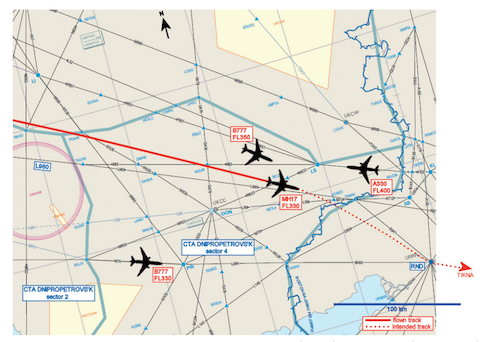
  • Three other commercial airliners, two 777s and an A330, were in the same general vicinity as flight MH17 at the time of the occurrence, with the closest aircraft about 30 km (18.6 miles) away.
  • The aircraft experienced an inflight breakup, with the wreckage falling to the right of the projected flight path of the airliner.
  • The penetration of the high velocity objects likely led to a loss of structural integrity, which in turn led to the inflight breakup.
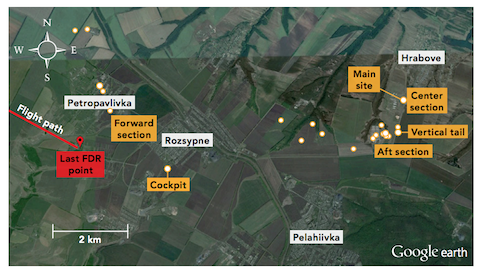
  • The cockpit was found about 2 km (1.25 miles) from the last position recorded by the FDR, and the main wreckage area about 8 km (5 miles) from the last recorded postion.
  • Damage in the cockpit area and forward fuselage was consistent with multiple high velocity projectiles penetrating the aircraft, with the source of those projectiles being above and outside of the aircraft.
  • The pattern of damage to the cockpit and forward fuselage was not consistent with the damage expected from any known failure mode of the aircraft, its engines, or systems.

What the preliminary report did not discuss
While it has been widely reported, both by the media and by a number of governments, that the aircraft was shot down by a surface to air missile, the Dutch Safety Board did not directly discuss the source of the high velocity projectiles that hit the aircraft. Also not mentioned in this preliminary report were the result of any forensic examinations of the passengers and crew members, or of any of the wreckage found on the site. Another key area not examined was how the government of Ukraine managed flight safety over a region of active military conflict.

Timeline of the final report
The Dutch Safety Board did not give a timetable for completing the final report, but given that the preliminary report stated that the wreckage should be examined further, this implies that the final report will be published only after the investigators regain access to the areas where the wreckage fell. At the time of the preliminary report was published, that area was still part of an active conflict zone.


Resources
Preliminary investigation report
Seven Todd Curtis interviews about flight MH17
Boeing 777 crashes
AirSafe.com MH370 page
Other AirSafe.com podcasts
Flight MH17 Wikipedia page
Crash rates by airliner model
AirSafe.com podcast home page
Listen to the podcast on TunIn


NTN 24 La Tarde interview (Spanish)


29 July 2014

Three airliner crashes in one week is not that rare

The recent loss of three airliners within a seven day span, starting with Malaysia Airliners flight MH17 on July 17th, has certainly drawn a large amount of attention from the world's media, the traveling public, and even from major aviation safety organizations.

In a 28 July 2014 article published by CNN, a representative of the Flight Safety Foundation, a nonprofit organization that since 1947 has provided safety guidance and resources for the aerospace industry, implied that with the exception of the 9/11 attacks, it was hard to know whether the loss of three airliners in seven days was unprecedented. A review of the AirSafe.com records revealed that this kind of loss has had a number of precedents within the last 20 years.

In a previous AirSafeNews.com article, a review of AirSafe.com records from 1996 to 2014 revealed that there were 25 occasions where there were three or more significant aviation events where the events were separated by 10 days or fewer.

Inspired by the statement from the Flight Safety Foundation, Todd Curtis reviewed AirSafe.com's records again, this time discover how many times the there had been three or more losses of airliners in no more than a seven day period, and where the following criteria were also met:

  • At least one passenger was killed in each aircraft,
  • The aircraft was either destroyed or seriously damaged and no longer flyable,
  • The aircraft had the capacity to carry at least 10 passengers, and
  • The airliner event could have been due to any cause, including hijacking, sabotage, or military action.

The review revealed that there were eight occasions during the 19 calendar years that AirSafe.com has been in operation (1996-2014), where three or more airliners have been lost within a seven day period. Below are the years and the dates of occurrence:

  1. 1997 - December 13, 15, 17, and 19
  2. 2001 - September 11, 12, and 18
  3. 2003 - January 8, 9, and 9
  4. 2008 - August 20, 24, and 24
  5. 2010 - May 12, 15, 17
  6. 2010 - August 24, 24, and 25
  7. 2011 - July 8, 11, and 13
  8. 2014 - July 17, 23, and 24

Noteworthy occurrences include the following:

  • In 1997, there were four separate events within seven days, and if an event on December 9th is included, five within 10 days.

  • In 2001, there were four airliners lost on 9/11, and one each in the two subsequent events

  • In 2010, if a fourth event on May 22 is included, there were four events in 10 days.

Given that the rate at which serious airline events occur has steadily decreased over the years, if this same analysis were done in the period prior to 1996, there would likely be a higher frequency of cases where three or more airliner were lost within a seven day span.


Fatal and serious events by year
1996, 1997, 1998, 1999, 2000
2001, 2002,2003, 2004, 2005
2006, 2007, 2008, 2009, 2010
2011, 2012, 2013, 2014

Related information
"Do plane crashes happen in threes" AirSafeNews.com article
Todd Curtis discusses his findings on the Rudy Maxa Show (6:44)
Related article from Patrick Smith of AskThePilot.com


AirSafe.com Bonuses
All subscribers to the AirSafe.com mailing list at subscribe.airsafe.com will be able to download free copies of all of the recent AirSafe.com books, including the latest, AirSafe.com Family Air Travel Guide.

Also available is the AirSafe.com Fear of Flying Resource Guide, with an overview of the symptoms of fear of flying, as well as recommended resources for managing or eliminating these fears.

24 July 2014

Do plane crashes happen in threes? - yes, and sometimes in fours and fives

Note:This an updated version of an article first published in February 2009

Since AirSafe.com was launched in 1996, the site has tracked fatal events and other significant events involving airline passengers. When these events occur, especially if two occur a just a few days apart, I sometimes get the "Do bad things like plane crashes always happen in threes?" question asked by visitors to the site, by members of the media, and by others.

I used to just dismiss the question out of hand because events like plane crashes, especially those involving passenger airliners, are very rare, and the circumstances are usually very different for each crash, often involving different airlines, different aircraft types, and even different countries.

Although it's easy to reject the original question, it is quite legitimate to ask a related question about how frequently groups of rare events occur over a relatively short period of time.

One day, just for fun, I turned the "things happening in threes" question into something that could be analyzed systematically using the information within AirSafe.com. I changed the general question into the following specific question: "How frequent are sequences of three or more fatal or significant aviation safety and security events where the time between events is ten days or less?"

For example, a sequence of three events could happen on the same day, or it could be over a period as long as 20 days, with a 10-day gap between the first and second event, and another 10-day gap between the second and third event.

The most recent sequence of three events took place over the course of seven days beginning with the crash of Malaysia Airlines flight MH17 on July 17th, followed by the crash of an TransAsia ATR airliner in Taiwan on July 23th, and ending with the crash of an Air Algerie MD83 in Mali on July 24th.

For the purposes of answering this question, I limited the data to those events that are regularly tracked by AirSafe.com. These would be plane crashes or other airline events that kill at least one passenger, or other events that AirSafe.com considers to be significant with respect to aviation safety or aviation security.

Multiple events due to the same cause (for example, the four crashes associated with 9/11) were treated as one event. Significant events that don't kill anyone sometimes attract more media attention than the average plane crash. The January 2008 ditching of a US Airways A320 in the Hudson River in New York was one example. It was very dramatic, it got a huge amount of media exposure, and no one was killed.

A review of the AirSafe.com records from 1996, the year AirSafe.com was launched, to July 2014 revealed some interesting facts:

  • With the exception of 2007, 2009, and 2013, every year since 1996 included at least one sequence of three fatal or significant events that were separated by no more than ten days. There was a sequence of five significant, but nonfatal, events in January 2008 (one of which involved Senator Barack Obama), and a sequence of eight events in 2010, seven of which involved fatalities.

  • There were 25 sequences of three or more events that were separated no more than ten days. One was a sequence of eight events, three were sequences of five events, five sequences had four events, and the other sixteen consisted of three events each.

  • Most of the fatal and significant events tracked from 1996 to the present were not part of any sequence of three or more events.

  • Well known fatal events that were a part of one of these sequences include the Swissair MD-11 crash in 1998, the Concorde crash in 2000, the August 2006 crash of a Comair jet, in Lexington, KY, the August 2008 crash of a Spanair MD83 in Madrid, and the July 2014 crash of Malaysia Airlines flight MH17.

  • Well known events that were not a part of one of these sequences include the ValuJet and TWA Flight 800 crashes in 1996, the Alaska Airlines crash in 2000, the four crashes associated with 9/11, and the March 2014 loss of Malaysia Airlines flight MH370.

  • For 16 of the past 19 calendar years (1996 to 2014), there has been at least one grouping of three or more fatal or significant events that occurred over a relatively short period.

  • No information has come about in the investigations of any of those events that indicates that there was any sort of connection among the crashes that were part of a sequence of three or more events, or that suggested that earlier events in a sequence made a later event more likely.

After reviewing the facts, I no longer say that plane crashes don't happen in threes. Since 1996, they have happened in sequences of three, four, five, and eight.

- Todd Curtis


Fatal and serious events by year
1996, 1997, 1998, 1999, 2000
2001, 2002,2003, 2004, 2005
2006, 2007, 2008, 2009, 2010
2011, 2012, 2013, 2014

Related information
26 July 2014 - Todd Curtis discusses his findings on the Rudy Maxa Show (6:44)
Related article from Patrick Smith of AskThePilot.com
Losing three airliners in one week is not that rare


AirSafe.com Bonuses
All subscribers to the AirSafe.com mailing list at subscribe.airsafe.com will be able to download free copies of all of the recent AirSafe.com books, including the latest, AirSafe.com Family Air Travel Guide.

Also available is the AirSafe.com Fear of Flying Resource Guide, with an overview of the symptoms of fear of flying, as well as recommended resources for managing or eliminating these fears.

19 July 2014

Seven Todd Curtis interviews about the crash of Malaysia Airlines flight MH17

In the immediate aftermath of the crash of a large airliner, there is typically an intense focus on the event by the world's media.

In the case of the crash in eastern Ukraine of Malaysia Airlines flight MH17; a Boeing 777 that was traveling between Amsterdam, Netherlands and Kuala Lumpur, Malaysia; there was ample circumstantial evidence that the jet was shot down by a surface to air missile, but this was not directly confirmed within the first two days after the crash.

The crash occurred in an area of active military activity in eastern Ukraine, and no official investigative bodies were able to examine the crash site or the aircraft wreckage. In spite of that situation, there was substantial video and photographic evidence that clearly indicated that the aircraft experienced a catastrophic inflight breakup prior to impact.

Todd Curtis of AirSafe.com was interviewed over a dozen times in the first 48 hours after the crash. Seven of those interviews, which were conducted from 17-19 July 2014, were compiled into the latest podcast episode from AirSafe.com.

The media organizations in the podcast episode included the following:

  • 17 July 2014
    - BBC World (TV)
    - BBC Five Live (radio)
    - NTN 24 La Tarde (see video below)
    - BBC WM 95.6 (radio)
  • 18 July 2014
    - CKNW Vancouver, BC (radio)
    - CJAD Montreal (radio)
  • 18 July 2014
    - CTV News Channel Canada (TV)

Resources
Seven Todd Curtis interviews about flight MH17
Boeing 777 crashes
AirSafe.com MH370 page
Other AirSafe.com podcasts
Flight MH17 Wikipedia page
Crash rates by airliner model
AirSafe.com podcast home page
Listen to the podcast on TunIn


NTN 24 La Tarde interview (Spanish)


26 June 2014

New search area for Malaysia Airlines flight MH370

26 June 2014, Canberra, Australia - Australian Deputy Prime Minister Warren Truss announced a new search area for Malaysia Airlines flight MH370. Based on a revised analysis of information from the aircraft and from the Inmarsat satellite, this new search area is several hundred miles away from the areas that were extensively searched from late April to late May of this year.

The highlights of today's announcement included the following:

  • The new primary search area is about 60,000 square kilometers, which is about the size of the state of West Virginia, or the nation of Norway.

  • The area to be searched is previously uncharted, and a three-month charting effort involving two ships is currently underway.

  • The underwater search effort will commence in August, and is expected to last 12 months.

Primary search area in orange lies southwest of earlier search areas in red, yellow, and green


Updated analyses refocused search area
To date, no physical or photographic evidence from the aircraft has been recovered from the surface or the bottom of the ocean, and Australian officials, who are in charge of the search effort, have concluded that acoustic signals that were the focus of the earlier underwater search during April and May of this year are unlikely to have been associated with the missing aircraft.

A new and more extensive analysis of data from the Inmarsat satellite, and analysis of the performance of the aircraft, led to the identification of the new search area.

The analysis team, which included satellite and aircraft specialists from Boeing, the NTSB, Inmarsat, and several other organizations, uses the limited data that was transmitted between the aircraft and the ground, radar and other flight data from the early part of the flight, and combined that information with the known behavior of the aircraft's systems, to determine the new search areas. The search areas were identified using the aggregate result of five independent analyses.

Satellite communications with the aircraft
The recently released report stated that after normal communications between the aircraft and the ground ceased, and after the last recorded radar contact with the aircraft, that there were nine satellite communications attempts either to or from the aircraft. Two were unanswered ground to air telephone calls, and seven were 'handshake' signals between the aircraft and Inmarsat. These signals consistent of short messages with no significant data about the aircraft speed, position, or status.

An analysis of the seven handshake signals allowed the authorities to estimate the distance the aircraft traveled. The timing of last transmitted handshake signal was consistent with a shutdown of the engine electrical generators due engine flameouts due to fuel starvation.

Additional insights into the investigation
Earlier in the week, on June 23rd, Todd Curtis of AirSafe.com was interviewed on CJOB radio in Winnipeg, Canada on the progress of the investigation. Part of the interview concerned recent statements by the Malaysian authorities that if the plane was lost by deliberate action, then the captain would be the main suspect.

Resources
26 June 2014 report from the Australian Transport Safety Bureau
29 May 2014 update from the Australian JACC
ATSB determination of search area
Ocean mapping effort
Satellite communications logs
Additional information from the Ministry of Transport
AirSafe.com MH370 page

Graphics: Australian Transport Safety Bureau

30 May 2014

11 weeks and counting in the search for MH370

30 May 2014 - It's been over 11 weeks since Malaysia Airlines Flight MH370 went missing, and it is likely that it will be two months or more before a search of the Indian Ocean for the missing 777 will resume. Among the recent highlights are the following:

  • The Malaysian government, specifically the Ministry of Transport, has released very detailed data about the information from Inmarsat that was used to narrow the search area.

  • While some recent media reports have cited unofficial sources that have suggested that acoustic signals heard several weeks ago were not from the aircraft (a discovery that led to an extensive underwater search in the area of the pings), there has yet to be any official announcement from the investigating authorities.

  • The Australian government has concluded that the search in the vicinity of the acoustic detections is complete, and that general area (about 850 square kilometers) is now being discounted as the final resting place of MH370.

  • The Australian government, which is leading the search for the aircraft on behalf of the Malaysian government, has suspended its active search for the aircraft, and is planning an extensive mapping effort of an area of the Indian Ocean that is about 60,000 square kilometers, or about the size of the state of West Virginia, or the nation of Sri Lanka.

  • The mapping effort will take about three months, and the Australia Transport Safety Bureau, which is leading the search effort, plans to resume the search for the aircraft in August.

Resources
29 May 2014 update from the Australian JACC
ATSB determination of search area
Ocean mapping effort
Satellite communications logs
Additional information from the Ministry of Transport
AirSafe.com MH370 page

01 April 2014

Key questions about the ongoing search for Malaysia Airlines flight MH370

1 April 2014 - As the search for flight MH370 enters the middle of its fourth full week, what is known about the flight is still greatly overshadowed by what is not known. The key unknowns are the location of the aircraft, and why it diverted from its planned destination. The search is concentrated in the southern Indian Ocean to the west of Australia, in an area that is roughly the size of Nicaragua or Pennsylvania, and so far no part of the aircraft has been recovered.


Search area from 31 March 2014


CTV television of Canada asked Dr. Todd Curtis a number of questions about the search and the investigation, and those questions and answers are below.

Australia has deployed an air traffic controller due to the crowded search for MH370. Why do you think they felt this was necessary?
There has to be some coordination of air traffic in the area. In spite of the large size of the search area, which at 120,000 sq km is about one quarter the size of the Yukon territory (and about the size of Greece or Pennsylvania), there exists the risk, however small, of midair collisions. Centralized coordination of the activities of the search aircraft may also enhance the effectiveness of the search.

Malaysia has been criticized for its handling of the search, and on Monday, the government changed its account of the final voice transmission from the cockpit. They told media the final words were ‘Good night Malaysian three-seven-zero’ not ‘all right, good night.’ Why do you think this is significant, and how is it possible Malaysia made an error like this?.
It is perplexing how such an error would be made. Like many, I'm waiting for a detailed explanation for this change from the Malaysian authorities. While the Malaysian government has released the transcript, I'm not aware of any release of the actual recording of the air to ground transmissions.

While it is normal procedure for accident investigation authorities to release only release relevant parts of a cockpit voice recorder (CVR) transcript and to not release the actual CVR audio, typically the audio content of air to ground communications with air traffic control would be freely available.

In fact, in many countries one can legally intercept and even rebroadcast such communications. The site liveatc.net routinely does this for dozens of airports around the world.

It’s been more than three weeks since the plane disappeared – are you surprised searchers haven’t been able to find a single piece of debris?
It is not surprising given that it was about two and a half weeks ago on March 24th (16 days after the aircraft went missing) that a general area of the southern Indian Ocean was determined to be the most likely area to find the aircraft, and on March 28th there was a refinement of that estimate that moved the search area to its current location.

In short, searchers have had only about five days to focus their efforts in the current search area. In spit of these delays, it is possible that debris has already been spotted from the aircraft, ships, and satellites employed in this search. However, confirmation that any piece of debris is from flight MH370 is a rather slow process that depends on the debris being brought back to Australia for analysis.

What about the black box on board – how much time is left to locate it?
Based on the Air France flight 447 experience, if the black boxes are relatively intact and the recording media is not damaged, they can be immersed in the sea for at least two years and still retain their data. It is unclear how much longer such devices could remain in the ocean before the data would be at risk.

There are so many countries involved in this search, including regional superpowers like India, global superpowers like China – have there been jurisdictional issues that have delayed the search/interfered with the process?
There do not seem to have been jurisdictional issues, in part because of a widely accepted framework (Annex 13 to the Convention on International Civil Aviation) which lays out the responsibilities nations have in the event of an airline accident or missing airliner. Specifically, if an aircraft is presumed lost outside of the jurisdiction of any of the signatory nations (in this case, the presumed location is in international waters), the country of registration, in this case Malaysia, has primary responsibility for the investigation.

There appears to have been management and coordination issues that have delayed the progress of the investigation. This is partly due to the nature of this event where it was necessary to use military information like radar data from several countries, and unconventional resources and procedures such as the analysis of data from communications and imaging satellites.

No one country had all of these resources under their direct supervision, so it is likely that there would have been delays in the process regardless of which nation was leading the investigation.

Winter is coming to the Southern hemisphere – what sort of challenges is that going to cause?
It is likely that search operations will be hampered by the rougher sea conditions and more challenging weather conditions that accompany winter in that part of the Indian Ocean. It would also depend on the progress made in the investigation by the time winter arrives, and on the kinds of resources used in the search and recovery effort. If parts of the aircraft have been identified at a specific location on the bottom of the ocean, documenting and retrieving the wreckage could potentially take place even in winter.


Related Resources


BBC radio interview from 13 March 2014 discussing the possibility that the aircraft continued to fly for several hours.


18 March 2014

Four plausible scenarios for Malaysia Airlines flight MH370

It has been more than 10 days since Malaysia Airlines flight MH370, a 777-200ER, deviated from its intended route during a flight from Kuala Lumpur, Malaysia to Beijing, China. Since then, no trace of the aircraft has been found, and the fate of the 227 passengers and 12 crew members is unknown. Some of the circumstances around the disappearance of the aircraft, especially the lack of any communication from the aircraft after it radically changed course, has led to speculation in the media and elsewhere about why the aircraft went missing.

Although there is currently no physical evidence from the aircraft or data from the cockpit voice recorder and flight data recorder (the black boxes) that can help investigators and the public understand what happened and why it happened, there is a substantial amount of other information, including radar data and data relayed from the aircraft to a satellite, that provide insights into the general kinds of situations that the crew may have had to deal with.

The investigation into the disappearance of the flight is still in the earliest phases, but that has not prevented the media and the public from speculating about what happened to the flight. While many possible scenarios have been put forth by the public and the media, some are much more plausible given the available evidence. Based on that evidence and a comparison with a number of past accidents, incidents, and acts of sabotage or hijacking; the following four scenarios are consistent with what is known about the behavior of the flight.

  1. Hijacking not involving the crew - One or more of the passengers hijacked the plane against the wishes of the flight crew and cabin crew.
  2. Hijacking involving the crew - One or more flight crew or cabin crew members hijacked the plane, possibly with the help of one or more hijackers from among the passengers.
  3. An extraordinary situation involving one or more aircraft systems - The deviations from the expected route and departures from normal procedures, including turning off transponders and other systems, could have been done by the crew in order to deal with a situation that put the aircraft at extreme risk. It is very likely in such a situation that a crew would exercise both initiative and creativity and take whatever steps were necessary, including disengaging, reconfiguring, or shutting down numerous systems, in order to maintain control of the aircraft.
  4. Inaction from the crew - The 777 has a complex flight control system that in some circumstances may be able to keep the aircraft in controlled flight without further input from the crew, even if no specific flight plan had been programmed by the crew, until the jet's fuel is exhausted.

Combinations of scenarios
It is possible that none of these general scenarios explain what happened. It is also possible that flight MH370 went through two or more of these scenarios, such as a hijacking followed by extraordinary attempts to regain control of the aircraft. Should additional information, specifically the information from the black boxes, become available, that information will likely clarify what actually took place.

Why would the crew not communicate with ATC? Pilots, no matter what kind of aircraft they may be flying, are taught to have three general priorities in an emergency. The first is to aviate, or to maintain control of the aircraft. The second is to navigate, which is to determine both one's location and intended flight path. The least important of these three priorities is to communicate, or to let someone else, including air traffic controllers or the cabin crew, know your plans or your needs.

The fact that the crew did not speak to air traffic controllers or to other aircraft after deviating from their flight plan could be do to many causes, including malfunctioning communications equipment or because they were not allowed to do so. It is also conceivable that there were attempts to communicate, but that no one heard them.

What is needed to understand this event Ideally, if the aircraft is recovered intact, and all of the crew and passengers are alive, there will be plenty of evidence from witness statements, black box data, and even from the personal electronic devices of passengers, and this evidence will likely answer all of the key questions surrounding this flight. However, even this ideal scenario won't include all of the relevant data because the cockpit voice recorder only records roughly the last two hours of cockpit conversations and radio communications, so there would be no recorded cockpit conversations from the early phases of the flight when the aircraft deviated from its flight plan.

If there are no crew or passengers available for interviews, it may become very important for the investigating authorities to recover as many potential recording devices such as tablets and mobile phones that may have been carried by passengers and crew members. These devices may provide direct or indirect evidence of what went on during the course of the flight.

Resources


BBC radio interview from 13 March 2014 discussing the possibility that the aircraft continued to fly for several hours.


NTN 24 La Tarde interview from 13 March 2014 discussing the investigation (Spanish)


14 March 2014

How far Malaysia Airlines flight MH370 could have flown

The search for the missing Malaysia Airlines continues, with recent evidence suggesting that the aircraft may have flown for at least four hours beyond its last known position. The following graphic published 14 March 20114 by the Washington Post illustrates the possible maximum range of the aircraft given the amount of fuel it had at takeoff (about seven hours worth), and the maximum range assuming four hours of flight after last contact.

This graphic illustrates several things that will give you an idea of just how difficult the search for this 777 may be:

  • Potential locations: Countries within a radius of four hours flying time (2,400 statue miles or about 3,900 km) include parts or all of Australia, Indonesia, Philippines, China, Taiwan, India, Bangladesh, Nepal, Palau, East Timor, and the Maldives Islands. Bodies of water include parts or all of the South China Sea, the Sea of Thailand, the Andaman Sea, the western Pacific Ocean, and the central and eastern Indian Ocean.
  • Potential size of the search area: A circle with a radius of 2,400 statue miles has a surface area about 18,095,600 square miles, or 46,847,250 square km, is an area slightly bigger than the combined surface areas of the US, Canada, Mexico, Australia, Brazil, and China.
  • Extent of search area: A circle with a 2,400 mile radius, has a 4,800 mile diameter, which is roughly the distance between the following city pairs:
    • Moscow and Washington, DC
    • Havana and Honolulu
    • Harare and Rio de Janeiro
    • Mumbai and the North Pole

Resources
Dr. Curtis 16 March 2014 Radio New Zealand interview (14:11)
Dr. Curtis 15 March 2014 BBC interview (8:58)
Dr. Curtis 13 March 2014 BBC interview (7:23)
Other 777 events


BBC radio interview from 13 March 2014 discussing the possibility that the aircraft continued to fly for several hours.

NTN 24 La Tarde interview from 13 March 2014 discussing the investigation (Spanish)


11 March 2014

Stolen passports and Malaysia Airlines flight MH370

The ongoing investigation into the disappearance of Malaysia Airlines flight MH370; a 777 that went missing about an hour after it departed from Kuala Lumpur, Malaysia for Beijing, China; continues to have a high level of media interest because no trace of the aircraft has yet to be found.

One of the leads that are being pursued by several authorities, including law enforcement agencies, was the use of stolen passports by two passengers.


These two men, Pouria Nour Mohammad Mehrdad, 19, and Delavar Syed Mohammad Reza, 29, are alleged by Malaysian authorities to have used stolen passports to board flight MH370


While there is no evidence that these two passengers had anything to do with the disappearance of the aircraft, it does raise questions about the use of stolen passports and the ability of authorities prevent passengers from traveling with false documents.

A member of the AirSafe.com audience provided some information that suggests that the the problem may be more widespread and insidious than just stolen passports. What follows are two alleged incidents of government officials offering passengers cash to engage in what were likely illegal activities.

Incident #1 - Offered $1,000 to carry two bottles
In 2011, this audience member, who was a citizen of India studying in Europe, was traveling from London to India. After arriving in New Delhi, an immigration officer asked him about his final destination. After learning that he was taking a domestic flight to another city in India, the immigration officer offered him the equivalent of $1,000 USD to carry a bag containing two bottles to his destination airport. He refused. Also, he was encouraged by friends and family to NOT report the incident to the police.

Incident #2 - Offered $4,000 to change travel plans
About two years ago, an acquaintance of the audience member was traveling on an international flight from Kuala Lumpur, Maylaysia to Kolkata, India, and at the immigration counter in Malaysia, an immigration officer offered this passenger the equivalent of $4,000 USD to travel to Taiwan rather than to India, and to deliver a pair of suitcases containing toys to someone in Taiwan.

In addition to the money, he was also a two-day stay at a resort in Taiwan. The Malaysian immigration officer also guaranteed that the passenger would get a passport with a Taiwan visa on it within a couple of minutes, which would have enabled that person to travel legally to Taiwan. This person also refused this offer.

If true, these incidents would imply that misuse of passports in air travel is not limited to criminals, but may also involve government officials entrusted with ensuring the safety and security of all airline passengers. The AirSafe.com audience member also shared some additional concerns about his experiences:

"I am not sure if immigration officers are checking the honesty of passengers or if there is a network which they are running to make more money. But after learning about some fake passport involved in the flight 370, I think it could have some potential relevance."

Resources
Dr. Curtis 16 March 2014 Radio New Zealand interview (14:11)
Dr. Curtis 15 March 2014 BBC interview (8:58)
Dr. Curtis 13 March 2014 BBC interview (7:23)


BBC radio interview from 13 March 2014 discussing the possibility that the aircraft continued to fly for several hours.