The AirSafe.com News

↑ Grab this Headline Animator

Showing posts with label mh17. Show all posts

09 September 2014

Preliminary report on the crash of flight MH17 released

Preliminary crash report
On 9 September 2014, the Dutch Safety Board, which at the request of Ukraine is heading the investigation, released their preliminary report about the crash. Because of the ongoing armed conflict in the area, the investigation focused on analysis of the information in the cockpit voice recorder (CVR) and flight data recorder (FDR), as well as information from photographs of the wreckage. Among the key findings and observations were:

  • The aircraft at the time of departure was in an airworthy condition with no known technical malfunctions.
  • There were no indications that either the CVR or FDR were altered.
  • Both the CVR and FDR stopped recording at the same time.
  • The last radio transmissions by the flight crew ended four seconds before the CVR and FDR stopped recording.
  • The aircraft was on a constant speed, heading, and altitude when the FDR stopped recording.
  • There were no indications of any technical or operation issue with the aircraft or the crew prior to the end of the CVR and FDR recordings.
  • Three other commercial airliners, two 777s and an A330, were in the same general vicinity as flight MH17 at the time of the occurrence, with the closest aircraft about 30 km (18.6 miles) away.
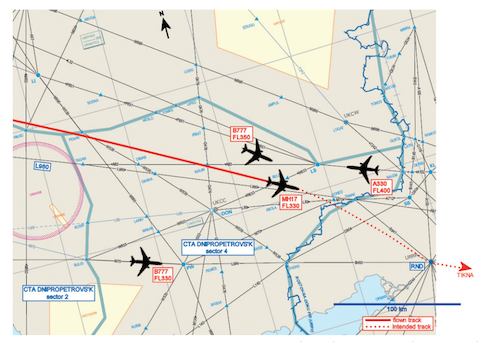
  • The aircraft experienced an inflight breakup, with the wreckage falling to the right of the projected flight path of the airliner.
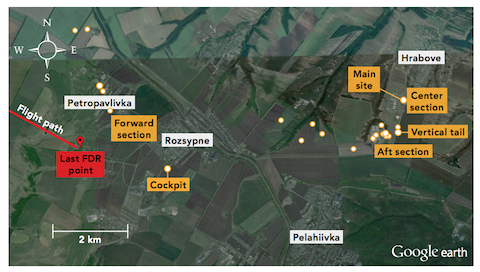
  • The penetration of the high velocity objects likely led to a loss of structural integrity, which in turn led to the inflight breakup.
  • The cockpit was found about 2 km (1.25 miles) from the last position recorded by the FDR, and the main wreckage area about 8 km (5 miles) from the last recorded postion.
  • Damage in the cockpit area and forward fuselage was consistent with multiple high velocity projectiles penetrating the aircraft, with the source of those projectiles being above and outside of the aircraft.
  • The pattern of damage to the cockpit and forward fuselage was not consistent with the damage expected from any known failure mode of the aircraft, its engines, or systems.

What the preliminary report did not discuss
While it has been widely reported, both by the media and by a number of governments, that the aircraft was shot down by a surface to air missile, the Dutch Safety Board did not directly discuss the source of the high velocity projectiles that hit the aircraft. Also not mentioned in this preliminary report were the result of any forensic examinations of the passengers and crew members, or of any of the wreckage found on the site. Another key area not examined was how the government of Ukraine managed flight safety over a region of active military conflict.

Timeline of the final report
The Dutch Safety Board did not give a timetable for completing the final report, but given that the preliminary report stated that the wreckage should be examined further, this implies that the final report will be published only after the investigators regain access to the areas where the wreckage fell. At the time of the preliminary report was published, that area was still part of an active conflict zone.


Resources
Preliminary investigation report
Seven Todd Curtis interviews about flight MH17
Boeing 777 crashes
AirSafe.com MH370 page
Other AirSafe.com podcasts
Flight MH17 Wikipedia page
Crash rates by airliner model
AirSafe.com podcast home page
Listen to the podcast on TunIn


NTN 24 La Tarde interview (Spanish)


29 July 2014

Three airliner crashes in one week is not that rare

The recent loss of three airliners within a seven day span, starting with Malaysia Airliners flight MH17 on July 17th, has certainly drawn a large amount of attention from the world's media, the traveling public, and even from major aviation safety organizations.

In a 28 July 2014 article published by CNN, a representative of the Flight Safety Foundation, a nonprofit organization that since 1947 has provided safety guidance and resources for the aerospace industry, implied that with the exception of the 9/11 attacks, it was hard to know whether the loss of three airliners in seven days was unprecedented. A review of the AirSafe.com records revealed that this kind of loss has had a number of precedents within the last 20 years.

In a previous AirSafeNews.com article, a review of AirSafe.com records from 1996 to 2014 revealed that there were 25 occasions where there were three or more significant aviation events where the events were separated by 10 days or fewer.

Inspired by the statement from the Flight Safety Foundation, Todd Curtis reviewed AirSafe.com's records again, this time discover how many times the there had been three or more losses of airliners in no more than a seven day period, and where the following criteria were also met:

  • At least one passenger was killed in each aircraft,
  • The aircraft was either destroyed or seriously damaged and no longer flyable,
  • The aircraft had the capacity to carry at least 10 passengers, and
  • The airliner event could have been due to any cause, including hijacking, sabotage, or military action.

The review revealed that there were eight occasions during the 19 calendar years that AirSafe.com has been in operation (1996-2014), where three or more airliners have been lost within a seven day period. Below are the years and the dates of occurrence:

  1. 1997 - December 13, 15, 17, and 19
  2. 2001 - September 11, 12, and 18
  3. 2003 - January 8, 9, and 9
  4. 2008 - August 20, 24, and 24
  5. 2010 - May 12, 15, 17
  6. 2010 - August 24, 24, and 25
  7. 2011 - July 8, 11, and 13
  8. 2014 - July 17, 23, and 24

Noteworthy occurrences include the following:

  • In 1997, there were four separate events within seven days, and if an event on December 9th is included, five within 10 days.

  • In 2001, there were four airliners lost on 9/11, and one each in the two subsequent events

  • In 2010, if a fourth event on May 22 is included, there were four events in 10 days.

Given that the rate at which serious airline events occur has steadily decreased over the years, if this same analysis were done in the period prior to 1996, there would likely be a higher frequency of cases where three or more airliner were lost within a seven day span.


Fatal and serious events by year
1996, 1997, 1998, 1999, 2000
2001, 2002,2003, 2004, 2005
2006, 2007, 2008, 2009, 2010
2011, 2012, 2013, 2014

Related information
"Do plane crashes happen in threes" AirSafeNews.com article
Todd Curtis discusses his findings on the Rudy Maxa Show (6:44)
Related article from Patrick Smith of AskThePilot.com


AirSafe.com Bonuses
All subscribers to the AirSafe.com mailing list at subscribe.airsafe.com will be able to download free copies of all of the recent AirSafe.com books, including the latest, AirSafe.com Family Air Travel Guide.

Also available is the AirSafe.com Fear of Flying Resource Guide, with an overview of the symptoms of fear of flying, as well as recommended resources for managing or eliminating these fears.

19 July 2014

Seven Todd Curtis interviews about the crash of Malaysia Airlines flight MH17

In the immediate aftermath of the crash of a large airliner, there is typically an intense focus on the event by the world's media.

In the case of the crash in eastern Ukraine of Malaysia Airlines flight MH17; a Boeing 777 that was traveling between Amsterdam, Netherlands and Kuala Lumpur, Malaysia; there was ample circumstantial evidence that the jet was shot down by a surface to air missile, but this was not directly confirmed within the first two days after the crash.

The crash occurred in an area of active military activity in eastern Ukraine, and no official investigative bodies were able to examine the crash site or the aircraft wreckage. In spite of that situation, there was substantial video and photographic evidence that clearly indicated that the aircraft experienced a catastrophic inflight breakup prior to impact.

Todd Curtis of AirSafe.com was interviewed over a dozen times in the first 48 hours after the crash. Seven of those interviews, which were conducted from 17-19 July 2014, were compiled into the latest podcast episode from AirSafe.com.

The media organizations in the podcast episode included the following:

  • 17 July 2014
    - BBC World (TV)
    - BBC Five Live (radio)
    - NTN 24 La Tarde (see video below)
    - BBC WM 95.6 (radio)
  • 18 July 2014
    - CKNW Vancouver, BC (radio)
    - CJAD Montreal (radio)
  • 18 July 2014
    - CTV News Channel Canada (TV)

Resources
Seven Todd Curtis interviews about flight MH17
Boeing 777 crashes
AirSafe.com MH370 page
Other AirSafe.com podcasts
Flight MH17 Wikipedia page
Crash rates by airliner model
AirSafe.com podcast home page
Listen to the podcast on TunIn


NTN 24 La Tarde interview (Spanish)