The AirSafe.com News

↑ Grab this Headline Animator

Showing posts with label accident. Show all posts

05 February 2016

This week in airline safety and security - 5 February 2016

First fatal airliner event of 2016
The February 2nd in-flight explosion on a Daallo Airlines A321 over Somalia led to the death of one passenger and was the first fatal airliner event of 2016. At present, the investigation into the explosion is ongoing, and the authorities in Somalia have not ruled out the possibility that the explosion was caused by a bomb.

Because of the nature of the event, and the ongoing challengers faced by the government of Somalia, there may not be a full and open investigation of the event. For a fuller description of the problems that the Somali government may have with the investigation, please read this recent article from AirSafe.com's Todd Curtis

A recent crash with many similarities to the Daallo event involved a MetroJet A321 last October.

This week's A321 event was the 13th time at least one airline passenger was killed on an A320 series aircraft.

Accident report from fatal AirAsia crash from December 2014 now available
The Indonesian government recently release their final report into the 28 December 2014 crash of an AirAsia A320 that killed all 155 passengers and seven crew members. The authorities concluded that a combination of system malfunctions and crew actions led to the crash.
Crash description and a link to the accident report

Laser encounter near Heathrow leads to arrest
Earlier this week, police near London's Heathrow airport arrested a man who allegedly pointed a laser at an aircraft. Laser encounters are a serious threat not only in the United Kingdom, but also in the United States, with over 20,000 laser encounters reported in the US between 2004 and 2014.

For a detailed look at the patterns of laser encounters in the US, as well as two Todd Curtis interviews with the BBC on laser threats to aircraft, please visit lasers.airsafe.com


Follow AirSafe.com
twitter.airsafe.com
facebook.airsafe.com
podcast.airsafe.com

Try out Uber and get up to $20 off your first ride

14 May 2015

Why the Amtrak train crash in Philadelphia is like a plane crash

The crash of Amtrak Northeast Regional Train 188 in Philadelphia, PA on May 12, 2015 involved an Amtrak passenger train, but in many ways this train crash was like a plane crash, specifically in the ways that the major US media outlets responded to the event. It is extremely rare for train crashes to generate intense media interest, but this kind of attention is routine for airline crashes. Upon closer review, the media response to the Amtrak crash is not so surprising.

Although it has only been a couple of days since the crash, the NTSB accident investigation team has revealed key details of the events that led to the crash. In short, it looks like the train was traveling just over 100 mph (161 kph), and derailed after entering a curve that had a 50 mph speed limit.

There were five crew members and about 240 passengers on board. Seven of those passengers were killed, and several dozen passengers and crew members were injured.


NTSB Board Member Robert Sumwalt at crash site

Amtrak accidents are common
While this accident has received the kind of attention usually given a major plane crash (for example, continuous coverage from major news networks that includes having news anchors at the crash site), Amtrak accidents are actually quite common. According to the Federal Railroad Administration, over the last decade, Amtrak has been involved with accidents and incidents that have resulted in over 1,000 deaths.


(Click to enlarge)

In the last three years, Amtrak has been involved in over 50 accidents per year, with 21 in the first two months of 2015.


(Click to enlarge)

Why this crash stands out
The circumstances around the Philadelphia crash that have led to an intense amount of media attention include where it happened, who was on the train, and perhaps more importantly, who is likely to travel by train on that route.

The crash took place on not only the most heavily traveled route in the Amtrak system, with over 12 million riders in 2011, it is also a route that connects New York City with Washington, DC, two metropolitan areas where many members of the US financial, political, and media elite live and work.

Many of the elite members of US society, even if they don't live or work in New York or Washington, have either traveled on that route on many occasions, or know friends, colleagues, or family members who do. A quick review of some of those killed in the crash can give you an insight into the kinds of people who regularly travel on this route. The dead include:

  • A tech company CEO
  • A software architect for a major news media organization
  • A US Naval Academy midshipman
  • A university dean
  • A senior vice president of a Fortune 100 company

Given the ongoing media coverage, it is very likely that the most influential business, political, and media decision makers throughout the US are not only keenly aware of the accident, but can also imagine circumstances where they could have been on that train that night. If it had been a jet airliner traveling between major cities in the northeast US, the airliner's passenger list would have likely reflected the profile of the people on that Amtrak train.

These are the reasons why the traveling public, especially the more influential members of the traveling public, may feel about this train crash the same way they would perceive a plane crash, as something that could happen to them.

Additional resources
Amtrak Northeast Corridor overview 2011

Graphics:
Federal Railroad Administration
National Transportation Safety Board

04 November 2014

NTSB provides timeline of SpaceShipTwo mishap

The following is an overview of the preliminary findings presented by the NTSB on the third day of their investigation.

During the fourth media briefing on the third day of the on site portion of the NTSB investigation of the crash of SpaceShipTwo, the most significant information provided by acting NTSB chair Christopher A. Hart was a general timeline of the events between the release of SpaceShipTwo from its mothership WhiteKnightTwo, and the loss of telemetry from SpaceShipTwo. In that roughly fifteen second span, a number of events occurred inside SpaceShipTwo:

  • SpaceShipTwo released from mothership WhiteKnightTwo at 10:07:19 PDT (17:07:19 UTC)
  • The rocket engine was ignited about two seconds later.
  • About eight seconds later, and 10 seconds after release, SpaceShipTwo was traveling at about Mach 0.94
  • Sometime during the next two seconds, the feather lock handle was moved from the locked to the unlock position by the person sitting in the right seat.
  • At about 12 seconds after release, the vehicle was traveling at Mach 1.02
  • The feathers began to deploy at about 13 seconds after release.
  • Telemetry and video data was lost about two seconds later, roughly 15 seconds after release.

In addition to the timeline, the NTSB stated that lightweight debris was recovered about 30-35 miles northeast of the main wreckage area, and it was not clear what role wind may have played in the distribution of that wreckage. Also, while there was clear evidence that the pilot in the right seat moved the feather lock handle, during the media briefing, Hart was not clear if it was the pilot or the copilot who did so.

Shortly after the media briefing, NTSB clarified its position on Twitter, stating that the copilot, who did not survive the mishap, was the person in the right seat who moved the lock/unlock handle into the unlocked position.

Additional resources
Initial NTSB SpaceShipTwo accident investigation
Review of first two NTSB briefings on 1 November 2014
Review of third NTSB briefing on 2 November 2014
Review of fourth NTSB briefing on 3 November 2014

03 November 2014

NTSB hints that SpaceShipTwo breakup was not related to an engine failure

The following is an overview of the factual data presented by the NTSB on the second day of their investigation.

During the media briefing on the second day of the NTSB investigation of the crash of SpaceShipTwo, acting NTSB chair Christopher A. Hart, reported on some of their early findings that implied that there was no fire, explosion, or other kind of breach or failure involving the engine, fuel tank, or oxidizer tank. Early evidence instead points to an un uncommanded deployment of the feathering system just prior to the loss of telemetry from SpaceShipTwo.

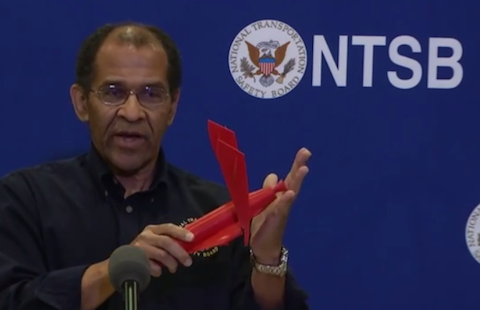
The feathering system on SpaceShipTwo allows the twin booms on the vehicle, referred to as the feathers, to rotate upward in order to provide more aerodynamic drag on reentry. They are intended to be deployed after the engine has shut down and prior to reentry. According the information provided at the briefing, deploying the feathers takes two actions from the flight crew. The feathering system has to first be unlocked before they can be deployed by moving the feather handle into the feathered position.

There is a feathering handle that moves the feathers into the feathered position. Based on video evidence from inside SpaceShipTwo, the copilot unlocked the system, but the system deployed without any crew input.


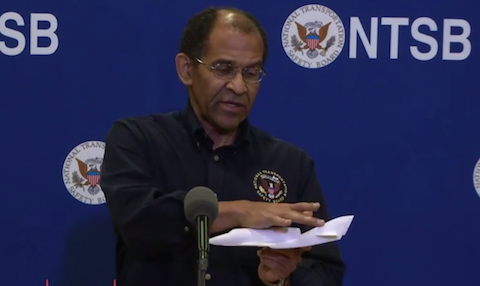
Model of SpaceShipTwo in unfeathered position

Model of SpaceShipTwo in feathered position


The sequence of events was roughly as follows:

  • After being released from its carrier aircraft, the crew of SpaceShipTwo ignited the rocket engine.
  • About nine seconds after engine ignition, telemetry data showed that the feather parameters changed from locked to unlocked.
  • Video from the cockpit showed that the copilot had unlocked the feathering system, and is consistent with the telemetry data.
  • About two seconds later, the feathers moved toward the deployed position even though the feather handle had not been moved into the feather position.
  • The feather deployment occurred at a speed just above Mach 1.
  • Shortly after feathering occurred, video data and telemetry data terminated.
  • The engine burn was normal prior to the deployment of the feathers.
  • Normal procedures would have had the crew unlocking the feathering system at a speed of about Mach 1.4.
  • Unlocking the feathering system alone should not have allowed the feathers to deploy.
  • The inflight breakup of the vehicle began sometime after telemetry ceased.
  • The NTSB has not determined if the inflight breakup was caused by aerodynamic forces or from some other cause.
  • The rocket engine, fuel tank, or oxidizer tank showed no evidence of a breach or burn through consistent with some sort of fire, explosion or structural failure affecting those components.

The NTSB emphasized that their statements were statements of fact rather than a determination of a cause of the mishap. Below is a video of the third media briefing.

Additional resources
Initial NTSB SpaceShipTwo accident investigation
Review of first two NTSB briefings on 1 November 2014
Review of third NTSB briefing on 2 November 2014

Note: An earlier version of this story inadvertently stated that there was evidence of a breach or burn on some components.

01 November 2014

Virgin Galactic SpaceShipTwo NTSB accident investigation

The NTSB is leading the investigation into yesterday's crash of Scaled Composites SpaceShipTwo north of Mojave, CA. Saturday November 1st was the first day of the investigation, and the NTSB has already had one one media briefing with a second planned for late in the evening.

The following is an overview of the crash and comments on the early media briefings.

31 October 2014; Scaled Composites; Model 339 (SpaceShipTwo); N339SS; near Cantil, CA: The vehicle, which is designed to fly into the lower reaches of space (above 100 km above Earth) was on its first powered test flight with a new engine fuel and oxidizer combination (nylon and nitrous oxide). SpaceShipTwo was dropped from its carrier vehicle at about 45,000 feet, and ignited its engine.

Roughly two minutes after release from the carrier aircraft White Knight Two, the SpaceShipTwo vehicle experienced an inflight breakup. One of the two crew members was killed, and the other was able to bail out of the vehicle and was injured.

Prior to the accident flight, there had been the 54 test flights of SpaceShipTwo, of which 34 involved a release from the carrier aircraft, including three powered flights.

Scaled Composites, which conducted the flight test, is a partner of Virgin Galactic, which had planned on using SpaceShipTwo to take passengers on suborbital trips into space in the near future.


Summary of first two NTSB briefings on 1 November 2014
Both NTSB briefing were given by acting NTSB chair Christopher A. Hart, was short, and provided the following preliminary information about the accident:

  • While the NTSB has previously participated in the investigations of the Challenger and Columbia Space Shuttle accidents, this will be the first time it has taken the lead role in the investigation of a crewed space launch vehicle accident.
  • The NTSB team consists of about 13-15 investigators and specialists in the areas of structures, including systems, engines, vehicle, performance, and operations.
  • The parties to the investigation are the FAA, Scaled Composites, and Virgin Galactic
  • The vehicle was flying in a southwesterly direction, and the wreckage field is about five miles (8 km) long, and is oriented from the northeast to the southwest.
  • The wreckage pattern indicates that an inflight breakup occurred, but the NTSB has not yet determined why this happened.
  • The left and right tail booms were near the beginning of the wreckage trail, followed by the fuselage, fuel and oxidizer tanks, cockpit, and the rocket engine.
  • There were a total of three tanks in the vehicle, a fuel tank, an oxidizer tank, and a methane tank.
  • The NTSB was unaware of the altitude of the mishap.
  • There was extensive video data available from the flight, including six cameras on SpaceShipTwo, another three on White Knight Two, one in a chase aircraft, and one on the Edwards AFB test range.
  • The NTSB does not know if the six cameras on board SpaceShipTwo have been recovered.
  • There were six data sources on SpaceShipTwo and about 1000 parameters of telemetry available from the flight. There was also a radar on the chase aircraft.
  • Interviews have been conducted, but NTSB will not reveal what has been discovered until later in the investigation.
  • The surviving pilot has not yet been interviewed because his doctors recommended against doing so at this time.
  • The NTSB does not know how the surviving pilot exited the vehicle.
  • The on scene portion of the investigation will continue for another four to seven days, and the full investigation will take about a year.
  • Scaled Composites can continue operations during the investigation.
  • News and updates to the investigation will be available at the NTSB's web site (www.ntsb.gov) Twitter feed (@NTSB).

Initial SpaceShipTwo NTSB briefings


Initial NTSB SpaceShipTwo briefings 1 November 2014

29 July 2014

Three airliner crashes in one week is not that rare

The recent loss of three airliners within a seven day span, starting with Malaysia Airliners flight MH17 on July 17th, has certainly drawn a large amount of attention from the world's media, the traveling public, and even from major aviation safety organizations.

In a 28 July 2014 article published by CNN, a representative of the Flight Safety Foundation, a nonprofit organization that since 1947 has provided safety guidance and resources for the aerospace industry, implied that with the exception of the 9/11 attacks, it was hard to know whether the loss of three airliners in seven days was unprecedented. A review of the AirSafe.com records revealed that this kind of loss has had a number of precedents within the last 20 years.

In a previous AirSafeNews.com article, a review of AirSafe.com records from 1996 to 2014 revealed that there were 25 occasions where there were three or more significant aviation events where the events were separated by 10 days or fewer.

Inspired by the statement from the Flight Safety Foundation, Todd Curtis reviewed AirSafe.com's records again, this time discover how many times the there had been three or more losses of airliners in no more than a seven day period, and where the following criteria were also met:

  • At least one passenger was killed in each aircraft,
  • The aircraft was either destroyed or seriously damaged and no longer flyable,
  • The aircraft had the capacity to carry at least 10 passengers, and
  • The airliner event could have been due to any cause, including hijacking, sabotage, or military action.

The review revealed that there were eight occasions during the 19 calendar years that AirSafe.com has been in operation (1996-2014), where three or more airliners have been lost within a seven day period. Below are the years and the dates of occurrence:

  1. 1997 - December 13, 15, 17, and 19
  2. 2001 - September 11, 12, and 18
  3. 2003 - January 8, 9, and 9
  4. 2008 - August 20, 24, and 24
  5. 2010 - May 12, 15, 17
  6. 2010 - August 24, 24, and 25
  7. 2011 - July 8, 11, and 13
  8. 2014 - July 17, 23, and 24

Noteworthy occurrences include the following:

  • In 1997, there were four separate events within seven days, and if an event on December 9th is included, five within 10 days.

  • In 2001, there were four airliners lost on 9/11, and one each in the two subsequent events

  • In 2010, if a fourth event on May 22 is included, there were four events in 10 days.

Given that the rate at which serious airline events occur has steadily decreased over the years, if this same analysis were done in the period prior to 1996, there would likely be a higher frequency of cases where three or more airliner were lost within a seven day span.


Fatal and serious events by year
1996, 1997, 1998, 1999, 2000
2001, 2002,2003, 2004, 2005
2006, 2007, 2008, 2009, 2010
2011, 2012, 2013, 2014

Related information
"Do plane crashes happen in threes" AirSafeNews.com article
Todd Curtis discusses his findings on the Rudy Maxa Show (6:44)
Related article from Patrick Smith of AskThePilot.com


AirSafe.com Bonuses
All subscribers to the AirSafe.com mailing list at subscribe.airsafe.com will be able to download free copies of all of the recent AirSafe.com books, including the latest, AirSafe.com Family Air Travel Guide.

Also available is the AirSafe.com Fear of Flying Resource Guide, with an overview of the symptoms of fear of flying, as well as recommended resources for managing or eliminating these fears.

13 December 2013

Review of NTSB Asiana flight 214 investigative hearing

On 11 December 2013, the NTSB conducted a day-long investigative hearing into the 6 July 2013 crash of Asiana flight 214 in San Francisco, featuring public testimony from representatives of Boeing, Asiana Airlines, and other organizations directly involved in the accident and the subsequent investigation. While the NTSB had previously released to the public substantial amounts of information about the accident, there was quite a bit more new material presented at the hearing.


For a summary of the hearing, listen to the Al Jazeera America interview featuring their transportation contributor Dr. Todd Curtis.


The amount of information presented at the hearing was noteworthy, as was the way that it was released. Like it has since the day of the accident, the NTSB has been very innovative in the way that it has used the Internet to get information very quickly to the public. This article describes some of the information presented in the hearing, and also points out some of the areas where the information released could be incomplete or misleading.

The purpose of the investigative hearing
The NTSB holds public hearings during major accident investigations for many reasons, among the most important is making the public aware of the progress of the investigation, and to focus attention on the key areas of the investigation. While the key parties involved in the investigation, most notably Boeing and Asiana airlines, provided testimony and answered detailed questions from NTSB Board members, they have all been closely involved with the investigation from the beginning, and have likely already provided the same information to the investigators.

The public testimony is more of an opportunity for the media and the general public, including accident victims and their families, to learn additional details of the investigation and to get an idea of where the investigation is heading.

What the NTSB discussed
The NTSB investigative hearing focused on five areas:

  1. Boeing 777 flight deck design concepts and characteristics
  2. Asiana pilot training on Boeing 777 automated systems and visual approach procedures
  3. Effects and influence of automation on human performance in the accident sequence
  4. Emergency response
  5. Airplane cabin crashworthiness and occupant protection.

The investigation is far from complete
The investigative hearing is only part of the accident investigation process, focusing on the factual aspects of what happened in the accident and the initial emergency response to the crash, as well as factors that may have played a role in circumstances that led up to the accident or that affected the emergency response.

Hearing testimony provided insights into the "what happened" kind of questions being asked by the NTSB, such as what was the sequence of events that occurred immediately before and after the accident, as well as insights into "why it happened" questions such as the kind of training provided to the flight crew on the accident aircraft. The latter parts of the investigation focuses on answering "why it happened."

Other "why it happened" type of questions may address issues or explain circumstances that happened days, months, or even years before the accident, and that may have led to the situations that allowed the accident to occur and that may have made deaths and injuries either more or less likely once the accident occurred. The hearing didn't fully answer all of the "what happened" and "why it happened" questions. Complete answers to these questions, and well as recommendations for changes and improvements, will likely not happen until the final report is published.

These recommendations, which are answers to "what should be done" questions, typically, but not always, get answered at the time the final report is published because much of the analysis of the accident happens after the NTSB and their investigative partners have had an opportunity to sort through information from a variety of sources. NTSB final reports have a similar organization, and typically have three sections; Findings, Probable Cause, and Recommendations, that are associated with the three kinds of questions mentioned earlier. The "Findings" section would answer the "what happened" questions, the "Probable Cause" section would answer the "why it happened" questions, and the "Recommendations" section would address the "what should be done" questions.

Key implied "what happened" questions
While the investigation is not complete, and other factual information may come to light later, the testimony provided in the hearing implied that the following scenario led to the crash:

  • Although the glideslope portion of the landing runway's instrument landing system was not operational, and the crew was vectored for a visual approach to the landing runway, the Asiana crew decided to used both the autothrottle and autopilot during their landing.
  • The autothrottle was being used to control airspeed, and the autopilot was being used to control the flight path.
  • During the latter part of the landing attempt, the crew disconnected the autopilot and manually adjusted the throttles, and this put the autothrottle in a mode where it was no longer controlling airspeed.
  • The crew continued the landing attempt, and the airspeed was decreasing, but did not take actions to increase the airspeed soon enough to avoid crashing short of the runway.

Key unanswered "why it happened" questions
Critical "why it happened" questions that were hinted at in the hearing, but not yet answered, include the following:

  • Why didn't the crew take corrective action sooner in the landing sequence?
  • Why did the crew use the autopilot and other cockpit automation in ways not recommended by Boeing?
  • Why did the Boeing training organization make certain assumptions about how much airline pilots know about how to use cockpit automation?

How this investigation was different
The Asiana crash was a high profile event, not only in the US, but also in South Korea, where Asiana is based, and China, which had a significant number of its citizens on the flight. The NTSB went to great lengths to accommodate the media interest in this investigation; as well as the public interest in the US, South Korea, and China; by doing the following:

  • Providing a streaming online video stream of the entire hearing,
  • Providing a real-time translation of the hearing in Mandarin Chinese and Korean,
  • Providing a simultaneous transcript in English of the proceedings,
  • Using social media, primarily Twitter, Flickr, and YouTube, to provide related photos,videos, and links to additional material.

While the NTSB has historically provided information freely to the public, until the advent of the Internet, it was very difficult for individuals to get access to the final reports or the supporting data behind their investigations. In recent years, and especially during the Asiana investigation, the NTSB has aggressively used social media like Twitter, Flickr, and YouTube to provide more information than ever before, with even fewer delays. While this level of openness has caused some friction in the past between NTSB and other aviation organizations, the amount and types of information provided by the NTSB during this hearing was consistent with their recent communications policies.

Issues with the NTSB's hearing information
While providing a live webcast, a real-time transcript, and simultaneous translations into other languages were very positive actions with respect to providing information, it is important to recognize that there are potential issues with this information that may limit its usefulness or lead to misinterpretations by the media or the public:

  • The transcript of the Asiana hearing was not completely accurate, so if someone requires an accurate transcription, that portion of that transcript should be compared to the appropriate portion of the video.
  • The webcast video of the hearing will be archived, but it is not clear if the original, somewhat flawed, transcript will also be archived, if there will be a revised transcript archived, or if the NTSB will not archive any transcript.
  • The participants in the hearing were provided with simultaneous translations of all the statements made during the hearing, and it is not clear if those translations were completely accurate. Some of the technical information provided in the hearing was both complex and subtle, and may not be completely understood even if the speaker and listener shared the same language. Some of the spoken testimony has accompanying presentation slides that would help understanding, and may be necessary to view those to make sense of the spoken testimony or the information in the transcript.

Dr. Todd Curtis interviewed by Al Jazeera America
Dr. Todd Curtis, transportation contributor for Al Jazeera America, was interviewed by John Seigenthaler about some of the issues discussed during the NTSB hearing.
Listen to the interview

Key NTSB Asiana investigation resources
Asiana flight 214 investigation main page
Asiana flight 214 accident docket
Asiana flight 214 investigative hearing transcript (archived by AirSafeNews.com)

Key NTSB social media resources
NTSB webcast archives
NTSB YouTube channel
NTSB Flickr photos
NTSB Twitter stream
NTSB RSS feeds
NTSB email subscriptions

Related AirSafeNews.com articles


Find out how to help Todd Curtis run the Boston Marathon at marathon.airsafe.com

05 December 2013

NTSB train crash investigation has lessons for future plane crash investigations

Normally, this site focuses on airline related safety and security events, but the NTSB investigation into the 1 December 2013 fatal derailment of a commuter train in New York is an exception because some of the recent developments in the investigation are quite relevant to how the NTSB would investigate future airline accidents.

The NTSB is best known for its investigations of airline accidents, but it also investigates accidents involving other modes of transportation, including rail accidents. NTSB Board Member Earl Weener, who is a former Boeing executive, is heading the investigation of the fatal 1 December 2013 crash of a Metro-North commuter train in New York, and part of that process includes involving relevant parties that provide technical expertise in support of the NTSB's investigation. During the early part of the investigation, the NTSB serves as the primary conduit of information to the media and the public on the progress of the investigation, and sticks primarily to factual information about the accident. Determination of probable causes, and the role of organizations and individuals in the accident typically happens much later in the investigation.

One of the parties invited to participate in this investigation was the Association of Commuter Rail Employees (ACRE), which represents Metro-North several categories of Metro-North employees. However, the NTSB abruptly removed ACRE from the investigation onm3 December 2013 after a representative of the union gave a series of briefings to the media where that representative discussed and interpreted information related to the ongoing investigation.

This is a very rare move for the NTSB, and one that underscores the importance that the NTSB places in adhering to its investigation process. If this had been an airliner accident investigation, the NTSB would have likely taken the same action. While news media organizations and other groups not directly involved in the investigation are free to speculate about the causes of an accident, parties that are part of the NTSB investigation don't have that option. There are many reasons for this, and perhaps the most obvious one is that publicly speculating about the causes of an accident is inappropriate before all of the relevant factual information about the accident has been analyzed.

Below is Earl Weener's NTSB briefing from 3 December 2013.


SOAR Fear of Flying offers $100 discount
The SOAR Fear of Flying program has a special extended Cyber Monday offer for you. From now until Friday December 6, 2013, save $100 on the most popular packages SOAR offers.You can save $100 from the normal $480 prices for the SOAR Program Package or the $595 Guaranteed SOAR Package. Please visit the SOAR special offer page for more information.

07 August 2013

Second NTSB update on Southwest 737 accident at LaGuardia

Earlier this week, the NTSB released a second update on the 22 July 2013 Southwest Airlines flight 345 landing accident at New York's LaGuardia Airport. The accident, which is being handled by the NTSB's Major Investigations Team, resulted in substantial damage to the aircraft.


Initial press release
The initial NTSB press release on 23 July 2013 stated that the jet's nose landing gear collapsed rearward and upward into the fuselage, damaging the electronics bay. The aircraft was also damaged from sliding over 2,000 feet (610 meters) before coming to rest off to the right side of the runway.

First investigative update
Key findings from the first NTSB investigative update released on 25 July 2013 included the following:

  • Evidence from video and other sources was consistent with the nose landing gear making contact with the runway before the main landing gear (this is the reverse of what happens in a normal landing).
  • Flaps were set from 30 to 40 degrees about 56 seconds prior to touchdown.
  • Altitude was about 32 feet, airspeed was about 134 knots, and pitch attitude was about 2 degrees nose-up approximately 4 seconds prior touchdown.
  • At touchdown, the airspeed was approximately 133 knots and the aircraft was pitched down approximately 3 degrees.
  • After touchdown, the aircraft came to a stop within approximately 19 seconds.

Second investigative update
Key findings from the second NTSB investigative update released on 6 August 2013 revealed additional information about the accident flight:

  • This was the first trip the flight crew had flown together and it was the second leg of the trip.
  • The first officer had previous operational experience at LGA, including six flights in 2013.
  • The captain had one previous flight into LaGuardia.
  • On approach into LaGuardia, the first officer was the pilot flying and the captain was the pilot monitoring.
  • The wind changed direction prior to landing, from an 11-knot tailwind when the aircraft was at 1,000 feet, to an 11-knot headwind at landing.
  • The aircraft had been cleared for an ILS approach on runway 4 (see diagram below).
  • The crew reported the airplane was on speed, course and glideslope down to about 200-400 feet.
  • At some point above 400 feet, there was an exchange of control of the airplane and the captain became the flying pilot and made the landing.
  • The NTSB has so far found no mechanical anomalies or aircraft malfunctions, and that a preliminary examination of the nose landing gear indicated that it failed due to stress overload.
  • The NTSB has collected five videos showing various aspects of the crash landing. The team will be analyzing these recordings as part of the investigation.


Photos: NTSB, Wikipedia

24 July 2013

NTSB launches investigation of Southwest Airlines LaGuardia accident

22 July 2013;Southwest Airlines 737-700; flight 345; LaGuardia Airport, New York, NY: The airliner, with 145 passengers and five crew members on board, was on a scheduled flight from Nashville, TN to New York, had a problem after landing which led to a collapsed nose landing gear and a runway excursion.


After the aircraft came to a stop in a grassy area adjacent to the runway, the occupants evacuated the aircraft using the emergency slides. Nine of the occupants were treated for minor injuries, and no one was serious injured or killed.

The NTSB has launched a formal investigation of this accident, and has already begun processing the information from the cockpit voice recorder and flight data recorder. While this is not a major investigation on the scale of what is happening with Asiana flight 214, this will be a more extensive investigation than what would normally happen after a typical landing gear accident. This is likely because of the level of damage caused by this event.

As can be seen in the photo below, the nose landing gear not only collapsed, it was also pushed up into the electronics bay beneath the cockpit.

Why so much media attention to this accident? While the response of the NTSB is typical for this kind of accident, the media response is not. While it did not garner the kind of nonstop coverage that happened on major cable news shows after the Asiana crash, it has two qualities that are often associated with high levels of media coverage of airline events:

  • It involved a major US airline, and
  • It occurred in New York, the most influential media market in the US, and arguably in the the entire English-speaking world.

The last point is possibly the most important since not only do many US news and broadcast media organizations have headquarters in New York, many of the people who work at those organizations use the airport where the accident occurred. Had the same event occurred at a US airport that was not in a major media market, it is unlikely that this event would have led to much media coverage.

Additional resources
Previous Southwest events

Photo: NTSB; Video: Bobby Abtahi

11 May 2013

FAA report raises questions about the oversight of maintenance repair stations

On 1 May 2013, the FAA Office of Inspector General office released a report (AV-2013-073) that detailed ongoing difficulties that the FAA has in overseeing the repair stations that provide airline maintenance services in the US and overseas. Like the airlines, organizations that provide FAA-approved repairs to airliner aircraft have to meet FAA regulatory standards.

While these organizations can be owned and controlled by an airline, increasingly these kinds of services, which could range from basic maintenance checks to complete aircraft overhauls, are being performed by contractors hired by the airliner rather than by an airline's own employees.

Based on a detailed study of a sample of certified repair stations in the US and elsewhere, Some of the key findings of the report was that while the FAA has invested significant efforts to create risk-based inspection procedures, those procedures are often ineffective, and in many cases inspectors don't even use the procedures when evaluating repair stations.

Aircraft maintenance responsibilities
Airlines are responsible for making sure that aircraft are maintained and repaired to the regulatory standards set forth by the FAA. Whether this work is done by the airline or an airline contractor, the organization doing the repairs has to do so according to FAA regulations. The FAA is responsible for making sure that the repair organizations meet FAA standards, and if they don't, the FAA is supposed to provide those organizations with guidance on how to stay in compliance.

Key issues raised by the report
According to the report, the ability of the FAA to fulfill their responsibilities has been hampered by the organization's lack of standardized processes, including missing or inadequate training of inspectors and not providing adequate guidance to repair stations.

What is a repair station?
The term 'repair station' refers to a maintenance facility that is certified by the FAA to perform maintenance, repair, inspection, overhaul, and alteration of aircraft and aircraft products. Not all repair stations are created equal, with only a small fraction of these stations authorized to maintain the kinds of large airliners used by most passengers.

Where the problems are
The report gives the impression that there is a serious problem with a wide range of reapir stations, and in fact that may be the case. However, the study looked at a very small sample of the repairs conducted by these repair stations.

As of September 2012, there were 4,788 total repair stations, of which 726 were outside the US. Of all of these repair stations, only 68 performed repairs on the kinds of aircraft that most US airline passengers may use.

The study covered the period from September 2008 to August 2011, and looked at documentation associated with work orders at 27 repair stations, of which 13 were outside the US. From these 27 stations, the FAA looked at a sample of 119 work orders from a population of 49,859 work orders.

How big is the problem?
The FAA found 57 errors within the 119 work orders studied. Further, after reviewing the tools and equipment at each facility and the 119 work orders, the FAA also found 92 of what they called "systemic deficiencies" at these 27 sampled repair stations. Based on their sample findings, the FAA estimated that from September 2008 to August 2011 there were deficiencies in about 37% of the estimated 589,573 work orders completed by the stations that the FAA inspects.

How does all this affect safety?
The answer is not clear for two reasons. First, because the definition of safety varies greatly depending on who you ask, and second, because the problems uncovered by the FAA do not necessarily imply that aircraft that are currently flying are being improperly repaired or that aircraft or their occupants are exposed to excessive risk or danger. The FAA study looked at documentation related to aircraft maintenance actions, and did not directly inspect the aircraft that were subject to the work orders that were reviewed.

One of the more popular safety measures used by the public is the number of airliner crashes that kill passenges. Using that measure, US airlines (specifically airlines offering passenger flights on aircraft operating under FAA Part 121 regulations) are experiencing the lowest ever number and rate of events causing airline passenger deaths, though maintenance-related issues still play a role in some crashes.

During the last ten years, there have been four events that have resulted in passenger deaths. One of those events was the December 2005 crash of a Chalk's Ocean Airways Grumman Turbo Mallard flying boat, where the NTSB cited FAA's failure to detect and correct deficiencies in the company's maintenance program as one of the probable causes. That maintenance would have taken place prior to the period covered by the latest FAA IG report.

Key definitions of risk and safety
While safety is a word that is often used to describe aviation situations involving potential harm, safety is not a concept that has a consistent definition. On the other hand, the concept of risk is much more well defined, and that concept can be used to help describe the situations uncovered by the FAA report. The FAA in its 2009 document FAA Risk Management Handbook (FAA-H-8083-2) has three key definitions that may help to clarify the key issues around the FAA Inspector General's report:

  • Risk - The future impact of a hazard that is not eliminated or controlled.
  • Risk Assessment - An approach to managing uncertainty. Risk assessment is a quantitative value assigned to a task, action, or event.
  • Risk Management - The part of the decision-making process which relies on situational awareness, problem recognition, and good judgment to reduce risks associated with each flight.

In short, in the eyes of the FAA, risk is something that can be objectively defined, measured, and managed. In contrast, safety may seem like a related concept, and in fact some key FAA documents like FAA Order 8040.4A (effective 30 April 2012) explicitly state that the terms safety and risk are used interchangeably. The findings of the FAA IG report clearly imply that the FAA maintenance oversight process allows a significant fraction of work orders to be improperly completed. Because of that, it increases the amount of maintenance-related risks in the system.

Is safety different from risk?
Safety and risk may be the same in the context of some FAA documents, but that is not the case for the average passenger or even the average aviation professional. In general, safety doesn't represent something objective and measurable like the FAA's definition of risk, but rather something subjective like the acceptance or tolerance of risk or uncertainty.

Risk can be defined differently for different situations, but it typically uses two key elements, a specific hazard and some kind of frequency or probability of occurrence. Safety on the other hand could be described as a level of acceptability of a hazard, or the frequency of that hazard occurring.

To use a crude example, since 1960, the risk of a fatality of one or more occupants during an intended space flight is about one per 100 flights. In contrast, the likelihood of a fatality on airline passenger flight on a large transport aircraft has far smaller than one per million flights. In spite of the reality of fatal accidents for both kinds of flights, anyone who decides to fly in the air or in space would not do so unless he or she first decided that it was safe to do so (that the risk is acceptable) before strapping in.

Different points of view on the FAA report
Several prominent aviation safety professionals have had a number of comments about the report, and when reading these comments, keep in mind that they were likely talking about both risk and safety, though not making the kind of distinction made by AirSafe.com.

  • John Goglia - This former NTSB board member with over 50 years of experience as a maintenance professional was quoted by USA Today on 6 May 2013 as saying that the discrepancies are a "major concern" because they mean that airlines aren't catching maintenance problems and the FAA isn't catching the airlines. Further, he said "That doesn't mean an airplane is going to fall out of the sky tomorrow, it means the system is broken."
  • Christian Klein - Vice president of the Aeronautical Repair Station Association, an organization representing aircraft maintenance stations, said in the same article that "Shortcomings at the FAA don't translate into safety deficiencies in the industry."
  • Rudy Quevedo - Director of global programs for the Flight Safety Foundation, was quoted in the same article as saying that "It's a perfectly safe system," but elsewhere he has also said that the problems identified need to be addressed as soon as possible to mitigate latent risk. Quevedo has also said that based on a standard risk management methodology of assessing probability and severity of what could happen because of the known deficiencies, that the problems, while serious, do not pose a "high level of danger" to air travel.

Quevedo's comments speak most directly to the way that the aviation industry may look at this situation. In the FAA Risk Management Handbook, there would be a high level of danger if the severity of the hazard were critical or catastrophic, combined with a likelihood that was occasional or probable. Based on the FAA IG report, it would appear that problems with work orders would be in the probable range of likelihood, but that the severity of the hazard is less than critical.

09 January 2013

What's wrong with the 787? - Hard to say for now

Earlier this week on January 7th, a Japan Airlines 787 at Boston's Logan Airport had a fire in the auxiliary power unit (APU) compartment of the aircraft, causing some damage to the aircraft and an injury to a firefighter. There was only a maintenance and cleaning crew on board, no passengers were injured, and as the NTSB photo below shows, there was relatively little fire damage in the APU compartment.


While most APU fires which cause minor damage don't usually merit much in the way of attention by either the news media or the NTSB, this event was different. The NTSB launched an investigation that included representatives from Boeing, FAA, Japan Airlines, and the Japan Transport Safety Board. This kind of involvement by multiple agencies usually happens for either accidents or very serious incidents. This was certainly not an accident as defined by the NTSB, but the NTSB's reaction implies that this is being considered to be a serious event, very likely for at least a couple of reasons:
  • The 787 had a number of prior incidents since entering passenger service last year, including an electrical problem that led to an emergency landing of a United 787 in New Orleans in December 2012, just a month after United began flying this aircraft model.
  • The 787 had a number of development issues that delayed commercial flights for several years.

This fire very likely heightened public attention for the 787 and led to a couple of minor incidents getting a higher than usual amount of national and international media attention. On January 8th, the day after the APU fire at Boston, another Japan Airlines 787, also at Boston, had a minor fuel problem that delayed a flight. About 40 gallons of fuel leaked from the aircraft. This leak was from a vent designed to release fuel rather than from a broken fuel line or some other system malfunction. The plane departed for Japan later that day.

The following day, on Janury 9th, ANA airlines in Japan, which was the first airline to operate the 787, cancelled a flight after the crew received an error message concerning the braking system. These last two events are so minor that the airlines are not required to report them to the FAA, NTSB, or similar civil aviation authorities in other countries.

Why is this happening to the 787?
Boeing's development of the 787 was different in two significant ways from that were a significant departure from previous large passenger jets. The first difference was the extensive use of composite materials for major components of the aircraft structure, and the second was the extensive use of contractors to design and build major aircraft systems, work that previously had been by Boeing.

Neither of these facts explain why these incidents have occurred. While many of the incidents that have occurred have involved the 787 fuel and electrical systems, there is nothing to directly several recent 787 incidents, including the following:

  • An electrical problem that forced the December 2012 emergency landing, along with a related electrical problem found later in another United 787.
  • A grounding of a Qatar 787, also in December 2012, after finding a similar electrical problem.
  • A July 2012 engine failure during a taxi test of newly manufactured 787
  • A December FAA Airworthiness Directive (AD 2012-24-07) requiring 787 operators to inspect part of the engine fuel system for possible improper installations.

What does this mean for passengers?
Unless the NTSB, FAA, Boeing, or the current 787 operators find something significant that may affect the safety of the 787, the recent events, however dramatic, are not a cause for concern. The 787 is a new aircraft model that currently has fewer than 50 aircraft in service, with over a third of the aircraft being delivered only in the past three months, and with six of the eight operators having fewer than six months experience flying this model. The first commercial flight was in October 2011, and Japan Airlines only began flying the aircraft in April 2012.

The recent NTSB investigation may have been launched in part because it is a new model and because there may be useful insights gained from thoroughly investigating incidents such as the Boston APU fire. As operators around the world gain more operational experience with the 787, there will certainly be more incidents. However, unless several of these incidents have one or more causes that are both related and unexpected, there would be real reason to suspect that the 787 has some sort of issue that is exposing passengers and crews to excessive safety risks.

Is it safe to fly on the 787?
If you define safety as an acceptable risk, then the 787 is safe to fly because there is nothing that currently indicates that the 787 has a much greater likelihood of experiencing safety-related problems compared to other large jet airliners. However, that answer may change as a result of the current NTSB investigation or after the airlines flying the 787 gain greater operational experience.


05 January 2011

AirSafe.com's airline safety review for 2010

This 15th annual review discusses 10 fatal airline crashes and 14 other significant events from 2010. While the overall rate of fatal and serious airliner crashes remains relatively low, 2010 saw an increase in fatal passenger airline crashes and other serious crashes compared to 2009, which had eight fatal airline crashes and 10 other noteworthy aircraft safety events. While the US and Canada account for about 60% of the world's airline flights last year, none of the fatal passenger airliner crashes involved an air carrier based in North America, though one of the other noteworthy events involved a US cargo airline.

While fatal crashes such as the crash of a military jet that killed the President of Poland, and a passenger airliner crash that had a single survivor were intensely covered by the world's major media organizations, perhaps the more notable airline safety or security event during 2010 had nothing to do with the risks passengers face when flying, but the risks passengers face when they submit to screening by the TSA, specifically the put-down procedures that the TSA implemented in late October to supplement their use of full body scanners. Several aspects of this policy and the public's negative reaction were covered in detail by AirSafeNews.com, from questions about whether the TSA was hiring convicted rapists, to suggestions on what passengers can do to change TSA policy, and a review of the public's responses to TSA policies.

Although AirSafe.com's primary focus is on those events that involved deaths of passengers on large airliners, the site's annual list of fatal or signifiant crashes includes both airline and non-airline events. There were ten events in 2010 that led to airline passengers fatalities, with the most catastrophic being a May crash of an Air India Express 737-800 that killed 158 of the 166 aircraft occupants. The full list is below:
  1. 25 January 2010; Ethiopian Airlines 737-800; Flight 409; near Beirut, Lebanon: The aircraft was on a scheduled international flight from Beirut, Lebanon to Addis Ababa, Ethiopia, and crashed into the Mediterranean Sea shortly after takeoff. All 82 passengers and eight crew members were killed.
    More information on the Ethiopian Airlines Crash
    Initial AirSafeNews.com report on this event
    Other 737 plane crashes

  2. 12 May 2010; Afriqiyah Airways; A330-200; Flight 771; near Tripoli, Libya: The aircraft was on a scheduled international flight from Johannesburg, South Africa (JNB) to Tripoli, Libya (TIP) with 93 passengers and 11 crew on board. The aircraft crashed short of the runway during its landing attempt. All 11 crew members and 92 of the 93 passengers were killed. The sole survivor was a 10-year-old Dutch boy.
    More Crash Details
    Fatal Events for Airlines from Africa and the Middle East
    Plane Crashes with a Sole Survivor
    Other A330 Plane Crashes
    Afriqiyah Airways Wikipedia page

  3. 22 May 2010; Air India Express; 737-800; flight 812; Mangalore, India: The aircraft (VT-AXV) was on a scheduled international flight from Dubai, UAE, to Mangalore, India, arriving just after 6 a.m. local time. The aircraft landed on one of the runways at Mangalore airport, but was unable to stop on the runway. There were reportedly six crew members and 167 passengers and on board, including four infants. Early reports indicate that there were at least six survivors.
    More details on this accident

  4. 28 July 2010; Airblue; A321-231; flight 202; near Islamabad, Pakistan: The aircraft (AP-BJB) was on a scheduled domestic flight from Karachi to Islamabad, Pakistan when it crashed during approach in a hilly area near the airport. The aircraft was completely destroyed in the crash, and all 146 passengers and six crew members were killed. The crash occurred at 9:45 am local time, and there was rain in the area at the time of the crash.
    More details on this Airblue crash
    Wikipedia page about the crash
    Wikipedia page about AirBlue

  5. 16 August 2010; Aires Colombia; 737-700; HK-4682; San Andres Island, Colombia: The airliner was on a scheduled domestic flight from Bogota to San Andreas Island, Colombia. San Andreas Island lies off the east coast of Nicaragua. The aircraft took off from Bogota just after midnight and was attempting to land just before 2 a.m. local time during a storm. The aircraft was reportedly struck by lightning just before touchdown. The airplane struck the runway and broke up into three large pieces. One of the 125 passengers was killed, and all six crew members survived.
    More on this event

  6. 24 August 2010; Henan Airlines; ERJ-190; B-3130; flight VD8387; Yichun, China: The aircraft was on a scheduled domestic flight from Harbin to Yichun, China. The aircraft broke up and caught fire after it overran the runway after landing. At the time of the crash, there was fog in the area and limited visibility. The aircraft carried five crew members and 91 passengers, and 43 of the occupants were killed. At least one flight crew member survived.
    Other Embraer plane crashes
    Other plane crashes involving airlines from China

  7. 24 August 2010; Agni Air; 9N-AHE; Dornier 228-200; near Shikharpur, Nepal: The aircraft was on a domestic flight from Kathmandu to Lukla, Nepal. Due to weather conditions at Lukla, the aircraft was returning to Kathmandu, but crashed near Shikharpur, Nepal, about 50 miles (80 km) from Kathmandu. All three crew members and 11 passengers were killed.

  8. 13 September 2010; Conviasa ATR 42-320; YV1010; Flight 371; Puerto Ordaz, Venezuela: The aircraft was on a scheduled domestic flight from Porlamar to Puerto Ordaz, Venezuela. It crashed into an industrial area just short of the destination airport. There were 17 fatalities among the 47 passengers and four crew members.

  9. 4 November 2010; AeroCaribbean; ATR 72-212; CU-T1549; Flight 883; near Guasimal, Sancti Spiritus Province, Cuba: The aircraft was on a domestic flight from Santiago to Havana, Cuba. The crew reported an emergency situation shortly before the aircraft crashed in mountainous terrain. All seven crew members and 61 passengers were killed.
    Additional crash details

  10. 4 December 2010; Dagestan Airlines (also known as South East Airlines); Tu154M; RA-85744; flight 372; Moscow, Russia: The aircraft was on a scheduled domestic flight from Moscow to Makhachkala, Russia. The aircraft departed from Moscow's Vnukovo Airport, and about eight minutes later, while the aircraft was climbing through an altitude of about 6,500 m (21,000 ft), there were reportedly problems involving the fuel system. When the aircraft was about 80 km away from the departure airport and at about 9,000 m (29,000 ft) altitude, two of the three engines flamed out and the crew elected to divert to Moscow's Domodedovo Airport. The aircraft experienced a hard landing near the runway, and broke up after striking a large earthen mound beyond the end of the runway. Two of the 160 passengers were killed, and all nine crew members survived.
    Additional details on the crash
    Other Russian airliner crashes

Other Noteworthy Events
AirSafe.com highlighted 14 other noteworthy events in 2010, including a crash that killed the President of Poland and a number of other high level Polish leaders. While some of these events resulted in fatalities, and others involved airliner aircraft normally tracked by AirSafe.com, none of these crashes are a fatal event as defined by AirSafe.com, and are included because of the seriousness of the events or because of other issues that may be highlighted by the crash.
  1. 10 April 2010; Polish Air Force Tu154, near Smolensk, Russia:
    The president of Poland, Lech Kaczynski, was killed, along with his wife and numerous Polish officials, when their aircraft, a Polish Air Force Tupolev 154M, crashed near Smolensk, Russia. The flight, took off from Warsaw with 88 passengers and eight crew members and crashed during its approach to Smolensk air base. All on board were killed.
    More details about this event

  2. 13 April 2010; AeroUnion A300B4-200; XA-TUE; Flight 302; Monterrey, Mexico: The aircraft was on a domestic cargo flight from Mexico City to Monterrey, Mexico and was destroyed when it crashed on a roadway about two kilometers from the destination airport. All five crew members were killed, as were two people on the ground.

  3. 19 April 2010; Southwest Airlines 737-700; flight 649; Burbank, CA: The airliner, with 119 passgengers and a crew of five on board, nearly collided with a Cessna 172 at Burbank Airport in California. Flight 649 was inbound from Oakland to the Burbank airport (also known as Bob Hope Airport) and was landing to the east on runway 8 while the Cessna 172 had just taken off to the south from runway 15, passing over the 737 at the intersection of the two runways. The two aircraft came within 200 feet vertically and 10 feet laterally of each other at the runway intersection. At the time of the event, skies were clear with 10 miles of visibility. No one on either aircraft was injured and neither aircraft was damaged.
    Fatal midair collisions
    AirSafeNews.com report of this event

  4. 15 May 2010; Blue Wing Airlines; Antonov An28; eastern Suriname: The aircraft was on a scheduled domestic flight between Godo Holo to Paramaribo, Suriname. The aircraft crashed in a wooded area in eastern Suriname. Both crew members and all six passengers were killed. This is the third time that a Blue Win An28 has been destroyed in a crash. One of the crashes in April 2008 also killed everyone on board.
    Wikipedia page on this airline

  5. 17 May 2010; Pamir Airways; Antonov An24B; flight 112; near Salang Pass, Afghanistan: The aircraft (YA-PIS) was on a scheduled domestic flight between Kunduz to Kabul, Afghanistan. All contact with the aircraft was lost about 10 minutes after departure, and it is presumed to have crashed in the Salang Pass area, which lies around 100 km (60 miles) north of Kabul and at an altitude of about 13,350 feet. Heavy fog was reported in the area at the the time. All five crew members and 38 passengers are missing and presumed dead. This was the first major crash for this airline.
    Wikipedia page on this crash

  6. 16 June 2010; United Express; Embraer E145; flight 8050; Ottawa, Canada: United Express 8050, a nonstop flight from Washington's Dulles airport to Ottawa's Macdonald-Cartier airport, landed on runway 7, was unable to stop on the runway, coming to rest about 150 meters off the end of the runway. It was raining at the time of the accident.

    One witness claimed that the aircraft was hydroplaning on the runway, and a second witness who was monitoring air traffic control communications reported that the pilot told the control tower he had no traction on the wet runway.

    The nose landing gear appears to have collapsed, although the rest of the aircraft appears intact. There was no post crash fire. Both pilots and one passenger was injured. The other 32 passengers and the flight attendant were not injured.
    More deatails on this accident

  7. 20 July 2010; United Airlines; 777-200; flight 967; over Kansas: The aircraft was on a scheduled domestic flight from Washington, DC (IAD) to Los Angeles (LAX) when it diverted to Denver, CO (DIA) after apparently experiencing significant turbulence while flying at 34,000 feet over Kansas.

    According to United, the aircraft had 255 passengers and 10 crew members. FAA spokesman Ian Gregor in Los Angeles said 26 passengers and four crew members were injured, and that one person was critically hurt, though no additional details were provided about the most seriously injured person. Local media reported that 21 people were transported to Denver area hospitals.
    More deatails on this incident

  8. 27 July 2010; Lufthansa; MD-11F; flight 8460; Riyadh, Saudi Arabia: The aircraft was on a cargo flight from Frankfurt, Germany to Riyadh, Saudi Arabia had a landing accident that fractured the fuselage. The two crew members survived. This plane crash was a cargo flight without passengers, and is not a fatal event as defined by AirSafe.com, but is included because of the seriousness of the event.
    Lufthansa plane crashes

  9. 28 July 2010; US Air Force; C-17; near Anchorage, AK: The aircraft had taken off from Elemendorf AFB near Anchorage, Alaska and crashed during a local training mission. The aircraft came down in a wooded area about two miles from the runway. All four on board were killed. The aircraft and crew were based at Elmendorf. This was the first fatal crash involving the USAF C-17, also known as the Globemaster III. In two previous incidents, a C-17 sustained engine damage after being struck by a surface to air missile in Iraq in 2003, and last year a C-17 had a gear up landing in Afghanistan.

  10. 9 August 2010; de Havilland DHC-3T Otter; near Dillingham, AK: Former Alaska Senator Ted Stevens was one of five people killed when an turbine engine, float equipped Otter crashed into steep terrain during a flight from nearby Lake Nerka to a fishing lodge in the Dillingham, Alaska area. The pilot and four passengers, including Stevens, were killed, and four other passengers were injured. One of the survivors was former NASA administrator Sean O'Keefe. Coincidentally, the pilot who was killed in this crash was the father-in-law of one of the C-17 pilots killed the previous month near Anchorage, AK.

    This was not the first fatal plane crash in Alaska involving Senator Stevens. In December 1978, the Senator was one of two survivors of a fatal crash of a Learjet in Anchorage, Alaska. Both pilots and three other passengers, including the Senator's first wife, were killed in the crash.
    Other crashes involving US political figures

  11. 25 August 2010; Filair; Let 410; 9Q-CCN; Bandundu, Democratic Republic of Congo: The aircraft was on a scheduled domestic flight from Kinshasa to Bandundu, and during its approach to Bandundu it crashed into a house about a mile from the airport. All three crew members and 18 of the 19 passengers were killed.
    Sole survivor plane crashes
    Wikipedia entry about this event

  12. 3 September 2010; United Parcel Service (UPS); 747-400F; flight 6; Dubai, United Arab Emirates: The aircraft was on an international cargo flight from Dubai, UAE to Colonge, Germany, and crashed shortly after takeoff about 10 km (6.2 mi) north of the airport. The two crew members were killed. The only previous fatal crash of a 747-400 was a 2000 crash of a Singapore Airlines in Taipei, Taiwan.
    Other UPS plane crashes
    Other 747 plane crashes

  13. 7 September 2010; Alrosa Mirny Air Enterprise; Tu154M; RA-85684; flight 514, Izhma, Russia: The aircraft was on a scheduled domestic flight from Udachny to Moscow, Russia. While en route at about FL347 near over Usinsk, Russia, the aircraft experienced a complete electrical failure that resulted in a loss of navigational equipment, fuel pumps, and flaps. The crew was able to make a successful emergency landing on an abandoned runway at the Izhma, Russia airport. None of the nine crew members or 72 passengers were injured.
    More details on this accident
    Russian airliner crashes

  14. 15 December 2010; Tara Air; DHC-6 Twin Otter; 9N-AFX; Palunge Hill, Nepal: The aircraft was on a domestic flight from Lamidanda to Kathmandu, and crashed into Palunge Hill while en route to its destination. The crew reported an emergency situation shortly before the aircraft crashed in mountainous terrain. All three crew members and 19 passengers were killed. Tara Air is a subsidiary of Yeti Airlines
Fatal and serious events by year
1996, 1997, 1998, 1999, 2000, 2001, 2002,2003
2004, 2005, 2006, 2007, 2008, 2009, 2010

17 June 2010

United Express Flight Crash in Ottawa Injures Three

16 June 2010; United Express; Embraer E145; flight 8050; Ottawa, Canada: United Express 8050, a nonstop flight from Washington's Dulles airport to Ottawa's Macdonald-Cartier airport, landed on runway 7, was unable to stop on the runway, coming to rest about 150 meters off the end of the runway. It was raining at the time of the accident.

One witness claimed that the aircraft was hydroplaning on the runway, and a second witness who was monitoring air traffic control communications reported that the pilot told the control tower he had no traction on the wet runway.

The nose landing gear appears to have collapsed, although the rest of the aircraft appears intact. There was no post crash fire. Both pilots and one passenger were injured. The other 32 passengers and the flight attendant were not injured.

The Transportation Safety Board of Canada is conducting an accident investigation, with the assistance of the NTSB.

About the ERJ-145
The Embraer ERJ-145, along with the similarly designed ERJ-135 and ERJ-170, were involved in three previous crashes during passenger flights, and none have resulted in any fatalities. In 2006, an ERJ-135 operating as an executive aircraft was involved in a midair collision with a Gol Linhas Aereas 737-800 over the Amazon in Brazil. The ERJ-135 was able to land and none of the occupants were injured. However, the 737 crashed and all six crew members and 148 passengers were killed.

About United Express
There have been three crashes involving United Express aircraft that have killed passengers, with the most recent being in 1996. None of them involved an aircraft operated by Trans States. The NTSB database also lists about 35 previous incidents and accidents involving United Express.

About Trans States
Trans States airlines, which has been operating under its current certificate since 1988, currently has a fleet of about 28 Embraer 145 aircraft. Prior to this accident, the NTSB lists four previous serious incidents involving Trans States. In the past, it has operated as a regional affiliate of a number of larger airlines including Delta (Delta Connection>, Northwest Airlines (Northwest Ailink), TWA (Trans World Express), United (United Express), and US Airways (US Airways Express).

08 January 2010

American Airlines Flight 331 Accident Investigation Update Released by Jamaican Authorities


As the investigation into the 22 December 2009 crash of American Airlines flight 331 enters its third week, the Jamaican authorities leading the investigation have provided extensive details about the circumstances of the accident.

Weather Conditions and Alternate Airports
The aircraft landed in Kingston, Jamaica in heavy rain about two hours after taking off from Miami, Florida. The crew chose to land with a tailwind, even after air traffic controllers advised them that the runway was wet and offered the crew an option that would have allowed the aircraft to land with a headwind.

The aircraft had sufficient fuel on board to reach its alternate airport at Grand Cayman Island.

Landing Speeds
The aircraft landed slightly below its permitted landing weight and with an airspeed of 148 knots (170 mph). However, because of the 14 knot tailwind, groundspeed was 162 knots (186 mph). The landing gear made contact with the runway about 4,000 feet down the 8,900 foot runway. The flight data recorder also showed that the aircraft bounced once before settling down on the runway, which further reduced the amount of remaining runway.

Aircraft Braking and Runway Overrun
Autobrakes deployed, and the crew was able to engage reverse thrust and spoilers, and also used maximum braking, but in spite of this, the aircraft veered to the left of the runway centerline and departed the end of the runway at a ground speed of about 63 knots (72 mph). The aircraft went through a fence and crossed a road before coming to rest on a beach about 175 feet (53 meters) beyond the end of the runway, and about 40 feet (12 meters) from the sea.


Aircraft and Airport Systems Normal Before Landing
The flight data recorder did not indicate any malfunctions or other anomalies with the brakes, spoilers, or thrust reversers, and that braking was normal given the wet runway and the autobrake setting. The fuselage was broken into three major pieces, and the right engine, right main landing gear, and parts of the right wing separated from the aircraft. Other than the crash related damage, no mechanical problems have been found with any part of the aircraft, and ground based navigation and landing aids were operating normally.

Other Accident Information
While the Jamaican authorities are running the investigation, the NTSB and other US organizations and companies are providing assistance. The aircraft wreckage will be shipped to the US and may be examined again later in the investigation.

The interim report did not provide any probable causes for the accident, and the runway has not yet been tested to see how slick it may be in rainy conditions. The interim report made no mention of crew issues, including whether the crew followed all relevant procedures, and whether the captain or first officer had any medical situation or physical condition that could have affected their performance.

AirSafeNews.com will continue to follow the progress of the investigation, and will publish additional information as it becomes available.

Additional Information
Previous AirSafeNews.com Article
Detailed information about this accident
Initial accident investigation press release

07 January 2010

FAA increases oversight of American Airlines after three landing mishaps

After three American Airlines landing mishaps in December 2009, including two MD80s that experienced wingtip strikes, and a 737 that overran a runway in Jamaica, the FAA announced that it was increasing its oversight of the airline. AirSafe.com's Dr. Todd Curtis was one of the airline safety experts interviewed by National Public Radio for the January 5, 2010 broadcast of the NPR show Morning Edition.
Listen to the interview
Details on 22 December 2009 American Airlines crash in Jamaica
American Airlines plane crashes

23 December 2009

Dozens Injured After American Airlines 737 Crashes in Jamaica

American Airlines flight 331, a Boeing 737-800 (N977AN) on a scheduled flight from Miami, Florida to Kingston, Jamaica, had a landing accident that resulting in the aircraft departing the runway. According to early reports, the aircraft was severely damaged after it overran the runway and about 40 of the 154 occupants (148 passengers and six crew members) were injured. The accident occurred about 10 pm local time, and it was raining at the time. The plane came to rest just short of the ocean, and had damage to the fuselage, as well as a separated engine and collapsed landing gear.

American Airlines Information
Anyone who believes they have family members or friends aboard Flight 331 may contact American Airlines at the following toll-free numbers: (800) 245-0999 for calls originating in the United States; (800) 872-2881 for calls originating in Jamaica. Family members from other locations outside the U.S. may contact American through the AT&T Direct Access system.

Callers should dial the local AT&T Access telephone number, which can be found at www.usa.att.com/traveler, for the country from which they are calling. Once in the AT&T system, callers can then dial American toll-free at (800) 245-0999. Family members in Canada, Puerto Rico, or the U.S. Virgin islands can call the (800) 245-0999 number directly. Non-family members are asked not to call those numbers so the lines can be kept available for those who truly need them.

Accident Investigation
The investigation is being led by the government of Jamaica Civil Aviation Authority, with help from a variety of organizations including the NTSB, FAA, American Airlines, Boeing, and General Electric Aircraft Engines. The Jamaican CAA phone number is 876- 960-3965, and the agency’s email address is jcivav@toj.com.

Additional Resources
Additional information on this event
American Airlines plane crashes
Boeing 737 plane crashes

Photos: Bryan Cummings, Naphtall Junior, Garfield Robinson