As the busy summer travel season arrives, the TSA Blog reminds passengers that guns and other firearms are not allowed in the passenger cabin, but are allow in checked baggage so long as you follow a few basic rules.
 As discussed in detail on AirSafe.com, Pistols, flare guns, BB guns, rifles, and other firearms are allowed in checked luggage, but must be unloaded, packed in a locked hard-sided container, and declared to the airline at check-in. This restriction also applies to firearms parts and ammunition. When passengers check in, they’re required to declare the items with the airline and ensure they are packed properly. TSA has no role in the declaration process. However,if the TSA searches your checked bag and finds weapons or ammunition that have not been properly declared or packed, they will have to notify a law enforcement officer and an airline representative. Depending on the local or state laws, you may be fined or even arrested.
The key regulations around transporting guns and other firearms include the following:
- You must declare all firearms to the airline during the ticket counter check-in process.
- The firearm must be unloaded.
- The firearm must be in a hard-sided container.
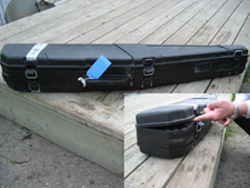 The container must be locked. A locked container is defined as one that completely secures the firearm from access by anyone other than you. Cases that can be pulled open with little effort do not meet this criterion. The pictures provided here illustrate the difference between a properly packaged and an improperly packaged firearm.
- TSA recommends that you provide the key or combination to the security officer if he or she needs to open the container. You should remain in the area designated by the aircraft operator or TSA representative to take the key back after the container is cleared for transportation. If you are not present and the security officer must open the container, TSA or the airline will make a reasonable attempt to contact you. If they can't contact you, the container will not be placed on the plane. Federal regulations prohibit unlocked gun cases (or cases with broken locks) on aircraft.
- You must securely pack any ammunition in fiber (such as cardboard), wood or metal boxes or other packaging that is specifically designed to carry small amounts of ammunition (the TSA does not specifically say how much is a "small amount").
- You can't use firearm magazines/clips for packing ammunition unless they completely and securely enclose the ammunition (e.g., by securely covering the exposed portions of the magazine or by securely placing the magazine in a pouch, holder, holster or lanyard).
- You may carry the ammunition in the same hard-sided case as the firearm, as long as you pack it as described above.
- You can't bring black powder or percussion caps used with black-powder type firearms in either your carry-on or checked baggage.