The AirSafe.com News

↑ Grab this Headline Animator

Showing posts with label airport. Show all posts

04 November 2013

Lessons learned and insights from the LAX attack

On 1 November 2013, 23-year-old Paul Anthony Ciancia allegedly used an M&P-15 assault rifle to attack TSA personnel and others at Terminal 3 at LAX. Ciancia, who was not a ticketed passenger, is accused of shooting and killing one TSA security officer and wounding two other TSA officers and one passenger.

According to the FBI's charging document, Ciancia took his weapon out of a bag, and fired at a TSA security officer at point-blank range. Ciancia went up an escalator toward the security screening area, but returned to his first victim to shoot him a second time. This was the TSA officer who killed by Ciancia. The alleged gunman later shot two other TSA officers and a passenger before airport police confronted him inside the terminal, shot him several times, and took him into custody.

Key questions about the attack
The news media an the general public had many questions about the attack, how it could happen, and what could be done to prevent similar attacks in the future. Some of the common questions, and AirSafe.com's responses, are below:

  • How could someone get a gun into an airport? - While only authorized persons are allowed to bring weapons onto aircraft or even past the TSA security screening areas, the rules are very different in other parts of the airport. Local laws control what firearms are allowed to be carried in the non-secure areas of the airport, including the ticket counter areas where passengers take their checked luggage. In fact, passengers who want to travel with their firearms have to bring them into the non-secure areas of the terminal and have them inspected before the airline will allow it to be shipped as checked luggage.

  • How could the gunman get past the security checkpoint? - There is typically a significant security presence in the TSA screening areas, and usually include a combination of TSA officers, airport police, and other security and law enforcement personnel. The investigative authorities have not release all the details of the attack, and it is not clear what security or law enforcement assets were available to keep the gunman from gaining entrance to the secure area of Terminal 3.

  • How can anyone get that close to a screening area without a ticket? - Airports in the US are freely open to the public, and with rare exceptions like a heightened security alert, there is no screening of cars arriving at the airport or of people walking around the non-secure part of the terminal.

  • Do TSA officers have guns? - TSA officers do not have law enforcement powers, and are not armed. They rely on local police or other law enforcement organizations to provide armed security.

  • Were there police on duty at the Terminal 3 checkpoint? - The investigating authorities (led by the FBI) have not yet stated where law enforcement officers were located at the time of the shooting.

  • Did the TSA or the government have any warning of a possible attack? - Neither the FBI, the TSA, or any part of the federal government has made any statement about what they new prior to the attack. Since Ciancia was not a ticketed passenger, there would have been little or no reason for for any federal agency to investigate him. However, the Los Angeles police department had been contacted by Ciancia's family, who had been concerned about his well-being. Police had reportedly tried to contact Ciancia in the morning on the day of the attack at LAX.

  • Are other airports vulnerable to this kind of attack? - The security procedures in place at LAX are similar to what would be found at every US airport. While every airport has the same vulnerabilities as LAX, in order for an attack to succeed, there has to be an attempt either by a group or an individual. Since 9/11, there have been two attacks of this type in the US, both at LAX, and both involving individual attackers. In both cases, security or law enforcement assets at the airport quickly addressed the situation shortly after the attacks began.

  • What can be done to keep this from happening again? - Many things can be done, and in the short term there may be an increased presence of police in or near airport screening areas. However, it is unclear if there will be any permanent changes in policies and procedures of the TSA, of airport police forces, or of airports. Major changes, if they occur, will likely not happen for several months.

This was not the first LAX attack
Coincidentally, the last time there was a similar attack at a US airport was also at LAX, at the terminal adjacent to the site of the attack on November 1st. On 4 July 2002, a gunman staged an attack in the area of the El Al ticket counter, and shot several people before El Al security personnel were able to subdue the attacker and shoot him to death. Two people shot by the gunman, an El Al employee and a passenger, were killed.

Responding to an active shooter situation
The Houston Police Department produced the following video with advice on how to survive an active shooter event. While it depicts an attack in an office environment, it offers insights that could be used to deal with a similar unexpected attack in other locations, including an airport terminal.

Were you a witness to what happened at LAX?
If you were at LAX the day of the shooting, you could help the FBI investigate this crime. The FBI is asking anyone with information to submit it at laxshootingtips.fbi.gov. That site is for submission of audio, video, photos, and general information relating to the shooting at Los Angeles International Airport (LAX) on Friday, November 1. No piece of information or detail is too small. You can also call the FBI Los Angeles tip line at (888) 226-8443.

Additional information
FBI charging document for Ciancia
FBI warrant for Ciancia's phone

12 August 2013

Why TSA may be searching you well outside of airports

A New York Times story on 5 August 2013 described an ongoing program that has allowed the TSA to expand their activities well beyond airports, to places like sporting events, music festivals, rodeos, highways, and train terminals. The story pointed out how some groups hold that what the TSA is doing in this program is well beyond their original mandate and that their behavior may violate the constitutional rights of people in the US.

The TSA currently has a legal right to act outside of airports, even though many in the US don't like what they are doing. To understand why this situation exists, it is important to understand a several key realities about the TSA

  • TSA is not a law enforcement organization.
  • Law enforcement organizations have significant limits when it comes to conducting a search.
  • TSA has an exemption from these limits when it comes to searches at an airport.
  • There is an ongoing program that allows the TSA to operate outside of airports under law enforcement supervision.

TSA is not a law enforcement organization
The TSA employees that you see at airport screening locations typically wear the uniform that you see in the photo below. While TSA employees wear an outfit that looks like a police uniform, have badges that looks like the type used by police officers, and sometimes have titles like Transportation Security Officer, TSA is not a law enforcement agency and its employees do not have typical police powers.

Typical law enforcement officers include the power to arrest someone, and the power to use force in order to execute their duties.

One similarity between police officers and TSA personnel is their ability to legally search individuals or their property. However, police officers in the US have significant limitations of when such searches can be conducted, and TSA, at least at an airport, do not have these limitations.

Typical law enforcement limitations on searches
In general, law enforcement officials in the US can search an individual or that individual's property without a warrant only if that law enforcement officer has probable cause to believe that someone has committed a crime, or has a reasonable suspicion that the person has committed a crime.

Why TSA can operate outside of common law enforcement limitations
The TSA's ability to search passengers and their belongings at airports is based in part on a US federal court decision from 1973 which ruled that airport screenings are considered to be administrative searches because they are conducted as part of a general regulatory scheme that had the purpose of preventing the carrying of weapons or explosives aboard aircraft.

The TSA outside of the airport
The TSA VIPR (http://www.tsa.gov/about-tsa/visible-intermodal-prevention-and-response-vipr) program uses TSA assets and personnel to augment law enforcemement (including Federal Air Marshals) resources to ensure security in all modes of transportation, as well as at special high profile events. The program, which began in 2005, allows TSA to extend its ability to conduct searches beyond the airport.

Past misconduct and legal limits on searches
The New York Times article pointed out that there had been some cases in the past where the VIPR teams have conducted searches that were ineffective, for example searching passengers after they had left a train, and the Inspector General's office of the Department of Homeland Security issued a report in August 2012 that discussed numerous concerns about how these teams stay within their legal limits when it comes to searches outside of the airport.

General public concerns
One of the fundamental concerns expressed both by the New York Times article and by some in the AirSafe.com community is that the TSA should not have the same kind of wide-ranging ability to search individuals and their belongings outside of the airport environment. This extension of TSA's authority outside of the airport parallels the New York City's "stop and frisk" program where police officers were allowed to stop, question, and search individuals without having the meet the basis law enforcement standards of reasonable suspicion or probable cause.

The program, which has been in place for about a decade, has often led to arrests and confiscation of illegal weapons. However, on 12 August 2013, a US federal judge ruled that the New York City policy was unconstitutional and must be changed to adhere to constitutional limits.

It is too early to tell if this decision will outlaw similar practices across the US, of it will have any effect on the TSA's VIPR program. No doubt, many who oppose the VIPR program will welcome this latest decision and will hope that it will lead to changes in how the TSA operates outside of the airport.

02 August 2013

Surprising exceptions to hazardous materials restrictions

While the TSA has a number of restrictions on hazardous and dangerous items, the FAA allows passengers to travel with several categories of hazardous items on commercial airliners. These exceptions are for small amounts of hazardous materials, typically included in items that are for personal use.

The FAA has provided a rather detailed table listing these exceptions, and they explain in that document that the TSA may on occasion prohibit these items, and that airlines may have additional limitations on these items. Some of the hazardous materials exceptions mentioned in the FAA document are listed below:

  • Toilet or medicinal articles that are hazardous materials such as rubbing alcohol, flammable perfume and colognes, nail polish and remover, and aerosols (hairspray, shaving cream, etc.).
  • One book of safety matches (book matches) allowed in carry-on bags only.
  • One lighter (gas or absorbed liquid) in carry-on baggage only.
  • Up to 5 liters of alcoholic beverages with an alcohol content of more than 24% but not more than 70% in unopened retail package, in carry-on or checked bags depending on the situation (Note: for tips on how to travel with liquor, which is typically a duty-free item, visit AirSafe.com for advice.
  • A cordless curling iron with a flammable gas cartridge installed.
  • Small personal mercury thermometer in a protective case.
  • Small arms ammunition (up to 19.1 mm for rifle and pistol cartridges, any size bshotgun shells) for personal use, when securely boxed (checked baggage only). Also, check out this 2010 AirSafeNews.com article on how to travel with firearms.
  • One small (4-ounce or less) self-defense spray (checked baggage only).
  • Diving lamps and other battery-operated extreme heat producing equipment, with power disconnected and in carry-on bags only.
  • Small lithium and lithium-ion batteries in consumer electronic devices. Spare batteries must be protected from damage and short circuit and placed in carryon baggage.

For questions or comments regarding these hazardous materials regulations, please contact the Hazardous Materials Information Center at: 800.467.4922 or infocntr@dot.gov

For questions about TSA prohibited items or other air travel security measures please visit tsa.airsafe.com, which has a detailed overview of what is allowed in either carry-on or checked baggage, what is completely prohibited, and what kinds of exceptions are allowed by the TSA.

For details on typical airport security procedures please visit security.airsafe.com. You can also visit the TSA web site at www.tsa.gov, or contact the TSA for questions about security procedures or prohibited items at 1.866.289.9673 or tsa-contactcenter@dhs.gov.

15 October 2012

Todd Curtis Interviewed about his new airline complaint book

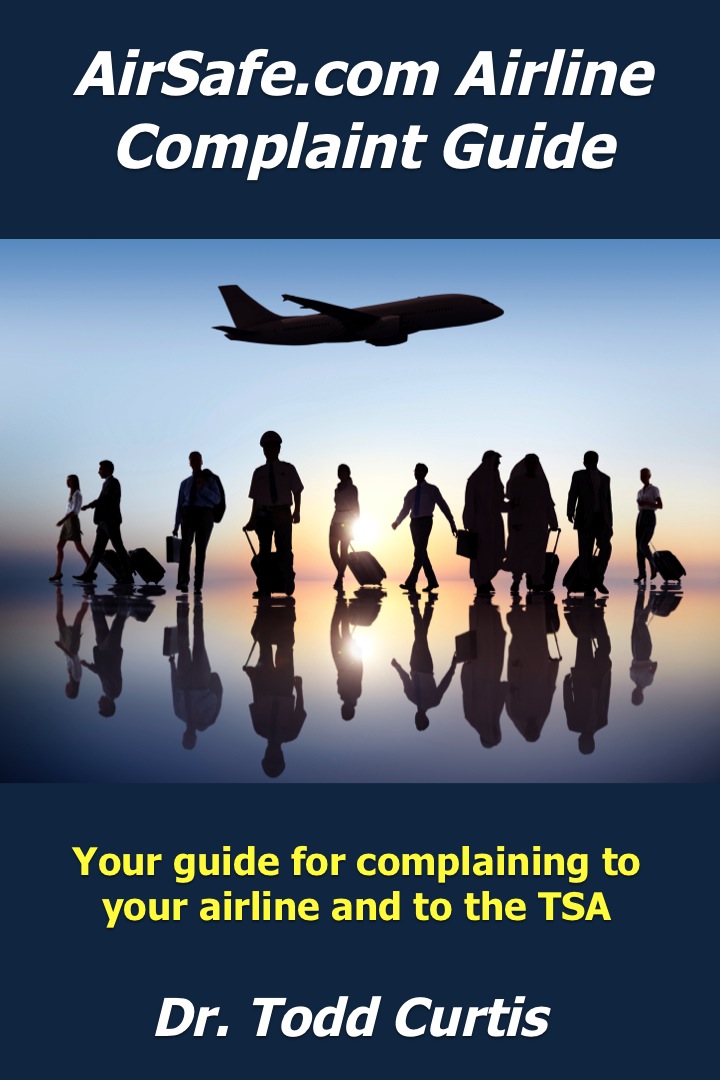
subscribe.airsafe.comCover of AirSafe.com Airline Complaint GuideDr. Todd Curtis of AirSafe.com was recently interviewed on the nationally syndicated radio talk show Rudy Maxa's World about his latest book, AirSafe.com Airline Complaint Guide. Rudy and Todd talked about a number of subjects, including the most common kinds of complaints seen by AirSafe.com and when a passenger should not complain.

This latest book is the first of a series of books that will be published by the end of 2012, with the next book covering child travel issues.

Todd Curtis interview on 13 October 2012
Listen to the interview

How to get this book
To get this newest AirSafe.com title, simply join the AirSafe.com mailing list at subscribe.airsafe.com. If you are a mailing list member, look for the book link in your latest email, or contact AirSafe.com for a copy.

31 March 2011

Rejected Landings and Safety Issues at National Airport

On March 30, 2010, the Washington Post newspaper featured a story about aborted landings at National Airport just outside Washington, DC. The story discussed how compared to the two other local airports, Dulles in Virginia and BWI Marshall near Baltimore, National had many more aborted landings. This is a procedure where the flight crew is directed by air traffic controllers to not land, or where the crew elects not to land because of weather, runway obstructions, or other reasons.

Typically, the aircraft is not in any imminent danger, and the usual result is either a delayed landing at the destination airport, or a diversion to a nearby airport. Although rejected landings are routine procedures that are designed to help aircraft avoid a hazardous situation, the experience can be unsettling for some passengers. According to research by the Washington Post, aborted landings happen about 10 to 20 times per month at the airport, compared to an average of about 10,600 scheduled landings per month (source: Bureau of Transportation Statistics). This means that at National, there is about one rejected landing for each 500 to 1,000 landing attempts.

On the day the Post article was published, Dr. Curtis of AirSafe.com discussed a number of potential safety issues associated with rejected landings at National Airport on WTOP radio in Washington, DC.

Listen to the interview (4:58)

09 February 2011

Does the TSA unfairly discriminate against private sector competitors?


In a memo released late last month, TSA administrator John Pistole decided to freeze a program that had allowed airports to use private contractors in place of TSA personnel to handle passenger screening duties at airports. The Screening Partnership Program, which had been in place at 16 airports, had several additional airports applying to the program at the time that Pistole made his decision.

This decision has been lauded and criticized by different airline security stakeholders. According to a report in FederalTimes.com, two unions vying to represent about 40,000 TSA screeners were in favor of the decision, while US House Transportation and Infrastructure Committee Chairman Rep. John Mica, who is in favor of privatization, stated that he planned to launch an investigation into the decision.

To the average air traveler, this decision does not change their airport experience, and according to the General Accounting Office, there is no real difference between the performance of the private companies and TSA when it comes to screening. Why then would something like this be of any concern to the flying public? Before answering that question, it may help to have a bit of background information about this program.

Quick overveiw of the Screening Partnership Program
The Screening Partnership Program, which was created by the TSA because it was required to by federal law, allowed airports to use private contractors to provide the kinds of screening services normally provided by the TSA. All of this would be under federal oversight, with a TSA security representative ensuring that the contractor meets the appropriate airports security standards.

Why did TSA director Pistole freeze the program?
Prior to last month's announcement by Pistole, there was no real public debate or any prior significant statement about any potential change in the program. Pistole's statement also didn't provided any hint of who within TSA leadership besides Pistole was involved in the decision. The brief statement implied that the freeze had nothing to do with performance or security screening problems at any of the 16 airports currently using the program, and also stated that airports currently using private contractors could continue to do so. The following is Pistole's full statement that was released by the TSA on January 28, 2011:

Shortly after beginning as TSA Administrator, I directed a full review of TSA policies with the goal of helping the agency evolve into a more agile, high-performing organization that can meet the security threats of today and the future. As part of that review, I examined the contractor screening program and decided not to expand the program beyond the current 16 airports as I do not see any clear or substantial advantage to do so at this time. The airports that currently use contractor screening will continue to be regulated by TSA and required to meet our high security standards.

Reading between the lines, there are two implications in this statement. First, the 16 airports currently using private contractors are currently meeting TSA's security standards. The second implication is that allowing other airports to privatize the TSA's screening function would somehow keep the TSA from improving its performance and make it less able to respond to current and future threats.

Do these reasons make sense?
There may be a substantial amount of thought and analysis that went into Pistole's decision, but the TSA has not made that part of their decision process public. Outsiders, including airport operators and the flying public are forced to evaluate this decision based on TSA's public statements and their actions.

Based on Pistole's public statements, and on the fact that the TSA is allowing the the current contractors to remain, it appears as though all the private companies involved in the Screening Partnership Program are meeting all the relevant security and screening requirements, implying that expanding the program would have no negative effects on security. Based on this admittedly scant evidence, it seems that Pistole is concerned that having more airports in this program would somehow compromise security at one or more of the airports where the TSA does the security screening.

In a recent TSA blog post from February 7th, the TSA stated that "TSA is still accepting applications, but unless a clear and substantial advantage to do so emerges in the future, the requests will not be approved." The announcement of January 28 and the blog post from February 7 imply that the TSA is arguing the following:
  • The current airports participating in the Screening Partnership Program are as effective as airports that use TSA personnel and can continue to stay in the program

  • Having additional airports in the Screening Partnership Program will prevent the rest of the TSA from evolving into a more effective organization

  • New airports can enter the Screening Partnership Program only if they can demonstrate that they have substantial advantages over the TSA

  • The 16 airports currently in the program don't have to demonstrate that they have substantial advantages over the TSA


Taken together, the TSA's statements don't clearly answer the question of whether the decision makes sense, because TSA has simply not provided enough information about the factors that went into its decision, or what factors would lead the TSA to accept or reject any new applications. More disturbing, some of TSA's statements imply that it is actively discriminating against private contractors, specifically the statement that new airports will be approved for the program only if they can demonstrate that they have substantial advantages over the TSA.

This implies that the TSA's leadership believes one of two things, either their procedures and requirements are adequate, but private competitors have a responsibility to show an extra level of competence; or that current TSA procedures and requirements are not adequate and private contractors need to be better than the TSA in order to provide an adequate level of security. In other words, TSA's statements imply that it is acceptable for their leadership to allow separate and unequal standards, with one set of standards for its own employees, and a higher one for potential private competitors.

It may be harsh to use words like discrimination and phrases like separate and unequal when describing the logic behind TSA's recent decisions on private sector alternatives to passenger screening, but given their public statements, it may be appropriate to do so.

13 April 2010

Survey Results on the Use of Full Body Scanners

In the January 2010 article reviewing security measures taken in the wake of the Christmas Day bombing attempt on Northwest flight 253, AirSafeNews.com conducted a poll about the US government's intention to increase the use of full body scanners. It was the most popular poll ever on AirSafeNews.com, with 103 responses. The questions were as follows:
  • Do you approve of full body scans at US airports?

  • Should children be scanned in this way?

  • Have you flown on an airliner at least once in the past 12 months?

  • What do you think about the increased security?

Those who responded were overwhelmingly in favor of the scanners. Of the 103 responding, 80 were in favor of using the scanners, and 75 of the 80 were in favor of using them on children. Of the 90 respondents who had flown during 2009, 70 approved of the scanners and 63 of them were in favor of using them on children.

Perhaps more revealing were the 59 people who wrote responses to the last question, What do you think about the increased security? Below, with some minor spelling and grammar corrections, are the responses:
  1. It works to a point. More emphasis on racial profiling as we all know who the real culprits are. What is done currently punishes the normal traveler at the expense of being politically correct.

  2. Good start. I was thinking about the shoe bomb guy We all had to take off our shoes and now the underwear bomb guy... would we all have to take off our underwear? LOL The big question would you rather have some probably bored TSA guy look at your private parts in a scanner or get on that plane and never return home? I don't think its a hard question.

  3. I'm all for it. We should do all we can do to ensure safety of the traveling public. I've traveled world-wide for 35 years to over 60 countries. Passenger and airplane safety MUST be the top priority for the future. The people who want to kill Americans are not going to go away.

  4. It will never be enough and most security measures are now for window dressing. Let us close all shopping centres in the airports and all food outlets. The airports will become safer. But an airport is not a military base and can never be 100 percent protected.

  5. Considering the threat level, I think it´s acceptable.

  6. Just part of flying.

  7. The odds of a successful bomb on an airline are infinitesimal. As long as we live in fear, terrorism is working. What is needed is an information campaign to show how terrorism is NOT working, given that the chance of being on board a jet about to be blown up is zero, for all practical purposes.

  8. Hogwash!

  9. Better that than being blown out of the sky.

  10. I think they should use anything to make flying safe. Would you prefer being dead over scanning?

  11. Necessary in all airports that fly in & out of the US. Additional face to face interview with anyone who buys one-way ticket with cash & offers no personal background information. These are all red flags.

  12. ALL available measures should be taken, including interviews of certain travelers, as the Israeli's do.

  13. If it keeps us safe, I think the extra security is great and cannot understand why some people object to it.

  14. WHATEVER IT TAKES IS OK.

  15. By all means. Profile folks too!

  16. Some parts are plain stupid, e.g. not going to the toilet an hour before landing will not stop anything. If they stopped me i would urinate in my seat if i really had to.

  17. It is not worth the hassle, using screening lists is a better procedure.

  18. Not enough.

  19. Fine by me. Whatever it takes to minimize the risk of a person or persons coming on board with weapons or bombs.

  20. Waste of time.

  21. No matter what the governments do the terrorists can always find a way around the security. Either by waiting until security guards get relaxed or by moving to smaller airports or by using more sophisticated methods. Security can never ever be 100% successful all of the time. The terrorists only have to be successful once.

  22. I am not worried about the increase at all, I would rather be safe than sorry.

  23. It is scaring and makes Air travel worrying. We hope this will be fully utilized without any reservations ,airline crew must also be subjected to this type of screening .

  24. I think that there should be more profiling. Concentrate on potential risk persons, even if this leads to accusations of racism or nationalism. Maybe passengers should be given clearance levels, similar to the classification system for national secrets. There could then be a group of low risk passengers who would go through the normal security procedures. Others might have to go though extra procedures.

  25. I don't like it - but is very much a necessary evil.

  26. Even though full body scan imaging is inarguably helpful in detecting threats and prohibited items, the TSA's use of this technology is a full attack on passengers' privacy. The TSA has proven over and over that it misrepresents and abuses full body scan technology. At many airports where the technology is in use, there is little or no hint that this method of screening is optional. For example, at BUR (Burbank, CA), the incoming stream of passengers gets randomly split between a regular metal detector and a millimeter wave machine. Here, the TSA gives no indication that the purpose of the machine is to view nude images of travelers, and only a small sign with tiny fine print indicates that passengers may request a traditional screening method instead.

    The intended purpose of forcing the technology on the unknowing public appears to be to allow the TSA to turn it into a primary screening method in the future with reduced public outcry. While US Customs have strong legal footing to invade passengers' privacy prior to admitting them into the country, the TSA has absolutely no legal footing whatsoever to peek underneath the clothes of US citizens and lawful residents.

    Every couple of weeks, there is a new story like that of the lady who was put into a TSA restricted hallway and forced to walk like a duck to see if something falls out of her private area; or one of my friends who was put into a concrete room without camera or supervision and a TSOP stuck their hand into his underwear trying to fish for nonexistent contraband. Even if the technology is automated such that prohibited items can be detected without a TSOP viewing nude images of passengers, it is still not the government's business what people have below their clothes or in their underwear. Other than explosives, this amounts to an unreasonable search which is prohibited by law, whether the passengers are carrying an implanted medical device, drugs, medication, or whatever they wish to carry.

    Technology may get better and better, but there must be a set limit how far the government can use it. Maybe one day technology will be advanced enough to detect the chemical composition of the blood flowing in passengers' veins from hundreds of feet away. The existence of the technology doesn't imply that the TSA or Customs or any law enforcement organization has a right to make use of that information or harass innocent people.

  27. It is a real nuisance to the traveler but I suppose it is for the good of all of us.

  28. Lame

  29. I think our government needs to do what ever steps are necessary to protect the passengers and flight crew. I feel our government needs to get more experienced TSA employees. Why not hire our soldiers and give them a good job once they have fulfilled their tour of duty rather than go back to some other jobs they might have had before they went in.

  30. Not enough

  31. Waste of time and money

  32. Too many irrelevant procedures. Security personnel, while performing assigned tasks, appear to lose sight of their goal. It would be good for the public to know what the increased procedures are yielding, this would bolster public support.

  33. I approve of the full body scanners, but my concern is two fold. Why was the TSA not using them more before December 2009, and why are we still not accepting that "threat profiling" (I did not say racial or ethnic) is the way to go! Since all of the 9-11 attackers were male, arabic, in ages of 20-40 years old, that should be a dead giveaway to profile. We were not attacked by young "italian nuns" or "young Brazilian tourists", but by 19 young men of arabic descent or origin. I believe it would be far more effective and cost beneficial to start doing this "threat profiling" on anyone that fits that description, instead of this "charade" of doing a "computer random" sampling, which means we waste our efforts on a 79-year-old Irish nun, or a 62-year-old auto worker from Michigan.

  34. Good. Questionary (Asking questions) like El Al would be good.

  35. Complete waste of time and money. Current systems are adequate for the task.

  36. It's a must.

  37. Negligible

  38. Some of the rules are ridiculous like no getting up during the last hour of the flight and no carryons for flights heading to the U.S. Those wouldn't have prevented the Northwest bombing attempt.

  39. It was hurry-up and wait, it could be a smoother process if we would adopt the Israeli security practices, (especially their predictive profiling and security questioning).

  40. Keep us safe.

  41. Happy to spend a few extra hours to help reduce the probability of NOT arriving at my destination.

  42. Only stands to reason nowadays.

  43. I am writing my Dissertation on Commercial Aviation Security to complete me Doctorate in Business Administration. Dr. Andrew Thomas is one of my committee members; I enjoy his guidance and conversations. I believe that we are in big trouble and politics is getting in the way of real security. The people in charge are clueless to direct the security, most of the TSA leadership does not have a aviation background and the average person does not understand that it is the leadership causing the system to be flawed.

  44. Extra care is needed.

  45. The first question is not well formed; the question should include how the full body scanners are used; if they were used as a secondary screening of those people of interest or for suspicion, I would approve. Second, the thing that saddens and amuses me is that all the measures the TSA is pushing in response to the December 2009 attack are imposed at US airports on mostly US passengers. If such screening were carried out at airports to foreign airports for flights destined for the US, I'd believe in their positive efficacy. Lastly, the reports or requirements to turn off electronic equipment and remain seated during an extended period before landing, keeping laps clear of items such as blankets for large portions of the flight, and additional restrictions on when the lavatories (can be used) seems absolutely ridiculous. This is sort of like closing the barn door after the horses ran out. What this means is that the potential terrorist will start their actions a little earlier than planned but literally millions of passengers will be unnecessarily bored,and scared senseless, with no chance of increasing safety.

  46. It is the right thing to do.

  47. Increase it more.

  48. Body scanner will help overcoming some fundamental deficiencies when it comes to passenger screening. However, it will require screeners to be able to 'interpret' devices, items or substances identified by these systems. Again, technology is not the only means and there is no single 100% cure for aviation security.

  49. I am still uneasy about flying. How do the TSA know who to screen and who not to, what if a terrorist does not get a full body scan? I would much rather take the risks of driving than flying at this point.

  50. Necessary evil.

  51. Every reasonable method must be used to stop would be terrorists. Full body scanner fall within the realm of reasonable. Better ticket counter 'tip off', and identification and alerts for secondary screening should be implemented ASAP. Hidden CCTV cameras should be installed at each ticket counter so that positive ID can be made for those deemed suspicious (no luggage, cash ticket, nervous behavior, etc.) by the ticket agent so that secondary screening can be conducted by TSA and foreign airports with flights to US. Use Israeli screening methods at secondary screening points.

  52. Cero

  53. What is needed for air safety must be done. Safety before privacy when you want to fly.

  54. While I do not object to more security procedures, I do believe the airports should be profiling people. We have had proven data that young males of middle eastern nationality are prime suspects. Subjecting children under say the age of 10, elderly people in wheelchairs, and medal of honor recipients to screening and searching is NOT the answer to better security. Body scans would help, but since not all airports would be having the equipment, that leaves holes in the process

  55. If somebody shows abnormal behavior, it is possible for him/her. But it must not be for everybody.

  56. FUD

  57. A joke. Implement it ASAP regardless of who complains, especially the ACLU (all criminals love us).

  58. Security definitely needs to improve and be strong enough to prevent future hijackings. I don't want any terrorist attacks happening ever again.

  59. It really is pointless, I personally can think of a few major holes in the security procedures which still have not been discovered and could easily bring down a plane. What's more, they aren't even difficult to do. My point being you will never truly make a flight totally safe as was said here. Arm the Pilots and Crew and you might be safe though.


Photo: gregoryjameswalsh

09 April 2010

TSA Says You Can Keep your iPad, Kindle, or Netbook in Your Bag

On Monday, this column discussed airline travel issues related to the new iPad device from Apple, and suggested that it didn't make sense to treat it like a laptop and take it out for separate screening. It looks like the TSA agrees with AirSafe.com. On Tuesday, an article in the TSA's blog stated that electronics smaller than the standard laptop could stay in your carry on bag or carrying case and does not have to be screened separately by their x-ray machines at the security checkpoint.

The TSA blog article emphasized that TSA security officers may still give your bag or electronic device a secondary screening, so be prepared to take out your iPad or other device if asked. Although all TSA screeners are regularly informed about policy changes, some TSA screeners may not be aware of this new policy about smaller electronics, so don't be too upset if you still get asked to remove them.

What can you keep in your carry on?
The TSA blog article stated that the following types of devices can be kept in your bag: netbook computers, laptop computers in a checkpoint friendly laptop bag, iPads, Kindles, Noes, Nooks, and Sony Readers. This also implies that cell phones, Blackberries, personal DVD players, iPods, iPhones, PDAs, electronic cameras, and handheld computer games can also stay in the bag.

What do you have to take out for separate screening?
The TSA article listed the following items that must be taken out for separate screening: regular size laptops; video game consoles such as those from Playstation, Xbox, and Nintendo; full sized DVD players, video cameras that use cassettes, and other larger electronic devices. For the large game consoles, the TSA implied that you should take out the large CPU type unit for separate screening. Presumably accessories such as the the handheld controllers can stay in your bag.

What is the difference between a netbook and a laptop?
While opinions vary on what is and what isn't a netbook, in general it is a small laptop computer with a diagonal screen size of less than 12 inches (25.4 cm). The typical netbook also doesn't have an internal CD/DVD drive, so if your laptop has one, it probably isn't a netbook.

About checkpoint friendly bags
If you intend to use a "checkpoint friendly" laptop bag for your full size laptop, make sure to check that:
  • It has a designated laptop-only section that you can lay flat on the X-ray belt

  • There are no metal snaps, zippers or buckles inside, underneath or on-top of the laptop-only section

  • There are no pockets on the inside or outside of the laptop-only section

  • There is nothing in the laptop compartment other than the laptop

  • You have completely unfolded your bag so that there is nothing above or below the laptop-only section, allowing the bag to lie flat on the X-ray belt
TSA will not approve or endorse any bag design or manufacturer. TSA will only allow laptops to stay in bags through screening if they provide a clear and unobstructed X-ray image of the laptop.

More baggage advice
Items prohibited and restricted by the TSA
Baggage basics
Carry on baggage tips
Top baggage tips

08 February 2010

Possible Major Security Breach at JFK - Stowaway Found in Wheel Well

A mechanic at Tokyo's Narita airport found the dead body of an apparent stowaway in the wheel well of a Delta Air Lines 777 that had recently arrived from New York's JFK airport. According to CNN, Delta Flight 59 had departed JFK at about 12:53 pm on Saturday February 6th, and arrived in Tokyo at 4:46 pm local time on Sunday. According to the Mainichi Daily News, the body was found about 80 minutes after the airplane landed. There was no identification on the body, and Japanese authorities are trying to identify him. The body reportedly had no visible injuries except for signs of frostbite.

The wheel well area of the 777, like that of most jet airliners, is unpressurized and unheated. Temperatures can fall well below -40 degrees during a flight, and can stay that low for several hours. Also, there is not enough oxygen at high altitudes to prevent hypoxia, and that alone can be fatal.

There is no way to access the 777 wheel well from the passenger cabin, and it is highly likely that the stowaway got into the wheel well at a previous departure airport. If that airport turns out to be JFK, this represents a very serious breach of security because it demonstrates that it is possible for someone to get close to an airliner on the ground without being stopped by security or by other airport staff. As is the case with entering the secure part of an airport terminal, no one is allowed to access to the airport apron or runway areas without authorization and without passing through some kind of security.

If it turns out that the stowaway got into the aircraft at a prior departure airport, it would still represent a potentially catastrophic lapse of security since it would imply that routine maintenance and security checks between flights would have been unable to find something as large as a man that was hidden in a wheel well.

So far, Delta, the airport authority that runs JFK, and the US Department of Homeland Security have not made any formal statements about this apparent security matter.

Reports of stowaways in jet airliner wheel wells are fairly common, typically involving someone from an economically challenged country attempting to fly to western Europe or North America. Unlike fatal events involving passengers, crew members, or airport ground personnel, deaths to stowaways are not routinely tracked by national or international civil aviation authorities. Given the heightened danger from individuals and groups intent on destroying airliners, it would make sense to treat all stowaway events as serious security matters that should be both tracked and investigated by the appropriate authorities.

Related article from Business Week

01 December 2009

Pet Travel Issues and Related Online Resources

According the US Department of Transportation, over two million pets and other live animals are transported by air every year in the United States. Most airlines in the US allow pets to travel on aircraft, sometimes in the passenger cabin, but also in the cargo hold. Over the last few years, the US government has addressed traveler concerns about the extent of pet travel safety issues by providing regular updates concerning reports of the loss, injury, or death of animals in their Air Travel Consumer Report.

AirSafe.com's pet travel resource page has basic advice about pet travel, pointing out that there are a number of considerations that passengers must consider, including what extra charges you may face, limitations on when pets can travel, and many other conditions of travel. If you plan to travel with pets, the most important thing to know that is that rules can be very different for different airlines. In the US, the Federal Aviation Administration (FAA) allows each airline to set its policies on travel with pets, including whether they are allowed in the cabin, or for that matter whether they can be transported at all.

Pets and Security Screening
According to the TSA, you will need to present the animal to the security officers at the checkpoint. You may walk your animal through the metal detector with you. If this is not possible, your animal will have to undergo a secondary screening, including a visual and physical inspection by our Security Officers. Your animal will not be placed through an X-ray machine. However, you may be asked to remove your animal from its carrier so that the carrier can be placed on the X-Ray machine.

Pets in the Passenger Cabin
Not every airline allows pets in the passenger cabin. Those that do typically allow only small animals that must be kept in some kind of cage or kennel for the duration of the flight. Also, the pets must be able to fit in the area under the seat and can’t be in the overhead baggage compartments. An airline may also limit the maximum number of pets in the passenger cabin, as well is the number of pets in coach, business, or first class sections of the aircraft. It is also possible that an airline may allow pets in one class of service or section of the aircraft, but not another.

Pets in the Baggage Compartment
If pets are not in the passenger cabin, they are typically transported in pressurized, temperature-controlled aircraft compartments. Confirm with your airline that this is the case.

One of the most comprehensive sites providing useful pet travel information PetFlight.com. Featuring practical travel advice, details on pet travel policy by airline, and lists of pet travel incidents reported to the DOT, this site will address many common questions pet owners may have about animal air travel safety.

Traveling to Hawaii with Pets
Hawaii has special limitations on pet travel, including quarantines of animals traveling to the state, even for passengers flying from other parts of the US. Make sure that you review Hawaii’s requirements at http://hawaii.gov/hdoa/ai/aqs/info, contact the airline, and possibly consult your pet’s veterinarian, prior to your travel to Hawaii. Otherwise, your pet could be quarantined for up to 120 days.

Service Animals
Service animals are not pets, but rather an animal individually trained to provide assistance to an individual with a disability. In the U.S., a disabled passenger can travel with his or her service animal in the passenger with relatively few limitations compared to the limitations on pets. While U.S. airlines are required to make accommodations for travelers with service animals, there may be situations where a service animal may not be allowed in the cabin. If you plan to travel with a service animal, it would be a good idea to contact the airline prior to your travel to see if there may be any difficulties.

Photo: shanan

04 November 2009

Phoenix area couple accused of stealing more than 1,000 airline bags - How to protect your baggage

On Monday November 1st, police arrested a Phoenix-area couple who were accused of stealing up to 1,000 bags and other items from the baggage claim areas of Phoenix's Sky Harbor Airport. The arrests came three weeks after police first observed suspicious behavior near one of the airport's luggage carousels, when one of those who was arrested this week was seen parking his car, taking a piece of luggage from one of the baggage claim carousels, and getting back into his car. Police began conducting surveillance on him after he was arrested on a theft charge and released. A police review of airport surveillance tapes revealed that he may have entered the terminal at least 64 times in the previous few months, but had not taken a flight from that airport in at least a year.

Getting the stolen items back to their rightful owner may be difficult because the suspects stripped off all identifying tags. The suspects may have also sold some of the items at garage sales and swap meets. Police said people who believe they may be victims should call 602-495-7808.

This event was noteworthy only because of the scale of the thefts. The risks that passengers face from baggage theft are not unique to Phoenix. Phoenix's Sky Harbor Airport is like many airports in the US and around the world in that once your bags arrive at the baggage carousel, there are no airline or airport employees who check to see if baggage is going to the rightful owner.

Reducing Your Risks
While every passenger is at risk of having a checked bag lost or stolen, There are a number of things that every passenger should do to keep their checked bags from being stolen or to minimize the impact of a lost bag. AirSafe.com's Top Ten Baggage Tips page has a number of suggestions, including:
  • Travel with only carry-on luggage
  • Put your contact information inside and outside every checked bag
  • Immediately report the loss of checked luggage
  • Don't pack valuable items in checked luggage
The kinds of things you should not put in checked bags include medicine, computers, electronic files, legal documents; credit cards, checks, or other financial documents; cash, jewelry, and items of great sentimental value.

Police reported that when they were searching the home of the arrested couple, one of those arrested was attempting to destroy a number of items, including passports, credit cards, and identification cards.

If you plan on avoiding checked baggage problems by taking carry-ons, AirSafe.com has additional advice about carry-on baggage, such as checking with the airline ahead of time to find out what their policy and limitations are for bags in the cabin. Even with carry-ons, you should make plans to check that bag. On some smaller aircraft and on very crowded flights, there may not be room for your bag and you may have to check the bag at the last minute. You should prepare for this by keeping valuable items in a smaller bag or container that you can take out of the carry-on and keep with you on the plane.

Compensation for Lost Bags

Should any of your luggage be lost, delayed, stolen, or damaged, you will very likely be eligible for some kind of compensation from the airline or even the airport, but you must act immediately after you find that your bags are missing. AirSafe.com also provides advice for how to go about the compensation process.

Related Resources
Hazardous Materials and Prohibited Items

13 February 2008

Podcast: Things You Should Not Take on Board

This show from February 13, 2008 provides an overview of the things passengers should know in order to deal with TSA and airport security with a minimum of hassle. In addition to providing suggestions for checked and carry on baggage, this show also provides a link to numerous other resources on baggage, banned and restricted items, and making complaints about your airline service.

For more information about the show, or about how to subscribe using iTunes, visit the home page of the Conversation at AirSafe.com at podcast.airsafe.org.

You can also download the episode directly at http://www.airsafe.com/podcasts/show39_tsa.mp3.

Additional Resources
Baggage and Security Insights and Information
http://tsa.airsafe.org/